The Legacy of the Infected Blood Scandal: Interim Estate Payments in 2025
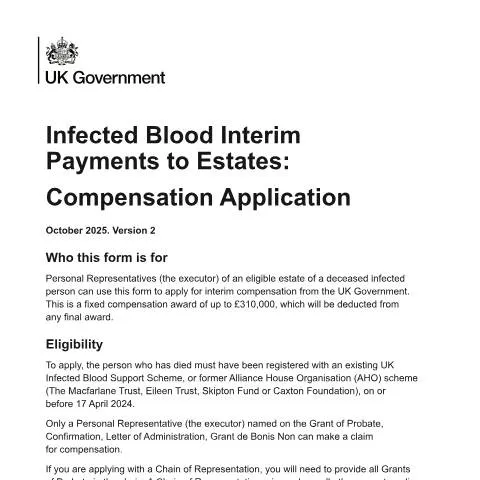
Decades after one of the most devastating healthcare scandals in UK history, the Infected Blood Compensation Authority continues processing claims for victims who died from contaminated blood products between the 1970s and early 1990s. The Infected blood interim estates payments: compensation application form represents a crucial lifeline for bereaved families, offering fixed interim awards of up to £310,000 whilst comprehensive compensation arrangements are finalised.
This specialised application process emerged following years of campaigning by affected families and the recommendations of Sir Brian Langstaff's public inquiry. Unlike standard inheritance procedures, these estate claims require specific documentation proving the deceased's registration with historical support schemes, creating unique challenges for personal representatives navigating both probate law and compensation frameworks.
Qualifying Estates: Registration Requirements and Historical Context
The eligibility framework centres on a critical date: 17 April 2024. Deceased infected persons must have been registered with either current UK Infected Blood Support Schemes or one of the former Alliance House Organisation (AHO) schemes before this deadline. This registration requirement reflects the complex evolution of support mechanisms established over decades.
Former Alliance House Organisation Schemes
The historical landscape includes four key organisations that provided support before current schemes emerged:
- The Macfarlane Trust - established for haemophiliacs infected with HIV
- Eileen Trust - supporting those infected through blood transfusions
- Skipton Fund - providing assistance for hepatitis C infections
- Caxton Foundation - offering support for various infection scenarios
These organisations maintained detailed records that now form the foundation for compensation claims. The requirement for prior registration ensures legitimate claims whilst preventing fraudulent applications from estates with no historical connection to infected blood support networks.
Current Support Scheme Integration
Modern infected blood support schemes operate across England, Scotland, Wales, and Northern Ireland, each maintaining separate registration systems with unique reference numbers. The compensation authority cross-references applications against these databases, explaining why providing the deceased's Infected Blood Support Scheme number can significantly accelerate processing times.
Personal Representative Authority: Navigating Probate Requirements
The application process demands strict adherence to probate law, with only specific categories of personal representatives authorised to submit claims. This reflects the substantial sums involved and the need to prevent disputes over compensation distribution.
| Jurisdiction | Required Document | Issuing Authority |
|---|---|---|
| England & Wales | Grant of Probate | Probate Registry |
| Scotland | Confirmation | Sheriff Court |
| Northern Ireland | Grant of Probate | Probate and Matrimonial Office |
| All jurisdictions | Letter of Administration | Relevant probate authority |
Chain of Representation Complexities
Particularly complex scenarios arise when original executors die before completing estate administration. The Chain of Representation procedure requires providing all grants of probate in sequence, documenting how executor authority passed from the original appointee through subsequent deaths to the current applicant.
For instance, if John Smith died in 2019 with executor Mary Jones, but Mary died in 2022 before claiming compensation, her executor David Brown would need both John's original grant of probate and Mary's grant of probate to establish his authority over John's estate compensation claim.
Documentary Evidence Framework: Certification and Authentication
The compensation authority operates under strict Data Protection Act 2018 and UK GDPR requirements, necessitating robust identity verification procedures. The certification process goes beyond standard document copying, requiring professional countersignatures that legally authenticate the applicant's identity.
Professional Countersignature Requirements
Acceptable professionals for certification include solicitors, chartered accountants, medical practitioners, and serving police officers. The countersignatory must physically examine original documents and provide specific attestation wording: "certified to be a true copy of the original seen by me", followed by their signature, printed name, occupation, address, and telephone number.
This rigorous approach reflects lessons learned from historical compensation schemes where inadequate verification led to fraudulent claims and administrative complications. The authority may contact countersignatories to verify their involvement, emphasising the importance of using genuinely qualified professionals.
Address Matching Protocols
A critical requirement involves matching the deceased's last known address with existing support scheme records. Discrepancies can delay processing significantly, particularly where infected persons moved frequently or used different addresses for medical correspondence versus general contact.
The form provides space at Annex B for additional addresses where the deceased lived during their support scheme registration period. This accommodation recognises that many infected persons experienced housing instability due to health complications or financial hardship following their infections.
Medical Identification Numbers: Accelerating Claims Processing
While not mandatory, providing NHS numbers (or CHI numbers in Scotland, H&C numbers in Northern Ireland) can substantially reduce processing delays. These unique identifiers allow the compensation authority to cross-reference medical records efficiently, confirming infection details without extensive manual verification.
Geographic Infection Context
The requirement to specify the infection location—England, Scotland, Wales, or Northern Ireland—reflects the different healthcare systems and blood supply chains operating across UK nations during the infection period. This information helps verify claims against historical records of contaminated blood product distribution.
Different regions used varying blood products and testing protocols, creating distinct infection patterns that compensation assessors use to validate claims. For example, Factor VIII concentrates used primarily in England came from different manufacturers than those distributed in Scotland, creating traceable infection pathways.
Power of Attorney Complications and Additional Documentation
Applications involving Power of Attorney arrangements face additional scrutiny, reflecting the potential for abuse in high-value compensation scenarios. The form references Question 7 for specific Power of Attorney requirements, though these details extend beyond the excerpt provided.
Typically, such arrangements require demonstrating that the attorney has authority to act on behalf of the executor, particularly where the executor lacks mental capacity or faces other impediments to managing estate affairs. The compensation authority must verify that Power of Attorney arrangements were established legitimately and remain valid.
Legal Representative Applications
Professional legal representatives follow different application pathways, bypassing individual applicant sections whilst providing alternative credentials demonstrating their authority to act for estates. This recognises that complex estates often require professional management, particularly where multiple beneficiaries or disputed inheritance issues complicate compensation distribution.
Fixed Award Structure and Future Compensation Integration
The £310,000 maximum interim award represents a carefully calculated sum designed to provide meaningful immediate relief whilst preserving resources for comprehensive final settlements. This amount reflects average compensation levels established through previous tribunal decisions and comparable international schemes.
Critically, interim payments face deduction from final awards, preventing double compensation whilst ensuring bereaved families receive prompt financial support. This structure acknowledges that comprehensive compensation assessments may take years, particularly where complex medical causation issues require detailed investigation.
Distribution Obligations
Personal representatives receiving interim payments assume legal obligations to distribute funds according to the deceased's will or intestacy laws. This responsibility extends beyond simply receiving compensation, requiring proper estate administration and potentially complex beneficiary negotiations.
Where estates include multiple beneficiaries or disputed inheritance claims, personal representatives must navigate compensation distribution alongside traditional probate obligations, potentially requiring court guidance on appropriate allocation methods.
Administrative Processing and Timeline Expectations
The compensation authority processes applications through dedicated teams familiar with infected blood support scheme records and medical documentation requirements. Processing times vary significantly depending on documentation completeness and the complexity of verifying historical registrations.
Applications with complete documentation, including support scheme numbers and verified addresses, typically progress more rapidly than those requiring extensive record searches. The authority maintains contact with applicants throughout processing, though response times may extend during periods of high application volume.
Personal representatives should expect periodic requests for additional information, particularly where deceased persons had complex medical histories or multiple support scheme registrations. Maintaining organised estate documentation and prompt response to authority requests significantly improves processing efficiency and reduces overall claim resolution timeframes.
Deceased Estate Claims: Navigating Complex Inheritance Scenarios
When an infected blood victim has passed away, their estate may be entitled to compensation through the interim payments scheme, but the application process involves additional complexities that personal representatives must carefully navigate. The Infected Blood Compensation Authority recognises that many victims died before the scheme's establishment, leaving families to pursue claims on their behalf.
Estate applications require the personal representative to demonstrate their legal authority to act on behalf of the deceased. This typically means providing a grant of probate or letters of administration issued by the Probate Registry. However, the Authority may accept alternative documentation in certain circumstances, particularly where the estate value falls below the threshold requiring formal probate proceedings (currently £5,000 for most assets).
The medical evidence requirements for deceased victims can prove particularly challenging. Hospital records may be incomplete or destroyed, especially for infections that occurred decades ago. The Authority accepts various forms of evidence, including GP records, specialist clinic notes, and witness statements from family members who observed the victim's condition. In cases where direct medical evidence is unavailable, the Authority may consider circumstantial evidence, such as records showing the deceased received blood products during high-risk periods and subsequently developed symptoms consistent with hepatitis or HIV infection.
Personal representatives must also navigate the complex question of causation when the deceased had multiple health conditions. The Authority applies a "but for" test, considering whether the infected blood transmission materially contributed to the victim's suffering or death. This assessment becomes particularly nuanced when dealing with elderly victims who may have had concurrent age-related conditions or those with pre-existing health issues.
Estate claims face unique time pressures, as the interim payments scheme operates within defined windows. Personal representatives should be aware that the Authority may request additional evidence or clarification, which can extend processing times. The Authority has indicated that estate claims may take longer to process than claims from living victims due to the additional verification requirements involved.
Financial Impact Assessment and Payment Distribution
The interim payment amounts vary significantly based on the specific circumstances of each case, with the Authority considering factors such as the type of infection, duration of suffering, and impact on quality of life. While the Authority has not published fixed tariffs for interim payments, early cases suggest amounts typically range from thousands to tens of thousands of pounds, with more substantial sums for cases involving severe complications or multiple infections.
For living claimants, the financial impact extends beyond the direct health consequences. Many infected blood victims experienced significant employment disruption, either through periods of illness preventing work or discrimination in the workplace once their condition became known. The Authority considers evidence of lost earnings, reduced career prospects, and additional costs incurred due to the infection, such as private healthcare expenses or travel costs for specialist treatment.
The tax treatment of interim payments represents an important consideration for recipients. While compensation payments are generally not subject to income tax, recipients should be aware that large lump sums may affect their entitlement to means-tested benefits. The Authority recommends that claimants seek independent financial advice before accepting payments, particularly those receiving Universal Credit, housing benefit, or other income-related support.
Payment distribution in estate cases requires careful coordination between the Authority and the personal representatives. The Authority typically issues payments directly to the estate's bank account, but personal representatives must ensure proper distribution to beneficiaries according to the will or intestacy rules. Where multiple beneficiaries exist, disputes may arise over how compensation should be divided, particularly if some family members were more directly affected by caring for the deceased victim.
The Authority has established protocols for handling cases where the original blood transfusion or treatment benefited multiple patients from the same batch of infected blood products. These "cluster cases" require additional investigation to establish individual causation and may involve coordination with other healthcare institutions or blood services that used products from the same source.
Appeals Process and Dispute Resolution Mechanisms
The interim payments scheme includes a structured appeals process for applicants who disagree with the Authority's decisions, whether regarding eligibility, causation, or payment amounts. Understanding these mechanisms is crucial for claimants who believe their cases have been incorrectly assessed or inadequately compensated.
The first stage involves an internal review by the Authority, where a different case officer examines the original decision and all supporting evidence. Applicants must request this review within 28 days of receiving the decision notice, though the Authority may extend this deadline in exceptional circumstances. The internal review process typically takes 8-12 weeks, during which claimants can submit additional evidence or clarification of their circumstances.
If the internal review upholds the original decision, claimants may escalate to an independent appeals panel established specifically for the infected blood compensation scheme. This panel includes medical experts, legal professionals, and lay members with relevant experience. The panel operates under formal procedures similar to tribunal hearings, though with more flexibility to accommodate the sensitive nature of these cases.
Appeals must be grounded in specific legal or factual disputes rather than general dissatisfaction with payment amounts. Common grounds include disagreement over medical causation, disputes about the timeline of infection, or challenges to the Authority's assessment of impact severity. The appeals panel can uphold, overturn, or modify the original decision, and may also remit cases back to the Authority for reconsideration with specific directions.
For estate claims, the appeals process presents additional complexities, as personal representatives must demonstrate not only their authority to act but also their detailed knowledge of the deceased's circumstances. The appeals panel may require witness evidence from family members, healthcare providers, or other individuals who knew the deceased during the relevant period.
The Authority maintains detailed guidance on preparing appeal submissions, including template forms and evidence checklists. Claimants are not required to have legal representation during appeals, though many choose to engage solicitors experienced in medical negligence or public compensation schemes. The Authority covers reasonable costs associated with obtaining medical evidence for appeals, though legal fees remain the claimant's responsibility.
Settlement discussions may occur at any stage of the appeals process, with the Authority empowered to negotiate revised offers based on additional evidence or legal arguments presented during the appeal. These discussions often prove particularly valuable in complex cases where the original application may not have fully captured the extent of the victim's suffering or the family's circumstances.