When Land Ownership Details Prevent Online Transfers
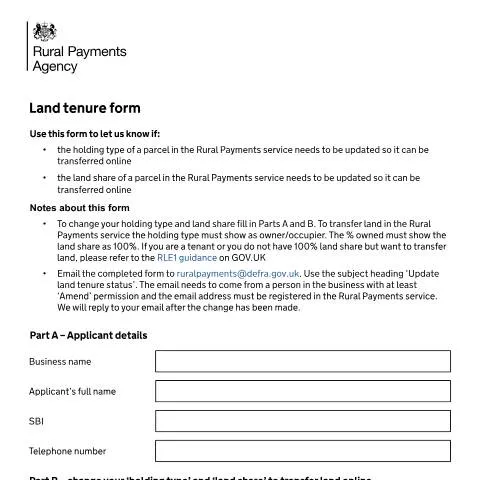
Farming businesses across England often discover their land parcels cannot be transferred through the Rural Payments service's online platform, despite appearing to meet all requirements. The obstacle frequently lies in holding type classifications or land share percentages that don't align with the system's strict transfer criteria. The Rural Payments Agency's land tenure form addresses precisely this technical barrier, enabling landowners to correct discrepancies that block digital transactions.
The form serves a highly specific purpose within the broader Rural Payments framework. Whilst the service manages various agricultural schemes and payments, the online land transfer function requires exact conditions: parcels must show as owner/occupier with 100% ownership share. Even minor variations—such as showing 99% ownership or an outdated tenancy classification—render the digital transfer impossible, forcing businesses into more complex manual processes.
Technical Prerequisites for Online Land Transfers
The Rural Payments service operates on precise data classifications that determine transaction capabilities. Understanding these technical requirements clarifies why correction forms become necessary and when alternative approaches might prove more suitable.
Holding Type Classifications and Their Impact
The system recognises several holding type categories, each carrying different transfer permissions. Owner/occupier status represents the only classification permitting online transfers, reflecting full legal control over the land parcel. Other classifications—including various tenancy arrangements, shared ownership structures, or historical designations—automatically exclude digital processing options.
Businesses may find their parcels incorrectly classified due to historical data entry, changed circumstances since initial registration, or inheritance situations where legal status evolved but administrative records remained static. The land tenure form provides the mechanism for aligning system records with current legal realities.
Ownership Percentage Thresholds
Beyond holding type requirements, the system demands 100% ownership share for online transfers. This reflects the Rural Payments Agency's approach to ensuring clear legal authority for land transactions. Partial ownership scenarios—common in family farming operations, partnership structures, or joint ventures—require manual processing to verify all parties' consent and legal standing.
| Current Status | Transfer Method Available | Action Required |
|---|---|---|
| Owner/occupier, 100% share | Online transfer | None - proceed directly |
| Owner/occupier, less than 100% | Manual process only | Land tenure form or RLE1 guidance |
| Tenant or other holding type | Manual process only | Land tenure form or RLE1 guidance |
| Mixed holding types across parcels | Varies by parcel | Individual assessment required |
Business Profiles Requiring Status Updates
Several distinct farming business scenarios commonly trigger the need for land tenure corrections, each presenting unique challenges and documentation requirements.
Succession and Inheritance Transitions
Family farm transitions frequently create discrepancies between legal ownership and Rural Payments service records. When farming operations pass between generations, the new legal owners may discover their SBI (Single Business Identifier) reflects outdated tenancy arrangements or shared ownership structures that no longer apply. Recent inheritance completions particularly require careful attention to ensure both probate documentation and Rural Payments records align.
These situations often involve multiple parcels with varying historical classifications, requiring systematic review across the entire holding. The land tenure form enables comprehensive updates, though complex inheritance scenarios may benefit from preliminary consultation with the Rural Payments Agency to ensure appropriate documentation accompanies the correction request.
Partnership Restructuring and Corporate Changes
Agricultural partnerships frequently evolve, with partners entering, leaving, or adjusting their stakes in the business. These changes impact land ownership percentages and may alter holding type classifications. Limited company structures present additional complexity, particularly when shares transfer between family members or external investors acquire stakes in farming operations.
Contract farming arrangements also create classification challenges. Businesses operating under contract farming agreements may find their parcels classified in ways that prevent online transfers, despite having operational control that would typically permit such transactions under different legal structures.
Purchase and Consolidation Activities
Active land acquisition creates ongoing classification challenges as newly purchased parcels integrate into existing farming operations. The Rural Payments service may initially classify new acquisitions based on previous ownership arrangements or incomplete transfer documentation, requiring subsequent correction through the land tenure process.
Farm consolidation activities, where businesses acquire neighbouring parcels or merge operations, frequently generate mixed holding type classifications across the enlarged holding. These scenarios often require comprehensive review to achieve consistent online transfer capability across all parcels.
Completing the Land Tenure Documentation
The form's structure reflects the Rural Payments Agency's systematic approach to data verification and correction. Understanding each section's purpose and requirements ensures accurate completion and efficient processing.
Applicant Details and Business Authentication
Part A requires standard business identification information, with particular emphasis on the SBI number that links the request to existing Rural Payments service records. The applicant's full name must match the person submitting the email request, ensuring proper authorisation for the requested changes.
The telephone number serves both verification and communication purposes, enabling the Rural Payments Agency to clarify details or confirm unusual circumstances during processing. Providing a direct number for the person completing the form expedites any necessary follow-up contact.
Detailed Parcel Information and Current Status
Part B demands precise parcel identification using the Rural Payments service's specific referencing system. Each parcel requires its complete reference number, including both sheet reference and parcel ID components. This detailed identification prevents confusion between similar parcels and ensures corrections apply to the intended land areas.
The form requires applicants to document current system classifications before requesting changes. This approach enables the Rural Payments Agency to verify the described discrepancies exist and understand the specific nature of required corrections. Applicants must indicate current holding types and ownership percentages as displayed within their Rural Payments service account.
Correction Specifications and Justification
For each parcel requiring correction, applicants must specify both the current incorrect classification and the desired correct status. The form explicitly notes that holding types must show as owner/occupier for online transfer capability, whilst ownership percentages must reach 100%.
This specification process serves dual purposes: ensuring applicants understand the requirements for online transfers and providing the Rural Payments Agency with clear instructions for system updates. Businesses seeking corrections that don't achieve these thresholds should consider whether the RLE1 guidance offers more appropriate solutions for their circumstances.
Digital Submission Requirements and Processing Protocols
The Rural Payments Agency's electronic submission requirements reflect broader government digital transformation initiatives whilst maintaining security and authenticity standards essential for land transaction systems.
Email Authentication and Permission Levels
Submission emails must originate from individuals holding at least Amend permission within the business's Rural Payments service account. This permission level ensures appropriate authorisation for requesting system changes that could affect land transfer capabilities and associated scheme eligibilities.
The email address itself must be registered within the Rural Payments service, creating an audit trail linking correction requests to verified business contacts. This requirement prevents unauthorised parties from requesting changes to land classifications, protecting farming businesses from potential fraud or administrative errors.
Using the specified subject heading 'Update land tenure status' enables efficient routing within the Rural Payments Agency's processing systems. Generic subject lines or unclear identification may delay processing as administrators work to categorise and prioritise incoming requests.
Processing Timeframes and Communication
The Rural Payments Agency commits to responding after completing requested changes, though specific processing timeframes depend on request complexity and current workload. Simple corrections affecting single parcels with clear documentation typically process more rapidly than complex cases involving multiple parcels or unusual ownership structures.
Response communications confirm completed changes and may include instructions for verifying updated classifications within the Rural Payments service interface. Applicants should allow reasonable processing time before following up, though urgent transfer requirements may justify preliminary contact to discuss expedited processing possibilities.
Alternative Pathways for Complex Land Arrangements
The land tenure form addresses straightforward classification corrections, but complex ownership structures or unusual legal arrangements may require alternative approaches through the broader Rural Payments framework.
RLE1 Guidance for Non-Standard Situations
Businesses unable to achieve the owner/occupier status with 100% ownership required for online transfers should consult the RLE1 guidance available through GOV.UK. This comprehensive resource addresses manual transfer processes, complex ownership documentation requirements, and special procedures for unusual legal arrangements.
Tenancy situations, shared ownership structures, and corporate arrangements often fall outside the online transfer system's scope but remain fully manageable through manual processes. The RLE1 guidance provides detailed procedures for these scenarios, including required documentation and processing expectations.
Timing Considerations for Transfer Activities
Businesses planning significant land transactions should consider correction timing relative to scheme application deadlines and payment windows. Whilst the Rural Payments Agency processes corrections efficiently, allowing adequate time between status updates and subsequent transfer activities prevents potential delays in critical farming business operations.
The agricultural calendar's impact on Rural Payments service activity levels may also influence processing timeframes. Peak periods around scheme application deadlines or payment processing windows typically experience higher volumes, potentially extending correction processing times.
System Integration and Ongoing Compliance
Land tenure corrections integrate with broader Rural Payments service functionality, affecting scheme eligibilities, payment calculations, and future administrative requirements. Understanding these connections helps farming businesses maintain compliance across all their Rural Payments activities.
Impact on Existing Scheme Participations
Correcting land classifications may affect existing scheme agreements, particularly where eligibility depends on specific ownership or tenancy arrangements. The Rural Payments Agency's systems automatically update related records, but businesses should verify that corrections don't inadvertently affect current scheme participations or future application eligibilities.
Payment calculations tied to specific parcels may require recalculation following classification changes, though the Rural Payments Agency typically manages these adjustments automatically. Significant discrepancies or unexpected payment changes following corrections warrant direct contact with the agency for clarification.
Future land transactions benefit from accurate classifications, enabling efficient online processing and reducing administrative overhead for both businesses and the Rural Payments Agency. Maintaining current and accurate land tenure information supports long-term farming business flexibility and operational efficiency within the evolving agricultural support framework.
Land Tenure Changes in Agricultural Holdings: Navigating the Agricultural Holdings Act Framework
Agricultural land tenure changes in England and Wales operate under a complex framework established by the Agricultural Holdings Act 1986, which provides specific protections for tenant farmers whilst recognising landlords' legitimate interests. When contemplating a change in land tenure arrangements, both parties must understand their respective rights and obligations under this legislation.
The Act distinguishes between different types of agricultural tenancies, with Agricultural Holdings Act (AHA) tenancies offering the strongest security of tenure. These tenancies, typically created before 1995, provide tenants with statutory succession rights and rent review mechanisms. If you're seeking to alter the terms of an AHA tenancy, you'll need to follow prescribed procedures, which may include serving appropriate notices and potentially involving agricultural land tribunals.
For Farm Business Tenancies (FBTs), created under the Agricultural Tenancies Act 1995, the process differs significantly. FBTs offer greater flexibility in negotiating tenure changes, as they're primarily governed by contractual terms rather than statutory protections. However, this flexibility comes with reduced security for tenants, making careful documentation of any proposed changes essential.
When initiating a land tenure change, consider whether your proposal constitutes a variation of existing terms or requires termination and creation of new arrangements. Simple variations—such as changes to permitted land use within agricultural parameters—may be achievable through mutual agreement and deed of variation. More substantial changes, such as converting from agricultural to commercial use, typically require termination of existing arrangements and may trigger compensation obligations.
The Rural Payments Agency plays a crucial role in tenure changes, particularly regarding Basic Payment Scheme entitlements and Environmental Land Management schemes. Any tenure modification affecting these schemes requires prompt notification to maintain compliance and payment eligibility. Failure to report changes can result in penalties or recovery of incorrectly claimed payments.
Succession planning represents another critical aspect of agricultural tenure changes. Under AHA tenancies, eligible family members may claim succession rights following a tenant's death or retirement. However, these rights are limited to two successions and subject to strict eligibility criteria, including demonstrating both commercial viability and agricultural experience. The process involves serving notice on the landlord and potentially facing tribunal proceedings if succession is contested.
Environmental Obligations and Stewardship Considerations in Tenure Modifications
Modern land tenure changes increasingly involve environmental stewardship obligations that extend beyond traditional agricultural use. The Environmental Land Management (ELM) schemes, replacing previous agri-environment programmes, create new considerations for both landlords and tenants when modifying tenure arrangements.
Under the Sustainable Farming Incentive (SFI), participants commit to specific environmental actions across their holding. If you're changing land tenure arrangements, you must consider how these commitments transfer or terminate. The scheme operates on a land-based rather than person-based model, meaning incoming tenants may inherit certain obligations, whilst outgoing parties may face clawback provisions if agreements terminate prematurely.
Countryside Stewardship agreements present particular complexities in tenure changes. These five-year commitments often include capital works such as hedge planting, pond creation, or building wildlife habitats. When land changes hands or tenure arrangements alter, responsibility for maintaining these features and claiming ongoing payments must be clearly established. Natural England requires formal assignment procedures to transfer agreements between parties.
Woodland creation schemes add another layer of complexity. If your land includes areas under Woodland Creation Grant or similar schemes, tenure changes must account for long-term management obligations extending decades beyond initial planting. These obligations typically run with the land, meaning new tenants or owners inherit both benefits and responsibilities associated with woodland management plans.
Conservation covenants, whilst still emerging in English law following the Environment Act 2021, represent a new mechanism for securing long-term environmental benefits. These covenants can bind successive landowners and may influence the marketability and terms of land tenure changes. Early adopters should carefully consider how such covenants might affect future flexibility in land use and tenure arrangements.
Biodiversity Net Gain requirements, mandatory for major developments since early 2024, create additional considerations where tenure changes involve potential development. Landlords and tenants must understand how these requirements might affect land values and development potential, particularly where 30-year habitat management obligations may be required.
Water quality obligations under the Water Framework Directive and Nitrates Directive increasingly influence agricultural land management. Tenure changes in Nitrate Vulnerable Zones require particular attention to ongoing compliance obligations, including nutrient management planning and record-keeping requirements that may transfer between parties.
Tax Implications and Financial Planning for Land Tenure Transitions
Land tenure changes trigger various tax considerations that require careful planning and professional advice. Capital Gains Tax (CGT) implications can be substantial, particularly where landlords dispose of interests in agricultural land or tenants surrender valuable tenancy rights.
Agricultural Property Relief (APR) and Business Property Relief (BPR) for Inheritance Tax purposes depend heavily on the nature of land occupation and use. Changes in tenure arrangements can affect eligibility for these reliefs, potentially creating significant tax liabilities for farming families. For instance, converting from agricultural tenancy to bare land ownership might affect APR eligibility if the land becomes investment property rather than actively farmed land.
The Capital Gains Tax annual exemption and entrepreneurs' relief provisions may apply to certain tenure changes, particularly where tenants dispose of tenant right or surrender valuable tenancies. However, these reliefs are subject to strict conditions and qualifying periods that must be carefully evaluated against proposed timing of tenure changes.
Stamp Duty Land Tax (SDLT) considerations arise where tenure changes involve premium payments or reverse premiums. Agricultural land transactions may qualify for reduced SDLT rates, but these depend on maintaining agricultural use and meeting specific conditions about land area and transaction values.
Income tax implications vary depending on the nature of tenure changes. Landlords receiving premiums for granting new tenancies may face income tax charges, whilst tenants making premium payments might claim business expense relief. The timing of payments and their characterisation as capital or revenue items can significantly affect tax positions.
VAT considerations become relevant where tenure changes involve commercial activities or where land has been used for VAT-exempt purposes. The VAT treatment of agricultural land varies depending on use, and changes in tenure arrangements may trigger VAT registration requirements or affect existing elections.
For partnerships and limited companies holding agricultural land, tenure changes may trigger corporation tax charges or affect partnership taxation arrangements. Changes in land use from agricultural to commercial purposes can affect tax treatment and may require specialist advice on timing and structuring of transactions.
Pension scheme considerations arise where Self-Invested Personal Pensions (SIPPs) or Small Self-Administered Schemes (SSAS) hold agricultural land. Tenure changes affecting these arrangements must comply with pension scheme rules and may require trustee approvals or benefit crystallisation assessments.