When Wildlife Research Meets Strict Border Control: Navigating Invasive Species Permits
The sight of a red-eared slider turtle basking on a British pond's edge might seem charming to casual observers, but for biosecurity experts, it represents a potential ecological disaster. This North American species, along with hundreds of others classified as invasive alien species of Union concern, requires special permission for any legitimate handling within the UK. The Animal and Plant Health Agency's permit application system stands as the sole gateway for researchers, conservationists, and specialists who need to work with these restricted organisms under controlled conditions.
Unlike standard wildlife licences, this permit framework operates under the Invasive Alien Species (Enforcement and Permitting) Order 2019, which transposes EU regulations into UK law. The application process demands rigorous documentation of containment measures, qualified personnel, and contingency planning—reflecting the serious environmental risks these species pose if they establish wild populations.
The Regulatory Framework Behind Invasive Species Control
The permit system emerged from mounting evidence of ecological damage caused by non-native species across Europe. Japanese knotweed alone costs the UK economy hundreds of millions annually in control measures and property devaluation. The regulatory response creates a Union list of species requiring special oversight, covering everything from aquatic plants like water hyacinth to mammals such as grey squirrels in certain contexts.
Under Schedule 1, Table 1 of the 2019 Order, activities requiring permits include importing, keeping, breeding, transporting, using, exchanging, and allowing reproduction of listed species. Notably absent from available derogations are placing on the market and release into the environment—these remain absolutely prohibited regardless of circumstances.
The legislation recognises three specific purposes justifying permits: scientific research, ex-situ conservation, and production for subsequent medicinal use. This narrow scope reflects the principle that invasive species handling should serve demonstrable public benefits while minimising escape risks.
Exemptions and Special Circumstances
Certain activities fall outside the permit requirement altogether. Animal welfare transport—such as moving an injured specimen to veterinary treatment—requires no permit provided escape prevention measures are maintained. Similarly, eradication activities conducted by authorised personnel typically operate under separate legal frameworks.
The Combined Nomenclature (CN) codes referenced in the application align with customs classifications, ensuring consistent identification across international borders. These eight-digit codes, derived from Council Regulation (EEC) No. 2658/87, prove essential when specimens cross multiple jurisdictions during research collaborations.
Dissecting the Application: A Section-by-Section Guide
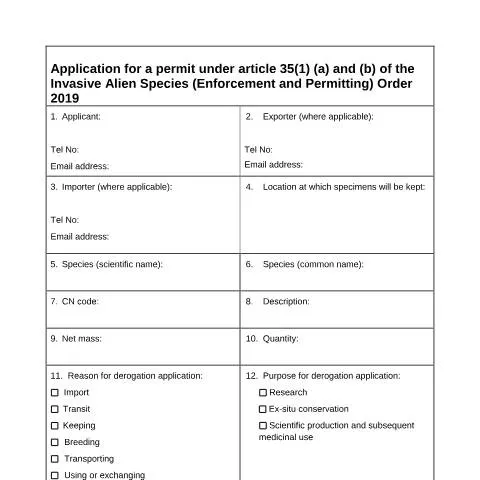
The permit application form demands precision across fourteen distinct sections, each serving specific regulatory and practical purposes. Understanding the nuances prevents costly delays and rejection.
Parties and Locations (Sections 1-4)
Applicant details must reflect the actual person or organisation assuming legal responsibility for compliance. For university research, this typically means the principal investigator rather than technical staff. Contact information receives particular scrutiny—applications with outdated phone numbers or generic email addresses often face processing delays.
The exporter and importer fields apply when specimens cross borders, requiring complete commercial details including registration numbers where applicable. Even internal UK transfers between research institutions may trigger these requirements if the original specimen source involved international movement.
Specimen location details demand comprehensive address information including building names, room numbers, and facility identifiers. Vague descriptions like "university laboratory" prove insufficient—inspectors need precise locations for compliance monitoring.
Species Identification and Quantification (Sections 5-10)
| Section | Required Information | Common Issues |
|---|---|---|
| 5 & 6 | Scientific and common names | Outdated taxonomic classifications, regional name variations |
| 7 | CN customs code | Incorrect code selection, missing subcategory digits |
| 8 | Specimen description | Insufficient detail for identification verification |
| 9 & 10 | Mass and quantity data | Inconsistent units, missing information when both apply |
Scientific nomenclature requires current accepted names—Trachemys scripta elegans for red-eared sliders, not outdated synonyms. The Animal and Plant Health Agency cross-references submissions against authoritative taxonomic databases, rejecting applications with incorrect classifications.
Quantity specifications prove particularly complex for colonial organisms or plant material. A single water hyacinth plant might fragment into dozens of viable pieces, each capable of establishing new populations. Applications must account for all potentially reproductive components, not just discrete individuals.
Purpose and Derogation Categories (Sections 11-13)
The reason for derogation checkboxes allow multiple selections reflecting complex research activities. A conservation breeding programme might require permits for keeping, breeding, and transporting specimens between facilities. However, each selected activity triggers specific containment obligations detailed in subsequent sections.
Purpose justification demands substantial detail beyond simple category selection. Research applications must outline specific scientific objectives, methodologies, and expected outcomes. Conservation projects require demonstration of species recovery plans and release site preparations. Medicinal production applications need evidence of pharmaceutical development protocols and regulatory approvals.
Duration specifications prove crucial for project planning. Open-ended permits face heightened scrutiny, while time-limited applications receive preference. Renewal procedures typically require fresh applications rather than simple extensions, necessitating advance planning for long-term projects.
Containment Protocols: Meeting the Mandatory Conditions
Section 14's containment requirements represent the application's most technically demanding component. Schedule 1, Table 2 conditions operate as mandatory safeguards, with applicants must demonstrate compliance capability before permit approval.
Physical Containment Systems
Contained holding definitions extend beyond simple enclosure to encompass entire management systems. Specimens must remain physically isolated with escape prevention measures addressing all life stages and reproductive strategies. For aquatic species, this includes drainage systems, overflow management, and filtration protocols preventing organism passage.
Cleaning and waste handling protocols demand particular attention for species with vegetative reproduction capabilities. A single overlooked plant fragment in disposal waste could establish new populations if improperly managed. Documentation must detail sterilisation procedures, waste tracking systems, and disposal site confirmations.
Removal, disposal, and destruction procedures require humane approaches for animal species while ensuring complete elimination of reproductive potential. This often necessitates specialist equipment and trained personnel, adding significant operational costs to project budgets.
Personnel Qualifications and Training
Qualified personnel requirements vary by species and activity type. Vertebrate animal work typically demands Home Office licensing under separate legislation, while botanical specimens require expertise in propagation prevention and identification of reproductive stages.
Training documentation must demonstrate competency in escape prevention, emergency response, and species-specific handling techniques. Generic laboratory safety training proves insufficient—applicants need targeted instruction addressing invasive species risks and containment failures.
Transport and Identification Protocols
Transportation arrangements must exclude escape possibilities throughout the entire journey, including loading, transit, and destination delivery. This extends beyond simple container security to encompass vehicle breakdown procedures, route planning avoiding environmentally sensitive areas, and emergency response protocols.
Animal marking requirements balance identification necessity against welfare considerations. Methods must prove permanent and readable while avoiding avoidable pain, distress or suffering. Microchip implantation suits larger vertebrates, while smaller species might require photographic documentation or genetic sampling for identification.
Surveillance Systems and Contingency Planning
Continuous surveillance obligations represent ongoing compliance requirements extending throughout the permit period. Monitoring systems must detect escape attempts, containment failures, and unauthorised access with sufficient sensitivity to trigger immediate response.
Technology solutions range from simple visual inspection schedules for small-scale operations to sophisticated sensor networks for larger facilities. Camera systems, motion detectors, and automated counting equipment all contribute to comprehensive monitoring, but human oversight remains essential for interpretation and response.
Escape Response Protocols
Contingency planning demands detailed emergency procedures addressing various escape scenarios. Plans must specify immediate containment measures, notification protocols for relevant authorities, and eradication strategies appropriate to the species and environment.
Response timelines prove critical—many invasive species establish rapidly once released. Early detection and rapid response principles require 24-hour contact availability and pre-positioned equipment for immediate deployment. Seasonal considerations affect response effectiveness, with some species proving more vulnerable to control measures during specific life stages.
Eradication protocols must account for environmental protection requirements, non-target species impacts, and legal constraints on control methods. Pesticide applications require separate approvals, while physical removal methods need consideration of protected habitat designations.
Submission Procedures and Documentation Standards
Application submission follows specific formatting requirements designed to facilitate processing and reduce errors. Capital letter completion ensures legibility during manual review stages, while clear option marking prevents interpretation ambiguities.
The tick or mark instruction for positive selections requires distinct symbols—ambiguous marks lead to processing delays while staff seek clarification. Crossing out irrelevant sections demonstrates thorough review and prevents accidental inclusion of inappropriate categories.
Supporting Documentation Requirements
Evidence supporting containment condition compliance varies by application type and scale. Research institutions typically provide facility plans, equipment specifications, and staff qualification certificates. Commercial operations might need additional insurance documentation, emergency response agreements, and regulatory compliance histories.
Photographic evidence proves particularly valuable for containment system documentation. Images should clearly show physical barriers, drainage systems, access controls, and monitoring equipment with sufficient detail for remote assessment by reviewing officers.
Financial guarantees or insurance coverage, while not explicitly required by the form, may prove necessary for larger-scale operations or higher-risk species. Some permits include conditions requiring demonstration of adequate resources for long-term containment and emergency response.
Processing Timeline and Inspection Protocols
Permit processing involves multiple review stages within the Animal and Plant Health Agency, with timelines varying significantly based on application complexity and risk assessment outcomes. Standard research applications typically require 6-8 weeks for initial review, while complex conservation projects or novel species applications may extend to several months.
The review process includes scientific assessment of proposed activities, containment system evaluation, and risk analysis considering local environmental conditions. Applications involving species with limited containment precedents face additional scrutiny and may require expert consultation or pilot studies.
Inspector Access and Compliance Monitoring
Inspection protocols grant appointed inspectors broad access rights to verify permit condition compliance. These visits may occur without advance notice, requiring permit holders to maintain continuous readiness for assessment.
Inspector qualifications span multiple disciplines including ecology, veterinary science, and biosecurity expertise. Their assessments consider not only current compliance but also long-term sustainability of containment measures and adequacy of contingency preparations.
Compliance failures can result in permit suspension, modification of conditions, or complete revocation depending on severity and risk implications. Minor technical violations often receive correction notices with specified remediation timelines, while serious breaches involving escape risks trigger immediate enforcement action.
Permit holders must maintain detailed records of all activities, monitoring results, and incident reports for inspector review. Documentation requirements typically extend beyond the permit period to support post-project environmental monitoring and regulatory learning.
Regional Variations and Devolved Authority Requirements
The regulatory landscape for invasive alien species permits varies significantly across the UK's constituent nations, reflecting the devolved nature of environmental policy. In England, the Animal and Plant Health Agency (APHA) serves as the primary licensing authority, working closely with Natural England for conservation-related assessments. Applications must demonstrate compliance with the Wildlife and Countryside Act 1981 and subsequent amendments, particularly Schedule 9 provisions.
Scotland operates under a distinct framework through NatureScot (formerly Scottish Natural Heritage), which applies additional scrutiny under the Nature Conservation (Scotland) Act 2004. Scottish applications often require enhanced biosecurity protocols due to the country's unique island ecosystems and internationally important habitats. The licensing process typically involves consultation with local biodiversity partnerships and may require species-specific risk assessments for Highland and Island regions.
In Wales, Natural Resources Wales (NRW) administers permits under the Environment (Wales) Act 2016, which introduced stricter provisions for non-native species management. Welsh applications must demonstrate consideration of the Well-being of Future Generations Act, requiring long-term environmental impact assessments extending beyond immediate project boundaries. This often necessitates additional documentation regarding ecosystem resilience and climate change adaptation measures.
Northern Ireland presents unique challenges due to its shared island geography with the Republic of Ireland. The Department of Agriculture, Environment and Rural Affairs (DAERA) coordinates closely with counterparts in Dublin to ensure cross-border consistency. Applications may require additional documentation addressing potential species movement across the Irish border, particularly for mobile species or those with natural dispersal mechanisms.
Cross-border movements within the UK require careful coordination between authorities. A permit valid in England does not automatically extend to Scotland or Wales, and applicants planning multi-jurisdictional activities must secure separate authorisations from each relevant authority. This is particularly relevant for research institutions, commercial operations, or conservation programmes spanning administrative boundaries.
Enforcement Actions and Compliance Monitoring
The enforcement landscape surrounding invasive alien species permits operates through a multi-tiered system combining routine inspections, incident response protocols, and progressive penalty structures. APHA enforcement officers conduct both scheduled and unannounced inspections, with powers extending to premises searches, sample collection, and immediate containment orders where public or environmental safety is at risk.
Compliance monitoring begins with initial permit conditions, which typically mandate detailed record-keeping requirements. Permit holders must maintain comprehensive logs documenting species numbers, health status, containment measures, and any incidents or escapes. These records must be made available for inspection within 24 hours of request, with digital submission increasingly preferred through secure government portals.
Graduated penalty structures reflect the severity and intent of violations. Minor administrative breaches, such as late submission of monitoring reports, may result in formal warnings or administrative penalties ranging from £200 to £2,000. More serious contraventions involving unauthorised releases or containment failures can trigger criminal proceedings under the Wildlife and Countryside Act, with maximum penalties reaching £40,000 and six months imprisonment for summary convictions, or unlimited fines and two years imprisonment for indictable offences.
The incident response protocol requires immediate notification to relevant authorities within 24 hours of any escape, unauthorised release, or containment breach. Emergency response procedures vary by species risk category, with high-risk organisms triggering coordinated multi-agency responses involving local authorities, emergency services, and specialist ecological contractors. Permit holders may be liable for full costs of emergency containment and eradication efforts.
Recent enforcement trends show increasing use of civil recovery mechanisms to recoup public expenditure on species management. Where unauthorised introductions result in established populations requiring long-term control programmes, authorities may pursue civil claims against responsible parties for ongoing management costs. These claims can extend years beyond the initial incident and may include habitat restoration expenses.
Technology integration in monitoring systems increasingly utilises GPS tracking, environmental DNA sampling, and remote sensing capabilities. Permit holders working with mobile species may be required to implement electronic monitoring systems, with real-time data transmission to regulatory authorities. Non-compliance with technological monitoring requirements can result in immediate permit suspension pending investigation.
Economic Impact Assessment and Financial Guarantees
Financial considerations form a critical component of invasive alien species permit applications, extending far beyond standard application fees to encompass comprehensive economic impact assessments and mandatory financial guarantees. The economic impact framework requires applicants to demonstrate understanding of potential costs associated with species establishment, including direct economic damages to agriculture, forestry, fisheries, and infrastructure, alongside indirect costs such as biodiversity loss and ecosystem service degradation.
For commercial applications, particularly those involving species with established invasion histories elsewhere, authorities may require independent economic modelling conducted by accredited environmental economists. These assessments must quantify potential impacts using recognised methodologies such as the Generic Impact Scoring System (GISS) or species-specific economic models developed by research institutions. Costs typically range from £5,000 to £25,000 for comprehensive assessments, depending on species complexity and geographical scope.
Financial guarantee mechanisms vary according to assessed risk levels and permit duration. Low-risk research permits may require modest bonds of £1,000 to £5,000, while commercial operations involving high-risk species can face guarantee requirements exceeding £100,000. These guarantees typically take the form of insurance policies, bank guarantees, or escrow arrangements, with specific terms negotiated based on individual circumstances.
The calculation methodology for financial guarantees considers multiple factors including species reproductive potential, dispersal capacity, establishment probability, and estimated eradication costs based on comparable international case studies. For aquatic species, assessments must factor in watershed-scale impact potential, while terrestrial species evaluations focus on habitat connectivity and climate suitability modelling.
Insurance market considerations present ongoing challenges for permit applicants, as standard commercial policies typically exclude coverage for invasive species incidents. Specialist environmental liability insurers offer bespoke policies, though premiums can be substantial for high-risk applications. Some applicants opt for self-insurance through dedicated reserve funds, subject to regulatory approval and regular financial auditing.
Long-term financial obligations extend beyond initial permit periods through legacy liability provisions. Permit holders may remain financially responsible for species management costs for periods extending 10 to 25 years post-permit expiry, depending on species characteristics and establishment risk. These ongoing obligations must be secured through renewable financial instruments or successor liability arrangements where organisational changes occur.
Recent regulatory developments have introduced industry-wide levy systems for certain high-risk sectors, creating collective insurance pools to address widespread species management costs. These mechanisms spread financial risk across industry participants while maintaining individual accountability for direct violations. Participation in levy schemes may reduce individual guarantee requirements while ensuring adequate financial coverage for regulatory authorities.