Navigating the EE MP02: A Comprehensive Guide for UK Economic Interest Groupings
For businesses operating within the framework of international collaboration, the formation and management of Economic Interest Groupings (EIGs) present both opportunities and challenges. The EE MP02 document serves as a pivotal notice regarding the establishment or closure of such entities whose primary address lies outside the United Kingdom. Understanding how to effectively use the EE MP02 can smoothen administrative processes, ensuring compliance with UK regulations while facilitating cross-border operations.
The Significance of UKEIGs in a Global Economy
UK Economic Interest Groupings (UKEIGs) are designed to enable businesses from different member states of the European Union (and other countries) to collaborate while mitigating the financial risks associated with joint ventures. This legal structure allows members to pool resources and share expertise without forming a full-fledged partnership or corporation.
Given the intricacies involved, the EE MP02 document plays a crucial role in formalizing changes that may impact the operational landscape of a UKEIG.
When is the EE MP02 Necessary?
- When an existing UKEIG establishes a new site of operation outside the UK.
- When a UKEIG needs to officially close any of its existing establishments outside the UK.
It is essential to note that this document cannot be used for the closure of the UKEIG itself. Instead, the EE MP01 along with relevant liquidation forms are required in such instances.
Understanding the Key Components of the EE MP02
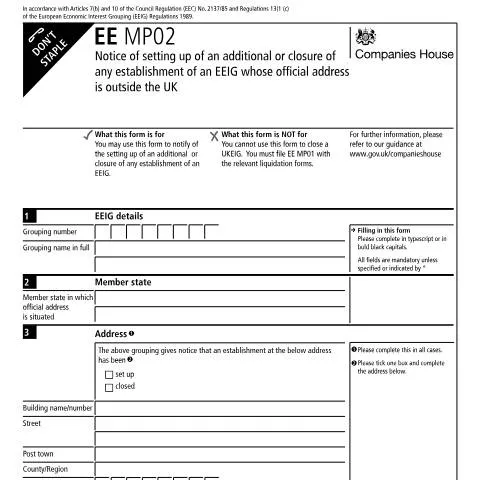
The EE MP02 contains specific sections to ensure that relevant information regarding the establishment or closure of a UKEIG's address outside the UK is accurately conveyed to Companies House. Let’s break down its primary components:
- Grouping Name and Address: Clearly specify the name of the grouping and its official address, including necessary details such as building name, street, and postcode.
- Member State Information: Indicate the member state where the grouping is officially based.
- Establishment Status: State whether you are notifying Companies House about the setting up or the closing of an establishment.
- Signature Section: This indicates who is authorized to sign the form on behalf of the grouping, which could be a member or a manager.
Legal Framework Surrounding the EE MP02
The EE MP02 is underpinned by Articles 7(b) and 10 of the Council Regulation (EEC) No. 2137/85 and Regulations 13(1)(c) of the European Economic Interest Grouping (EEIG) Regulations 1989. These regulations guide the operation and reporting requirements of Economic Interest Groupings, ensuring that the necessary compliance is maintained.
Practical Steps for Navigating the EE MP02 Process
Successfully managing the submission of an EE MP02 notice involves a series of strategic actions. Below are actionable steps to follow:
- Gather Required Information: Collect all necessary details, including the grouping name, member state, and address, ensuring compliance with the information held in the public register.
- Fill Out the Form Accurately: It’s crucial to complete the form in typescript or in bold black capitals. All mandatory fields must be filled in.
- Review for Accuracy: Check for any discrepancies or missing information that could result in rejection or delays.
- Submit to the Correct Address: Depending on the location of the establishment, send the completed form to the appropriate Companies House address, ensuring to retain proof of submission.
Common Queries and Their Clarifications
While the process might appear straightforward, certain questions frequently arise regarding the usage of the EE MP02. Addressing these can help in preventing common pitfalls:
What Happens if the Form is Completed Incorrectly?
Companies House may return the form if it is filled out incorrectly or lacks required information. This can delay the establishment process, so double-checking is advisable.
Can the Form be Used for Multiple Establishments?
The EE MP02 can report the opening or closure of establishments; however, if the grouping has multiple sites, it may provide the address where correspondence is most convenient in the UK.
Implications of Public Disclosure
All information provided on the EE MP02 will be made publicly available. This transparency is crucial for maintaining the integrity of business operations; however, businesses should consider the potential implications of disclosing sensitive information.
Presenter Information and Its Role
While providing contact information for the presenter of the form is not mandatory, it is recommended. If Companies House has any queries regarding the submission, having a clear point of contact can streamline the process.
Limitations and Misconceptions Surrounding the EE MP02
Misunderstandings can occur regarding the scope of the EE MP02. Here are key limitations to keep in mind:
- The document cannot facilitate the closure of the UKEIG itself; for this, the EE MP01 must be used.
- It does not encompass changes in the grouping's membership or its internal governance.
- The EE MP02 is purely for establishments outside the UK; domestic arrangements require separate documentation.
Conclusion: Leveraging the EE MP02 for Strategic Growth
The effective management of the EE MP02 can enhance operational efficiency for UK Economic Interest Groupings aiming to expand or restructure their international presence. By adhering to the outlined guidelines and being mindful of the document’s limitations, businesses can leverage this administrative tool to foster collaborative ventures across borders.
As the global economy continues to evolve, so too will the regulations and practices governing international business. Staying informed and proactive about the implications of documents like the EE MP02 is essential for success in an increasingly interconnected marketplace.
Understanding the Legal Framework for UKEIGs
When considering the establishment or closure of a UK Economic Interest Grouping (UKEIG) with an address outside the UK, it is essential to be aware of the legal stipulations that govern such organizations. UKEIGs are primarily designed to facilitate cooperation between businesses while allowing for a level of flexibility that is not typically available in more formal company structures. Governed by the Companies Act of 2006, these groupings must adhere to specific registration and operational guidelines, especially when their principal address falls outside UK jurisdiction.
To set up a UKEIG, the group must have at least two members who are involved in economic activities, and all members should be based in the UK or, in cases where the UKEIG operates abroad, demonstrate a significant connection to UK business interests. Notably, the HMRC offers guidance on how international tax treaties could affect the financial operations of the UKEIG and its members. This is particularly relevant for the allocation of profits and the implications for National Insurance contributions.
Moreover, understanding the implications of the Data Protection Act 2018 is crucial, especially when dealing with personal data across borders. Organizations must ensure compliance not only with UK GDPR but also with the data protection laws of the country where the UKEIG is based. This includes implementing privacy notices, conducting data protection impact assessments, and safeguarding personal data throughout all operational processes.
Practical Steps for Notifying HMRC about UKEIG Setup or Closure
To notify HMRC of the establishment or closure of a UKEIG whose address is outside the UK, the appropriate form to use is the EE MP02. The completion of this form requires careful attention to detail as it must include specific information about the UKEIG, including its registered name, principal address outside the UK, and the details of its members. It’s crucial to provide accurate information to avoid delays or complications in processing your notification.
The notification process begins with filling out the EE MP02 form accurately. You will need to include details such as the nature of the economic activities the UKEIG will undertake, the expected duration of its existence, and any relevant financial information. Once completed, the form must be submitted to the appropriate HMRC department. Ensure that you keep a copy for your records and confirm that it has been sent correctly, ideally by using a tracked postal service or secure electronic submission method if available.
In the case of closure, members must also provide a rationale for the dissolution, which can be linked to operational challenges, strategic business decisions, or other factors that necessitate the end of the UKEIG's activities. After submitting the closure notification, it is advisable to monitor for any correspondence from HMRC, as they may require additional information or clarification.
Implications of Non-Compliance with Notification Requirements
Failing to notify HMRC regarding the establishment or closure of a UKEIG can have significant legal and financial implications for both the grouping and its members. Firstly, the lack of proper notification may result in penalties. HMRC has the authority to impose fines, and repeated neglect of notification requirements can lead to increased scrutiny of the UKEIG’s operations.
Moreover, non-compliance may affect the members' tax liabilities, especially if the UKEIG is seen as continuing to operate without formal acknowledgment. This situation can lead to complications in tax reporting, potential double taxation, and even issues with National Insurance contributions. It's worth noting that businesses in the UK are required to adhere to the regulations set forth by HMRC, and non-compliance can jeopardize the legitimacy of the entire economic interest grouping.
Additionally, the reputational damage associated with non-compliance can hinder future business opportunities. Potential partners or clients may be reluctant to engage with a company that has unresolved legal issues or regulatory penalties. Thus, maintaining compliance with all notification requirements is crucial for securing the integrity and viability of a UKEIG.