The Part-Time Tuition Fee Support Landscape for 2026-27: Understanding Your Limited Options
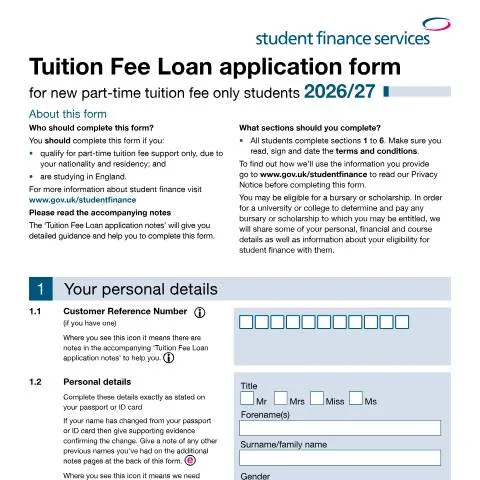
England's student finance system operates with distinct pathways for different categories of learners, and the Tuition Fee Loan application form for new part-time tuition fee only students 2026/27 represents one of the most restrictive routes available. This specialised Student Loans Company (SLC) form, referenced as SFE/EUPTL1/2627, serves students who find themselves in a particularly narrow eligibility band: those who qualify for tuition fee support alone due to their nationality and residency circumstances, rather than the broader financial assistance available to other student categories.
The form's very existence highlights a fundamental aspect of England's student finance architecture—not all part-time students are created equal in the eyes of the funding system. Whilst many part-time learners can access comprehensive support including maintenance loans alongside tuition fee assistance, this form caters exclusively to those whose immigration status, residency history, or nationality restricts them to tuition fee loans only. Understanding this distinction proves crucial before embarking on the application journey, as completing the wrong form can delay your academic start by months.
The 2026-27 academic year brings particular significance as universities continue adjusting their part-time offerings in response to changing demographics and funding landscapes. For students navigating this restricted pathway, the stakes feel higher—there's no safety net of maintenance support, making the successful completion of this single form their gateway to higher education accessibility.
Decoding Eligibility: The Intersection of Nationality, Residency and Academic Ambitions
The form's opening sections immediately establish the complex web of eligibility criteria that determine who should—and crucially, who shouldn't—complete this application. The fundamental requirement centres on qualifying for part-time tuition fee support only due to nationality and residency factors, whilst studying in England specifically. This creates several distinct scenarios worth examining in detail.
The Three-Year Residency Threshold and Its Complications
Section 3.2 reveals the form's most critical decision point: UK nationals who have maintained residency in the UK and Islands for three years prior to their course start date should abandon this form entirely and pursue full support through the standard online application. This creates an immediate filtering effect—many applicants discover they're using the wrong pathway altogether.
The residency calculation proves more nuanced than initially apparent. The three-year period must be continuous and calculated backwards from the first day of the first academic year. Temporary absences for holidays, work placements, or family emergencies don't automatically disqualify applicants, but extended periods abroad require careful documentation and assessment.
For those with European Economic Area (EEA) or Swiss connections, the form acknowledges pre-Brexit rights through a specific provision: residence in the EEA or Switzerland on or before 31 December 2020, combined with subsequent residency in the UK, Gibraltar, the EEA, or Switzerland for the required three-year period, may still qualify for full support rather than this restricted form.
The Qualified Teacher Status Exclusion
Section 2.4 introduces an unexpected barrier that catches many education professionals off-guard. Holders of Qualified Teacher Status (QTS) certificates face automatic exclusion if pursuing courses leading to additional QTS qualifications. However, the form creates a narrow exception for those holding Qualified Teacher Learning and Skills (QTLS) status through the Institute for Learning, who may remain eligible for part-time tuition fee support.
This distinction reflects the government's policy position on preventing multiple qualifications in the same professional area using public funding. Teacher training represents a significant investment, and the restriction aims to prevent individuals from accessing repeated funding for similar qualifications.
Navigating the Personal Details Minefield: Documentation and Identity Verification
Section 1 establishes the foundation for your entire application through meticulous personal detail collection, where precision matters more than convenience. The Student Loans Company operates within strict data protection frameworks under the Data Protection Act 2018 and UK GDPR, making accuracy essential not just for processing but for legal compliance.
The Passport Precedence Principle
The form's instruction to complete personal details exactly as stated on your passport or ID card creates both clarity and complications. This requirement stems from SLC's need to verify identity across multiple government databases, including HMRC for future repayment collection and the Department for Work and Pensions for National Insurance number validation.
Name discrepancies between your passport and current usage require supporting documentation, transforming what seems like a simple form-filling exercise into a potential evidence-gathering mission. Marriage certificates, deed polls, or statutory declarations may become necessary to bridge gaps between official documentation and current identity.
The National Insurance Number Integration
Section 1.3's National Insurance number requirement extends beyond simple identification—it establishes the infrastructure for future loan repayment through the tax system. The SLC shares this information with HMRC to facilitate automatic deductions once your income exceeds repayment thresholds, typically £27,295 annually for Plan 5 loans in the current system.
Students without National Insurance numbers face additional complexity, requiring separate applications to HMRC before completing their student finance application. This dependency can extend application timelines significantly, particularly for international students newly arrived in England.
| Documentation Type | Primary Purpose | Verification Process |
|---|---|---|
| Passport/ID Card | Identity verification | Cross-referenced with Home Office databases |
| National Insurance Number | Repayment infrastructure | Validated through DWP systems |
| Name Change Evidence | Identity continuity | Manual verification by SLC staff |
| Address Confirmation | Correspondence delivery | Postal verification |
Untangling Previous Study History: The Academic Paper Trail That Determines Your Future
Section 2's comprehensive examination of previous educational experiences serves multiple purposes beyond simple record-keeping. The Student Loans Company uses this information to calculate Equivalent or Lower Qualification (ELQ) restrictions, determine previous funding usage, and assess your overall academic trajectory for risk management purposes.
The Full-Time, Part-Time, and Distance Learning Distinction Matrix
Section 2.5's requirement to categorise all previous courses as full-time (FT), part-time (PT), or full-time distance learning (DL) reflects the complex funding rules governing different study modes. Each category carries distinct implications for future funding eligibility, with full-time study typically consuming more of your lifetime funding allowance than part-time equivalents.
The form's insistence on documenting all courses since leaving school creates potential complications for students with diverse educational backgrounds. Short courses, professional qualifications, incomplete programmes, and international study all require disclosure, even when they seem irrelevant to current applications.
Distance learning classification proves particularly nuanced in the post-pandemic educational landscape. Courses that transitioned to online delivery during COVID-19 maintain their original classification, but programmes designed as distance learning from inception carry different funding implications and must be accurately categorised.
The Previous Funding Investigation
Section 2.5.2's detailed examination of previous SLC funding creates a comprehensive audit trail that influences current eligibility. Students who received funding for courses they didn't complete may face restrictions or requirements for partial repayment before accessing new support. This particularly affects those who withdrew from previous programmes or changed courses multiple times.
The form's inquiry into funding applications—even unsuccessful ones—helps SLC identify patterns of behaviour and assess risk factors. Multiple unsuccessful applications might indicate underlying issues that require resolution before new funding approval.
The Residency Verification Maze: Proving Your Geographical Loyalty
Section 3 transforms the seemingly straightforward concept of residence into a complex legal and administrative challenge. The SLC's residency requirements extend beyond simple address history to encompass concepts of ordinary residence, temporary absences, and the distinction between physical presence and legal domicile.
The Normal Residence Paradox
Section 3.1's request for your normal residence when not studying creates philosophical complexity for students whose lives revolve around education. International students, those from military families, or individuals with multiple family homes must determine which address represents their genuine residential base rather than temporary accommodation.
The form's specific mention of British Forces Post Office (BFPO) addresses acknowledges the unique circumstances of military families, whose residency patterns don't conform to civilian norms. These addresses receive special treatment in residency calculations, often with more flexible interpretation of the three-year requirement.
The UK and Islands Definition
The form's reference to UK and Islands encompasses England, Scotland, Wales, Northern Ireland, the Channel Islands, and the Isle of Man, but excludes British Overseas Territories. This distinction affects students from places like Gibraltar, Bermuda, or the Falkland Islands, who may assume their British connection guarantees eligibility but find themselves subject to different rules.
The three-year residency requirement operates on a rolling basis, calculated backwards from your course start date rather than application submission. This timing difference can prove crucial for students whose residency status changes during the application process or who experience delays in course commencement.
Managing Existing Debt and Alternative Funding Sources
Section 2's investigation into existing Student Loans Company debt and alternative funding sources reflects the organisation's comprehensive approach to financial assessment. These inquiries serve both administrative and risk management functions, ensuring students don't exceed funding limits whilst identifying potential repayment issues that could affect new lending decisions.
The Mortgage Style Loan Legacy Issue
Students with outstanding Mortgage Style (MS) loans from pre-2012 face particular complexity, as these older products operate under different terms and conditions than current Income Contingent Repayment (ICR) loans. The form's specific instruction to contact debt owners for MS loans reflects the fragmented nature of student debt management, where different loan types may be administered by various organisations.
The distinction between debt owners becomes crucial when resolving repayment arrears. MS loans may have been sold to private companies, whilst ICR loans remain with government-appointed servicers. Identifying the correct organisation requires specific phone numbers provided in the form, emphasising the importance of maintaining accurate records throughout your student finance journey.
Employer and Third-Party Funding Disclosure
Section 2.1's requirement to declare any other source of funding for tuition fees extends beyond obvious sponsorship arrangements to include employer training budgets, professional development funds, and family contributions. This comprehensive disclosure allows SLC to adjust loan amounts appropriately and prevents over-funding situations that could create repayment complications.
The interaction between SLC funding and employer sponsorship often proves more complex than initially apparent. Some employers require students to repay training costs if they leave within specified periods, creating potential conflicts with SLC repayment obligations. Understanding these interactions before accepting multiple funding sources prevents future complications.
Form Submission and Processing: The Administrative Journey Ahead
Completing the form represents only the beginning of your student finance journey. The SLC's processing systems operate within strict timelines that align with academic calendars, but individual applications may face delays based on documentation quality, eligibility complexity, or verification requirements.
The Evidence Gathering Imperative
The form's frequent references to supporting evidence and accompanying notes indicate that successful applications require substantial documentation beyond the basic form completion. The SLC's evidence requirements vary based on individual circumstances, but common needs include identity verification, residency proof, and academic transcripts from previous institutions.
International documents often require official translation and authentication, adding time and expense to the application process. Students from countries with different educational systems may need additional explanatory documentation to help SLC assessors understand their academic background and its UK equivalence.
The Privacy Notice and Data Sharing Framework
The form's emphasis on reading the Privacy Notice before completion reflects the extensive data sharing arrangements that underpin student finance administration. Your information flows between SLC, HMRC, DWP, your chosen institution, and potentially other government agencies depending on your circumstances.
Understanding these data sharing arrangements proves particularly important for students from countries with different privacy expectations or those with concerns about government data collection. The UK's post-GDPR framework provides extensive rights over personal data, but exercising these rights within the student finance system requires understanding the legitimate interests that justify data processing.
The form's mention of sharing information with universities and colleges for bursary and scholarship determination creates additional considerations for students who prefer to keep financial information private. This sharing operates automatically unless specific objections are raised, making early understanding of these arrangements essential for informed consent.