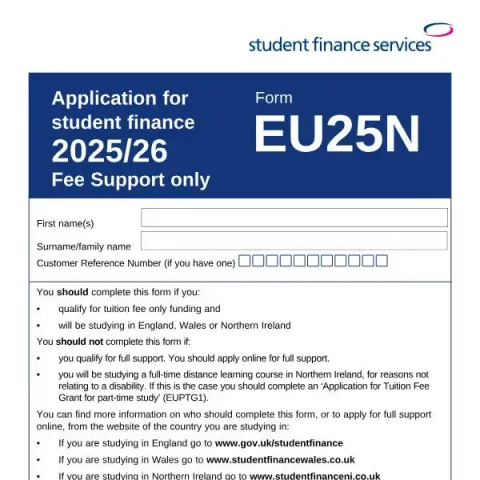
When Fee-Only Support Makes the Difference: Understanding the EU25N Application
Starting university in England, Wales, or Northern Ireland as an international student often means navigating a maze of financial support options. For many students from EU backgrounds or specific qualifying territories, the EU25N Student Finance Application Form represents their pathway to securing essential tuition fee funding for the 2025/26 academic year. Unlike comprehensive student finance packages that include maintenance loans and grants, this particular application focuses exclusively on fee support only – a crucial distinction that determines both eligibility criteria and the application process itself.
The Student Loans Company has designed this streamlined application specifically for students who qualify for tuition fee funding alone, creating a more focused alternative to the full support applications available through online portals. This targeted approach recognises that certain student populations require different types of financial assistance based on their residency status, nationality, and course arrangements.
Qualifying for Fee-Only Support: Who Needs Form EU25N
The EU25N form serves a specific cohort of students whose circumstances place them in a unique funding category. Students must qualify for tuition fee only funding and be planning to study full-time courses in England, Wales, or Northern Ireland to use this application route. This typically includes students from EU member states, certain Commonwealth countries, and other qualifying territories whose residency status doesn't extend to full maintenance support eligibility.
Importantly, the form explicitly excludes students who qualify for comprehensive support packages. These students should instead apply online through the relevant country-specific portals – gov.uk/studentfinance for England, studentfinancewales.co.uk for Wales, or studentfinanceni.co.uk for Northern Ireland. The distinction between fee-only and full support eligibility often relates to complex residency requirements, with students typically needing three years' continuous residence in the UK for full support consideration.
Special Course Considerations
Distance learning students face particular restrictions when using the EU25N form. Full-time distance learning courses in Northern Ireland require different applications unless the distance learning arrangement relates specifically to disability accommodations. Students in this situation must complete the 'Application for Tuition Fee Grant for part-time study' (EUPTG1) instead, highlighting how course delivery methods can significantly impact funding eligibility and application requirements.
The form's scope also extends to students whose academic circumstances might seem borderline between fee-only and full support. International students who have established some UK connections but haven't met the comprehensive residency requirements often find themselves in this category, making the EU25N their most viable funding route.
Navigating the Academic Year Framework and Critical Deadlines
Understanding academic year definitions proves crucial for EU25N applicants, as the Student Loans Company operates on specific timeframes that don't always align with traditional September starts. Academic years run for 12 months but begin on different dates depending on when courses commence, creating a structured system that affects both application timing and funding periods.
| Course Start Period | Academic Year Begins | Application Implications |
|---|---|---|
| 1 August - 31 December | 1 September | Standard autumn intake applications |
| 1 January - 31 March | 1 January | Winter start programmes |
| 1 April - 30 June | 1 April | Spring intake courses |
| Other periods | 1 July | Summer or irregular start dates |
The nine-month deadline from academic year start represents an absolute cut-off point that can result in complete loss of funding eligibility. This deadline applies regardless of when students actually discover their funding needs or encounter unexpected circumstances. Students starting courses in September 2025 face a June 2026 deadline, while those beginning in January face an October deadline – timing that requires careful advance planning.
Strategic Timing Considerations
Early submission proves particularly important for EU25N applicants, as fee-only funding often involves additional verification processes for nationality and residency status. Unlike domestic students whose details can be cross-referenced against existing government databases, international applicants typically require more extensive documentation review, extending processing timeframes significantly.
Country-Specific Funding Variations Within the UK Framework
The EU25N form accommodates three distinct funding systems operating within the UK, each with its own characteristics and additional opportunities. England, Wales, and Northern Ireland maintain separate student finance arrangements despite using the same application form, creating important variations that affect both available funding and application requirements.
English institutions offer Tuition Fee Loans alongside institutional bursaries and scholarships, representing the most straightforward fee-only support model. Welsh arrangements include similar provisions but operate through Student Finance Wales with distinct processing procedures and timelines. Northern Ireland presents the most complex scenario, offering Tuition Fee Grants for certain course categories alongside standard loan provisions.
The Northern Ireland Grant Exception
Students whose courses in Northern Ireland started between 1 September 2012 and 1 August 2018 can access Tuition Fee Grants rather than loans – funding that doesn't require repayment. This historical provision creates a unique opportunity for qualifying students, though it requires careful documentation of course start dates and institutional confirmation. Students eligible for this grant route can opt out of loan applications entirely by ticking the designated box on the form.
The grant provision reflects Northern Ireland's distinct approach to higher education funding during that period, maintaining support levels that differed from arrangements in other UK countries. Students whose courses span this transition period may find themselves eligible for mixed funding packages, combining grants for earlier study years with loans for continuation.
Evidence Requirements and Documentation Standards
All EU25N applicants must provide original documentation or certified copies to verify identity and nationality – requirements that prove more complex than standard domestic applications. The Student Loans Company maintains strict certification standards, accepting only specific professional categories as valid certifiers and excluding university administrative staff from the approved list.
Acceptable certifiers include ministers of religion, doctors, lawyers, civil servants, teachers or lecturers (excluding college administration staff), and police officers. The certifier cannot be a relative and must provide comprehensive contact details including name, job title, telephone number, and work address. This requirement often proves challenging for international students with limited UK professional contacts.
Certification Process Details
Certified copies require specific elements to meet Student Loans Company standards. The certifier must stamp, sign, and date each document copy, explicitly stating it represents "a true copy of the original." The Certifier Checklist form, available through country-specific student finance websites, must accompany all certified evidence to ensure processing efficiency.
Students studying abroad or in their home countries before UK arrival often struggle with these certification requirements. UK embassies or consulates sometimes provide certification services, though availability varies by location. Professional services like solicitors or notaries public can also provide certification, though fees may apply.
Form Completion Strategy and Section Navigation
The EU25N form's modular structure requires strategic completion based on study location, with different sections applying to England, Wales, and Northern Ireland students. Section 1 serves as a routing mechanism, directing applicants to complete specific combinations of subsequent sections based on their chosen study destination.
English students complete sections 1, 2, 3a, 3d (if applicable), 3e, 4, 5, and 6, representing the standard fee-only application pathway. Welsh students follow a similar pattern using section 3b instead of 3a, while Northern Ireland students use section 3c and may have additional grant considerations. Section 3d appears conditional across all routes, suggesting specific circumstances that trigger additional requirements.
Personal Details Precision Requirements
Section 2 demands exact alignment with birth certificates or passport details, creating potential complications for students whose academic records use different name variations. Common issues include shortened first names on academic transcripts versus full names on official documents, or surname variations due to marriage or cultural naming conventions.
The form requires black ink completion – a seemingly minor requirement that reflects document scanning and processing needs. Previous Student Loans Company experience creates additional complexity, as students with existing loans face different processing pathways and potential repayment considerations that affect new funding eligibility.
Data Sharing and Institutional Coordination
EU25N applicants automatically enter a data sharing arrangement between the Student Loans Company and their chosen institutions for bursary and scholarship consideration. This coordination ensures that universities and colleges can assess additional funding opportunities without requiring separate applications, streamlining the overall financial support process.
The sharing encompasses personal details, financial information, course specifics, and student finance eligibility determinations – comprehensive data exchange that enables institutions to make informed decisions about additional support. Students concerned about data privacy can review detailed Privacy Notices through country-specific websites before completing their applications.
Institutional bursaries and scholarships often provide crucial additional funding for fee-only students who lack access to maintenance loans. Universities may offer specific support for international students, academic merit awards, or subject-specific funding that significantly reduces overall study costs. The automatic data sharing ensures these opportunities remain accessible without additional administrative burden.
Managing Expectations and Long-term Financial Planning
Fee-only funding through the EU25N route requires careful financial planning beyond tuition coverage. Students must independently finance accommodation, living expenses, study materials, and travel costs – expenses that maintenance loans typically address for students with full support eligibility. This reality often necessitates additional funding sources including family support, part-time employment, or private educational loans.
Tuition Fee Loans carry the same repayment terms as other Student Loans Company products, with repayments beginning once earnings exceed current thresholds and continuing until the loan balance plus interest is cleared or written off after the statutory period. Students should understand these long-term implications, particularly if they plan to remain in the UK after graduation or return to countries with different tax arrangements.
The form's Terms and Conditions on pages 43-44 require careful review, as they establish legal obligations that extend well beyond the study period. Students accepting fee support enter into formal agreements that affect their financial obligations for decades, making informed decision-making crucial before signature.
Special Circumstances and Evidence Requirements
Student Finance England recognises that not all applicants fit the standard profile, and various special circumstances may affect your eligibility or entitlement calculations. Understanding these scenarios and the evidence requirements can significantly impact your funding outcome.
Estrangement from Parents
If you're estranged from your parents or guardians, you may be assessed as an independent student, which can substantially increase your loan entitlement. The Student Loans Company requires robust evidence of estrangement, which must demonstrate a complete breakdown in the family relationship that's unlikely to be resolved.
Acceptable evidence includes letters from social services, housing departments, or registered charities that have supported you. A simple disagreement or temporary falling-out won't qualify—the estrangement must be long-standing and irreconcilable. You'll need to provide documentation covering at least a 12-month period before your course starts.
Care Leavers and Vulnerable Groups
Former looked-after children automatically qualify for the maximum tuition fee loan regardless of household income. You'll need to provide evidence of your care status, such as a letter from your local authority or your pathway plan. This also applies if you were in care in Scotland, Wales, or Northern Ireland but are studying in England.
Students who've been in local authority care for at least 13 weeks since age 14, or who were looked after and accommodated by a local authority, qualify for enhanced support. The definition extends to those who were on remand or committed to local authority secure accommodation.
Mental Health and Disability Considerations
While mental health conditions don't directly affect tuition fee loan eligibility, they may impact your ability to complete the application process within standard timeframes. Student Finance England can make reasonable adjustments, including extended deadlines or alternative communication methods.
If you have a diagnosed learning difficulty that affects form completion, you can request support or have someone complete the application on your behalf with appropriate evidence. This requires medical documentation and may involve a phone assessment to verify your circumstances.
Income Assessment Complexities and Exceptions
The household income assessment process involves numerous nuances that can significantly affect your loan calculation. Understanding these intricacies helps ensure accurate reporting and optimal funding outcomes.
Self-Employment and Variable Income
If your parents or partner are self-employed, the income assessment becomes considerably more complex. Student Finance England typically uses the most recent tax year figures available, but this may not reflect current financial circumstances, particularly for seasonal businesses or those affected by economic fluctuations.
For self-employed individuals, the assessment considers profit after allowable business expenses, not gross turnover. This includes sole traders, partnerships, and company directors with significant shareholdings. You'll need to provide SA302 forms or tax calculations from HMRC, not just accountant-prepared figures.
Where current year income has dropped significantly below the previous tax year (typically by 15% or more), you may request a Current Year Income assessment. This requires detailed evidence including business accounts, bank statements, and projected income figures supported by an accountant's letter.
Pension Income and Investment Returns
The assessment includes various forms of unearned income that applicants often overlook. Private pension income, whether from defined benefit or defined contribution schemes, counts towards household income. This includes pension drawdown arrangements and annuity payments.
Fill in your form directly online
No printing: type your details into the boxes of the official form, tick, then download the PDF ready to send.
- 1Type into the form boxes
- 2Tick in one click
- 3Save and download the PDF
Investment income from stocks, shares, and property rentals also forms part of the calculation. Dividend income should be reported at the gross amount before any tax credits. Rental income should reflect the profit after allowable expenses like mortgage interest, maintenance costs, and letting agent fees.
Capital gains from property or investment sales don't typically count unless they represent regular trading activity. However, if parents have realised significant gains that supplement their annual income, this may warrant disclosure and assessment.
Benefits and Tax Credits Integration
Certain state benefits are disregarded in the income assessment, while others are included. Working Tax Credit and Child Tax Credit are generally excluded, but the underlying earned income that qualified for these credits is assessed.
Universal Credit presents particular complexities as it combines multiple legacy benefits. The work allowance and taper rate within Universal Credit mean that small changes in reported income can have disproportionate effects on both benefit entitlement and student finance calculations.
If parents receive Employment and Support Allowance in the income-related category, this may indicate lower household income that could increase your loan entitlement. However, contribution-based ESA doesn't necessarily reflect reduced income capacity.
Application Timing Strategies and Deadline Management
Strategic timing of your student finance application can influence both processing speed and funding availability. Understanding the administrative calendar and peak periods helps optimise your application experience.
Early Application Advantages
Applications open in early spring for the following academic year, typically around March. Applying within the first month offers several advantages beyond avoiding deadline pressure. Student Finance England processes applications in roughly chronological order during peak periods, meaning earlier applicants often receive faster decisions.
Early applicants also benefit from clearer communication channels with customer service teams, as call volumes remain manageable during spring months. By summer, wait times can extend significantly, and online chat services may be unavailable during peak hours.
Universities receive provisional funding notifications earlier for students who apply promptly, which can facilitate accommodation offers and course planning. Some institutions prioritise accommodation allocation based on confirmed funding status.
Academic Year Transition Periods
The transition between academic years creates specific administrative challenges that affect application processing. Between July and September, Student Finance England manages both new applications and renewals for continuing students, creating bottlenecks in their systems.
If you're applying for a course starting in January or at non-standard times, your application may receive faster processing as it falls outside peak periods. However, evidence requirements remain identical regardless of course start date.
Gap year students who defer entry must reapply for student finance, as awards don't automatically carry forward. This reapplication should occur during the standard application window for your revised start year, not when you initially planned to begin studying.
Evidence Submission Timing
The 'evidence deadline' differs from the application deadline and varies depending on your course start date. For September starts, evidence must typically reach Student Finance England by early May to guarantee processing before the academic year begins.
Documents submitted after the evidence deadline don't invalidate your application, but they may delay payment until several weeks into your first term. This creates particular hardship for students relying on the first loan instalment to cover initial course costs and accommodation deposits.
Electronic document submission through the online portal typically processes faster than postal submissions. However, original documents may still be required for certain evidence types, particularly foreign qualifications or complex financial documentation. Planning document collection and submission several weeks before deadlines helps accommodate any requests for additional evidence.
Amendment and Reassessment Timescales
Changes to your circumstances after initial application submission can trigger reassessment processes with their own timescales. Income changes, course switches, or personal circumstance modifications each follow different processing paths within Student Finance England's systems.
Course-related changes typically process faster than income reassessments, particularly if they involve straightforward adjustments like module selection or attendance pattern changes. However, switching between institutions or changing course levels may require completely new applications rather than amendments.
Income reassessments, particularly Current Year Income applications, can take 8-12 weeks to process and may require multiple rounds of evidence submission. Starting these processes early in the academic year helps ensure resolution before financial pressures accumulate.