Wildlife Licences A08 and A09: Your Legal Obligation to Report Back
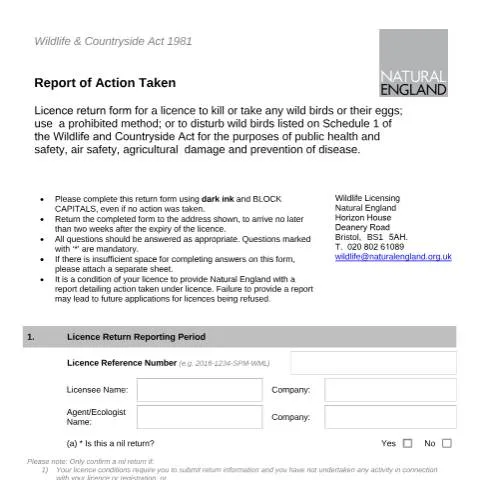
When Natural England grants you an A08 or A09 licence under the Wildlife and Countryside Act 1981, you're not simply receiving permission to control wild birds or disturb protected species—you're entering into a legal contract with strict reporting requirements. The "Report of Action Taken" form isn't optional paperwork you can file away and forget. It's a statutory condition of your licence, and failing to submit it within two weeks of your licence expiry could see future applications rejected outright.
This return form serves multiple purposes: it provides Natural England with crucial data on wildlife management effectiveness, helps monitor the impact of licensed activities on protected species, and demonstrates your compliance with the strict conditions attached to your authorisation. Whether you've undertaken extensive bird control operations or haven't acted at all during your licence period, you must still complete and return this form.
Who Holds These High-Stakes Wildlife Authorisations
A08 and A09 licences are issued to a specific cohort of professionals and organisations dealing with complex wildlife management scenarios. A08 licences typically authorise the killing or taking of wild birds, destruction of nests and eggs, or use of prohibited methods where conventional approaches have failed. These might be issued to airport operators managing bird strikes, agricultural businesses protecting crops from persistent corvid damage, or conservation organisations controlling invasive species.
A09 licences focus on disturbance activities, particularly relevant for developments affecting Schedule 1 species during breeding seasons. Construction companies working near sensitive habitats, renewable energy developers, or ecological consultants conducting surveys often hold these authorisations.
The licence holder named on the original application bears ultimate responsibility for the return, but the form acknowledges that an Agent/Ecologist may complete it on their behalf. This reflects the reality that specialist ecological consultants often manage the day-to-day implementation of licensed activities for their clients.
Corporate Responsibilities and Individual Accountability
Where licences are held by companies or public bodies, the organisation must ensure robust internal systems track licensed activities across different sites and personnel. The form requires both the licensee name and company details, establishing a clear audit trail. Individual ecologists working under corporate licences should maintain detailed records, as they may be called upon to provide evidence if compliance issues arise.
Decoding the Licence Reference System
Every licence carries a unique reference number following Natural England's standardised format. The example given—2016-1234-SPM-WML—reveals the systematic approach: the year of issue, a sequential number, the licensing team code (SPM likely referring to Species Management), and the licence type (WML for Wildlife Management Licence).
This reference number becomes your key identifier throughout the reporting process and any subsequent correspondence. Natural England's Wildlife Licensing team at Horizon House in Bristol uses these references to track your compliance history, and they'll appear on any renewal applications you submit.
The Critical Reporting Timeline and Nil Returns
The form explicitly addresses nil returns—submissions where no action was taken under the licence. Far from being unnecessary, nil returns provide valuable data on licence utilisation rates and help Natural England assess whether certain authorisations are genuinely needed. The form asks whether you're submitting a nil return and, if so, requires confirmation that you haven't undertaken any licensed activity.
Even if circumstances changed and the bird control or disturbance activity became unnecessary, you cannot simply ignore your reporting obligation. The nil return demonstrates you've complied with licence conditions by not exceeding your authorised activities.
Licence Period Variations and Reporting Windows
The reporting period fields accommodate Natural England's flexible approach to licence duration. Some licences run for specific seasonal periods (protecting breeding birds), others cover calendar months, and emergency licences might span just days or weeks. You must report on the exact period specified in your licence conditions, not the period when you were most active.
| Licence Type | Typical Duration | Reporting Deadline | Common Issues |
|---|---|---|---|
| Seasonal bird control | March-September | Two weeks after 30 September | Forgetting summer holiday periods |
| Development disturbance | Project-specific dates | Two weeks after end date | Construction delays affecting dates |
| Emergency authorisations | Days to weeks | Two weeks after expiry | Rapid turnaround requirements |
Detailed Action Reporting: Getting the Specifics Right
Section 2 of the form demands granular detail about each action taken under your licence. The three-column format allows for multiple separate incidents, recognising that licensed activities often occur across different dates, locations, or target species. Each action requires precise categorisation using the provided tick-boxes, covering everything from direct killing to nest destruction and Schedule 1 species disturbance.
The species identification field requires scientific accuracy. Vague descriptions like "corvids" won't suffice—you must specify whether you targeted carrion crows, magpies, or jackdaws. For Schedule 1 species, precise identification becomes even more critical, as disturbance licences often specify individual species or subspecies.
Location Data and Grid References
The Ordnance Survey grid reference requirement reflects Natural England's need to map licensed activities spatially. The form notes that you must provide "RLR field numbers for the fields where the action has been taken or OS Grid References for each field." This dual system accommodates both agricultural users familiar with Rural Land Registry field numbers and other operators working with standard OS coordinates.
For multi-site operations, each location must be separately recorded with its own grid reference. Urban wildlife control operations might require six-figure grid references to distinguish between adjacent buildings, while rural operations could use four-figure references for broader field areas.
Navigating Renewal Applications Within the Return Process
The form's dual function as both a compliance report and potential renewal application creates opportunities and pitfalls. Section 4 allows you to request licence renewal alongside your return, potentially streamlining the administrative process. However, this convenience comes with additional obligations and declarations.
If seeking renewal, you must confirm that "the species in question is still present at the site, or likely to return next season" and that "the species in question is still causing, or likely, to cause the same problem." These aren't mere formalities—they're legal declarations that Natural England will scrutinise against your reported actions and any supporting evidence.
The Evidence Requirement for Renewals
Renewal applications must include updated evidence supporting continued need for licensed intervention. The form specifically requests:
- New evidence of damage, including photographs and updated catch records
- Bird counts and scaring logs demonstrating ongoing problems
- Field reference numbers for agricultural damage prevention licences
This evidence requirement reflects Natural England's commitment to ensuring licences remain necessary and proportionate. Historical damage reports from your previous licence period won't suffice—you need current evidence justifying continued intervention.
Data Protection Compliance and Information Sharing
Section 3 addresses the complex data protection landscape surrounding wildlife licensing information. Natural England operates under specific legal gateways that allow sharing of licensing data with other government departments, enforcement agencies, and research institutions. By submitting your return, you're acknowledging that your reported actions may be shared beyond Natural England's immediate team.
The Wildlife Licensing privacy notice, accessible through the government website, details exactly how your personal and business information will be processed. This includes potential disclosure to organisations investigating wildlife crime, researchers studying conservation effectiveness, and other public bodies managing environmental impacts.
Criminal Liability and False Information
The form carries stark warnings about the criminal consequences of providing false information. Under both the Wildlife and Countryside Act 1981 and the Conservation of Habitats and Species Regulations 2017, knowingly making false statements can result in imprisonment for terms not exceeding six months or substantial fines. Even reckless inaccuracy—failing to check your records properly—could constitute an offence.
Natural England emphasises that licences can be revoked immediately if false information comes to light, regardless of whether criminal proceedings follow. This creates a strong incentive for meticulous record-keeping throughout your licence period.
Submission Logistics and Follow-up Procedures
The completed form must reach Natural England's Wildlife Licensing team at Horizon House, Deanery Road, Bristol, BS1 5AH, within the specified deadline. The requirement for dark ink and block capitals reflects the form's processing through document scanning systems that struggle with light or cursive text.
Natural England processes returns in chronological order, but complex cases involving multiple species or renewal applications may take several weeks to resolve. If you've requested renewal, you should receive acknowledgement within 10 working days, followed by a substantive response within the standard licensing timeframes.
When Returns Go Wrong
Incomplete or illegible returns will be returned to you with specific guidance on deficiencies. Common issues include missing grid references, vague species descriptions, and unsigned declaration sections. Each resubmission delays processing and may push your renewal application beyond seasonal deadlines for certain activities.
If you discover errors after submission, contact the Wildlife Licensing team immediately on 020 802 61089. Minor corrections can often be handled by phone, but significant changes may require a fresh submission with explanatory covering letter.
Beyond Compliance: Strategic Licence Management
Experienced licence holders use the return process strategically, building relationships with Natural England case officers and demonstrating exemplary compliance standards. Detailed, accurate returns with supporting photographic evidence and comprehensive site maps create positive impressions that influence future applications.
Consider the return form as part of your broader wildlife management documentation system. Cross-reference your submitted data with insurance records, health and safety logs, and environmental impact assessments. This integration helps identify patterns, justify management decisions, and prepare for potential audits or enforcement investigations.
The most successful applicants maintain ongoing dialogue with Natural England throughout their licence periods, not just at renewal time. If circumstances change significantly—perhaps the target species disappears or new protected species colonise your site—proactive communication demonstrates professional competence and regulatory awareness.
Special Circumstances and Exemptions for A08/A09 Reporting
Whilst the standard A08 and A09 reporting requirements apply to most licence holders, Natural England recognises that certain circumstances may warrant modified reporting protocols or temporary exemptions. Understanding these special provisions can prevent unnecessary compliance issues and ensure your licence remains valid during exceptional periods.
Emergency Situations and Force Majeure
When unforeseen circumstances prevent normal monitoring activities, licence holders must still fulfil their reporting obligations, albeit with modified parameters. Natural England accepts that severe weather events, such as flooding or prolonged snow cover, may render survey sites inaccessible or make standard monitoring techniques impractical.
In such cases, you should document the circumstances thoroughly, including photographic evidence where possible, and submit this alongside your standard report. The regulator may accept reduced survey effort or alternative methodologies, provided you can demonstrate that reasonable attempts were made to conduct monitoring within the prescribed parameters.
For A08 licences covering bat roost modifications, structural damage to buildings containing roosts may necessitate immediate welfare interventions that deviate from original licence conditions. Emergency repairs to prevent roost collapse or water ingress should be reported within 48 hours via the online portal, with a detailed explanation of the circumstances and any temporary mitigation measures implemented.
Research Project Extensions and Multi-Year Studies
Academic researchers holding A09 licences for longitudinal studies often encounter situations where project timescales extend beyond the original licence period. Natural England has established specific protocols for handling these scenarios, particularly where continuous data collection is essential for scientific validity.
If your research project requires extension, you must submit a variation request at least eight weeks before your current licence expires. This should include updated project timelines, justification for the extension, and evidence of continued institutional support. Failure to secure licence renewal before expiry creates a legal gap where no licensed activities can occur, potentially compromising years of research effort.
For collaborative research involving multiple institutions, each participating organisation must hold appropriate licences or be named as authorised agents under a lead licence. Changes to research partnerships during the licence period require formal notification to Natural England, as personnel changes can affect the technical competency requirements underpinning licence approval.
Seasonal Variations and Weather-Dependent Activities
Many A08 and A09 licensed activities are inherently seasonal, with optimal survey windows dictated by species behaviour patterns and environmental conditions. Natural England's reporting requirements acknowledge these constraints whilst maintaining robust monitoring standards.
For amphibian surveys conducted under A09 licences, breeding pond monitoring must align with species-specific activity periods. Common toads typically require surveying between February and May, whilst great crested newts need monitoring from mid-March through June. If adverse weather conditions compress these windows, you may need to intensify survey effort during suitable periods rather than spreading activities across the full licensed timeframe.
Botanical surveys for rare plant species often depend on specific flowering periods for reliable identification. If spring arrives unusually early or late, your monitoring schedule may require adjustment to capture peak identification opportunities. Such modifications should be documented in your methodology notes and explained in the annual report submission.
Digital Transformation and Online Reporting Systems
Natural England's digital infrastructure for licence management and reporting has undergone significant modernisation, fundamentally changing how A08 and A09 licence holders interact with regulatory processes. Understanding these systems' capabilities and limitations is crucial for efficient compliance management.
The Wildlife Licensing Online Portal
The centralised online portal serves as the primary interface for all licence-related activities, from initial applications through to annual reporting submissions. This system integrates with Natural England's internal case management databases, enabling real-time tracking of compliance status and automated reminder notifications.
When uploading monitoring data through the portal, ensure file formats comply with Natural England's technical specifications. Spreadsheet submissions should use the prescribed templates, with column headers exactly matching the required format. GPS coordinates must be provided in British National Grid format (OSGB36), not latitude/longitude decimal degrees, as the system's mapping functions rely on standardised spatial referencing.
The portal's document management system maintains complete audit trails of all submissions, amendments, and communications. This proves invaluable during compliance reviews or when responding to information requests from other regulatory bodies. However, the system has strict file size limitations—typically 10MB per upload—requiring large datasets to be compressed or submitted across multiple files.
Data Security and GDPR Compliance
Under the Data Protection Act 2018 and UK GDPR, Natural England must protect personal information contained within licence applications and monitoring reports. This particularly affects A09 research licences where individual researchers' contact details, qualifications, and project affiliations are recorded.
If your research involves collecting personal data about landowners, volunteers, or research participants, you must ensure appropriate data protection measures are implemented before submitting reports to Natural England. This includes obtaining explicit consent for data sharing with regulatory authorities and implementing appropriate anonymisation techniques where possible.
The online portal uses government-standard encryption protocols and multi-factor authentication to protect sensitive information. However, licence holders remain responsible for securing data before upload, including password-protecting sensitive documents and ensuring personal devices used for portal access meet basic cybersecurity standards.
Integration with Other Regulatory Systems
Natural England's licensing database increasingly interfaces with other environmental monitoring systems, including the National Biodiversity Network (NBN) Atlas and local environmental records centres. This integration streamlines data sharing whilst reducing duplication of reporting requirements across different schemes.
For A08 licences involving development projects, monitoring data may be automatically shared with local planning authorities where Section 106 agreements require ongoing biodiversity monitoring. This eliminates the need for separate reporting to multiple agencies but requires careful attention to data formatting and quality standards, as information will be scrutinised by various stakeholders with different technical expertise levels.
Enforcement Actions and Compliance Monitoring
Natural England operates a risk-based compliance monitoring system for A08 and A09 licences, with inspection frequencies determined by licence complexity, previous compliance history, and the conservation significance of affected species or habitats. Understanding enforcement procedures helps licence holders maintain appropriate standards and respond effectively to regulatory scrutiny.
Inspection Triggers and Risk Assessment
Routine compliance inspections typically occur on a three-to-five-year cycle for standard A08 licences, though high-risk activities or previous non-compliance issues may trigger more frequent visits. Natural England's risk assessment algorithms consider factors including the conservation status of affected species, the scale and duration of licensed activities, and the technical complexity of required mitigation measures.
Certain activities automatically elevate inspection priority, particularly those involving European Protected Species with unfavourable conservation status or operations within or adjacent to designated sites such as Special Areas of Conservation (SACs) or Sites of Special Scientific Interest (SSSIs). A08 licences for bat roost destruction in buildings of architectural significance also receive enhanced scrutiny due to the intersection of wildlife and heritage protection requirements.
Unannounced inspections may occur following third-party complaints, reports of unlicensed activities, or concerns raised during routine data analysis. Natural England's compliance officers have powers under the Wildlife and Countryside Act 1981 to access licensed sites during reasonable hours and examine monitoring records, though they will typically provide advance notice except where immediate welfare concerns exist.
Common Compliance Issues and Penalties
Analysis of Natural England's enforcement actions reveals recurring patterns of non-compliance that licence holders should actively avoid. The most frequent issues include incomplete monitoring records, failure to implement prescribed mitigation measures, and conducting licensed activities outside approved timeframes or spatial boundaries.
For A09 research licences, common problems include exceeding authorised capture quotas, using unauthorised personnel for licensed activities, and failing to report accidental mortalities or injuries within required timeframes. These issues often arise from poor communication within research teams or inadequate training of field assistants rather than deliberate non-compliance.
Enforcement responses follow Natural England's published prosecution policy, with penalties ranging from formal warnings and licence modifications through to prosecution under wildlife protection legislation. Serious breaches may result in licence revocation and disqualification from holding future licences, whilst repeated minor infractions typically trigger enhanced monitoring requirements and mandatory training.
Appeals Process and Dispute Resolution
Licence holders who disagree with Natural England's compliance decisions have clearly defined appeal routes, though these must be initiated within strict timeframes to preserve legal rights. Understanding these procedures is essential for maintaining productive working relationships with regulators whilst protecting legitimate interests.
Initial disputes should be raised through Natural England's internal review process, providing detailed evidence to support your position and identifying specific factual or procedural errors in the original decision. This informal route often resolves misunderstandings arising from incomplete information or communication failures without escalating to formal proceedings.
If internal review fails to resolve the dispute, formal appeals may be lodged with the Secretary of State for Environment, Food and Rural Affairs, typically within 28 days of receiving Natural England's final position. Such appeals require comprehensive documentation and may benefit from specialist legal advice, particularly where significant commercial interests or research programmes are at stake.