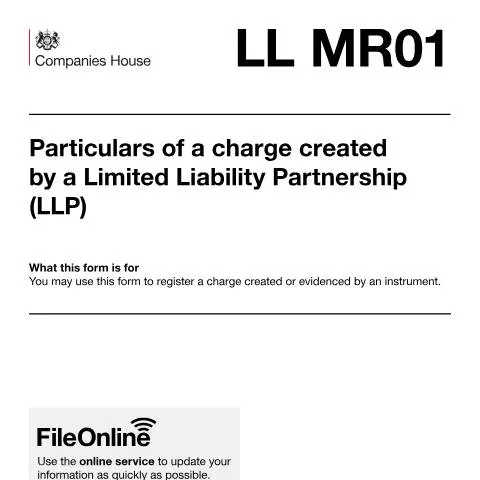
Understanding the LL MR01 Form: A Crucial Step for Limited Liability Partnerships
When a Limited Liability Partnership (LLP) establishes a charge against its assets, it’s essential to document this transaction accurately. The LL MR01 form, which registers particulars of a charge created by an LLP, plays a critical role in safeguarding the interests of both the partnership and its creditors. This document not only provides transparency but also ensures compliance with the relevant legal framework as stipulated under the Companies Act 2006.
The Role of the LL MR01 in Financial Transactions
The LL MR01 form serves as a formal declaration that a charge has been created against certain assets of an LLP. This can include a wide range of properties, from tangible assets like buildings to intangible ones such as intellectual property. Registering this charge with Companies House is not merely procedural; it establishes a public record of creditors' rights and is crucial for maintaining order in financial transactions involving the LLP.
The Importance of Timeliness
One of the key aspects of the LL MR01 form is the requirement for submission within a specific timeframe. The form must be delivered to the Registrar for registration within 21 days from the day after the creation of the charge. Failing to adhere to this deadline can result in the registration being rejected unless accompanied by a court order extending the timeframe. This underscores the importance of acting promptly to protect the LLP’s assets and comply with legal obligations.
Navigating the Submission Channels: Online versus Paper
Filing the LL MR01 can be completed through different channels, and understanding the distinctions can significantly affect processing times and convenience.
Online Submission
- Speed: The online submission method allows LLPs to register charges swiftly, with most forms processed on the same day.
- Cost: Online filings incur a fee of £24 per charge.
- Accessibility: The online service is available 24/7, providing flexibility for businesses to submit their forms at their convenience.
Paper Submission
- Processing Time: Paper forms sent by post typically require longer processing times, which can delay the registration of the charge.
- Fee: A fee of £24 is also applicable for paper submissions.
- Requirements: Paper submissions must include a certified copy of the instrument evidencing the charge.
Components of the LL MR01 Form Explained
Completing the LL MR01 form involves careful attention to detail, as each section is designed to capture specific information regarding the charge created. Here’s a breakdown of the key sections:
Section 1: LLP Details
This section requires the full name of the LLP and its registered number. Accuracy is paramount; any discrepancies between the submitted information and the public register could lead to processing delays or rejection.
Section 2: Charge Creation Date
The date on which the charge is created must be indicated clearly. This date is crucial for the 21-day submission timeline and must follow the format DD/MM/YYYY.
Section 3: Names of Persons Entitled to the Charge
In this section, the names of individuals or entities entitled to the charge must be provided. If there are more than four, the LLP may submit just four names and indicate that there are additional parties entitled. Be cautious; failure to list names accurately can lead to complications.
Section 4: Brief Description of the Charge
A succinct description of the charge is necessary. If multiple properties are included, it’s acceptable to briefly describe some and refer to the instrument for further details. This section should not exceed the available space.
Sections 5-8: Specific Charge Details
These sections require the LLP to respond to specific questions regarding the nature of the charge, including whether it’s a floating charge or if it includes any restrictions on future securities. This is where many users can encounter pitfalls if they do not thoroughly understand their charge’s implications.
The Consequences of Errors and Missing Documents
Submitting the LL MR01 form is not without risks. If errors are made or documents are missing, the form may be returned unprocessed. This can lead to significant delays in registering the charge, potentially leaving the LLP vulnerable to financial litigation.
What to Do if Your Submission is Rejected
- Review the Feedback: Carefully read the feedback from Companies House to understand the reasons for rejection.
- Correct the Mistakes: Make the necessary amendments to the form and ensure all required documents are included.
- Resubmit Promptly: After corrections, resubmit the form as quickly as possible to remain compliant with the 21-day rule.
Future Implications: What Happens After Submission?
Once the LL MR01 form is submitted and accepted, Companies House will register the charge and issue a certificate confirming this registration. This certificate is an important document, as it serves as proof of the charge’s registration in the public record.
Record Keeping and Public Disclosure
All information provided on the LL MR01 form becomes part of the public record. This transparency is crucial for maintaining trust among creditors and stakeholders, as it allows them to assess the financial obligations of the LLP.
Fees and Payment: What to Expect
As mentioned earlier, a fee of £24 is applicable for registering each charge through either online or paper submission. For those opting for paper submission, it’s essential to make cheques or postal orders payable to Companies House. Keep in mind that payment methods may vary for online submissions.
Final Checklist Before Submission
| Checklist Item | Status |
|---|---|
| LLP name and number match the public register | ✔️ |
| Date of charge creation is accurately filled | ✔️ |
| Names of persons entitled to the charge included | ✔️ |
| Appropriate boxes in Sections 3, 5, 6, 7 & 8 ticked | ✔️ |
| Description in Section 4 provided | ✔️ |
| Form authenticated by an interested party | ✔️ |
| Correct fee enclosed for paper submission | ✔️ |
Completing the LL MR01 form is a vital process for any LLP wishing to secure its financial commitments properly. Ensuring accurate and timely submission can have far-reaching implications for the partnership's financial health and credibility.
Understanding the Registration Process for Charges in Limited Liability Partnerships
Registering a charge created by a Limited Liability Partnership (LLP) is a crucial aspect of ensuring that the interests of creditors are protected. A charge essentially acts as a security over an asset, and its registration serves to notify other parties of this security interest. The process of registering these charges is primarily governed by the Companies Act 2006, which outlines the requirements and implications of registering such charges through Form LL MR01.
The registration process involves several key steps. First and foremost, the LLP must prepare Form LL MR01, ensuring all particulars regarding the charge are accurately filled out. This includes details such as the creation date of the charge, the nature of the charge, and the assets the charge covers. It is vital to provide clear and precise information, as even minor inaccuracies can lead to complications in the registration process.
Once the form is completed, it must be submitted to Companies House. This can be done electronically or via postal service. If submitting electronically, the LLP must ensure they have an account set up with Companies House to facilitate the online submission. The registration fee associated with Form LL MR01 must also be paid at this time, which can vary depending on the method of submission.
After submission, Companies House will process the registration. It is essential for the LLP to keep a record of the submission to track its status. If accepted, the charge will be recorded in the LLP's public register, allowing creditors and other interested parties to inspect it. Should Companies House require any further information or clarification on the submitted details, they will notify the LLP, so being prompt and responsive is crucial.
Implications of Failing to Register a Charge
Failing to register a charge can have serious consequences for a Limited Liability Partnership. According to Section 859A of the Companies Act 2006, if a charge is not registered within the requisite time frame, it may become void against a liquidator or other creditors. This essentially means that the creditor holding the unregistered charge may struggle to enforce their rights over the secured asset in the event of the LLP entering insolvency.
Moreover, the time frame for registration is critical. The charge must typically be registered within 21 days from its creation. If this deadline is missed, the LLP will need to apply for a late registration, which is not guaranteed and may involve additional scrutiny from Companies House. Furthermore, failure to register can lead to reputational damage and hinder the LLP's ability to secure future financing, as potential lenders may view the LLP's failure to properly document existing charges as a red flag.
Additionally, unregistered charges might complicate the process of asset disposal. Should the LLP decide to sell the charged asset, any prospective buyers will likely conduct due diligence that includes checking for registered charges. If a charge is found to be unregistered, it may deter buyers, affecting the LLP's ability to transact effectively.
Revoking or Modifying a Registered Charge
Under certain circumstances, Limited Liability Partnerships may find it necessary to revoke or modify a registered charge. This process is not as straightforward as registration and requires careful consideration of the legal implications involved. To revoke a charge, the LLP must complete the appropriate form (LL MR02) and submit it to Companies House, along with any requisite supporting documentation.
Modification of an existing charge also necessitates a detailed approach. A modification could involve changing the terms of the charge, the assets it covers, or the parties involved. Similar to revocation, an LLP must ensure that all details are correctly documented in the appropriate form. It's important to note that any changes to the charge must be registered within the same time frame as initial registrations, typically within 21 days of the change occurring. Failing to do so will again lead to potential voiding of the charge against creditors.
In both revocation and modification scenarios, maintaining accurate records and following the correct procedures is essential to protect the LLP's interests. Furthermore, it is advisable to seek legal counsel when undertaking such actions to ensure compliance with all applicable laws and regulations.