Understanding Purchase Notices Served Under the Town and Country Planning Act 1990
The Purchase Notice is a formal mechanism within the UK planning system, governed by the Town and Country Planning Act 1990, specifically under Section 137. It provides a means for landowners to request the local planning authority (LPA) to purchase land that has become incapable of beneficial use due to planning restrictions or decisions. This guide aims to clarify the purpose, application process, and implications of such notices for landowners, developers, and local authorities.
The Purpose and Scope of Purchase Notices
A Purchase Notice is served when a landowner believes that their land has lost its reasonable beneficial use because of a planning decision. This could occur in situations where:
- The land has become incapable of reasonably beneficial use in its current state.
- Developments permitted under planning conditions do not restore or enable beneficial use.
- No other permitted development rights or granted permissions can make the land usable again.
In essence, the notice is a legal request for the local authority to acquire the land, compensating the owner for the loss of use. This process aims to balance property rights with the planning objectives of the local authority, particularly where land is rendered effectively unusable due to planning restrictions.
Legal Framework and Application Procedure
Legal Basis
The statutory authority for serving a Purchase Notice is found in Section 137 of the Town and Country Planning Act 1990. This section allows landowners to notify the local council of their wish to sell their interest in the land if certain conditions are met.
Submitting a Purchase Notice
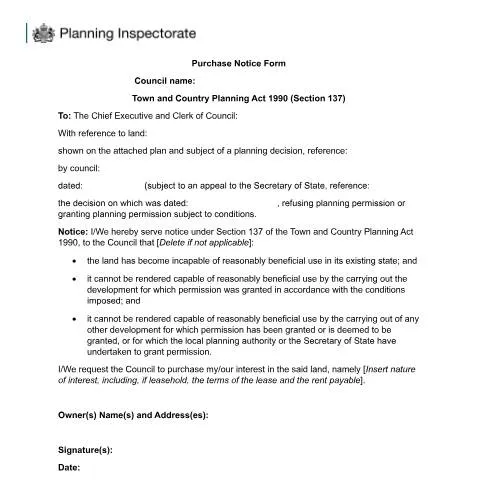
The process involves completing a formal Purchase Notice form, which must include details such as:
- The land's location, shown on an attached plan.
- The planning decision reference and date.
- The reasons why the land is considered incapable of beneficial use.
- The specific interest in the land (freehold, leasehold, etc.) and relevant lease terms if applicable.
- Owner(s) details and signatures.
The completed notice is then served on the Chief Executive and Clerk of the relevant council. It is important to adhere to the statutory deadlines and requirements to ensure the validity of the notice.
Implications for Landowners and Local Authorities
For Landowners
Serving a Purchase Notice obligates the local authority to consider purchasing the land. If the council agrees to acquire it, negotiations on the purchase price follow, based on the land's market value at the time of service. The process provides a legal avenue for owners to recover their land when planning restrictions have rendered it unusable.
For Local Authorities
Upon receipt of a valid Purchase Notice, the council must evaluate the land's condition and the reasons provided. If they accept the notice, they are obliged to negotiate in good faith with the owner to reach a fair purchase agreement. This process ensures that landowners are compensated appropriately, and the land is transferred to public ownership if agreed.
Considerations and Limitations
It is important to note that serving a Purchase Notice does not automatically guarantee the sale of the land. The local authority has discretion, and negotiations may lead to alternative arrangements or disputes. Additionally, the circumstances under which a Purchase Notice can be served are specific, and not all planning decisions will qualify.
Owners should seek professional advice before serving a notice, ensuring that all legal criteria are met and that the process aligns with their intentions and rights under UK planning law.
Conclusion
The Purchase Notice mechanism under the Town and Country Planning Act 1990 provides a valuable tool for landowners facing the loss of beneficial use due to planning restrictions. It balances property rights with the planning objectives of local authorities, ensuring fair compensation and facilitating the transfer of land where necessary. Understanding the legal requirements and procedural steps is essential for effectively navigating this process and protecting one's interests within the UK planning framework.