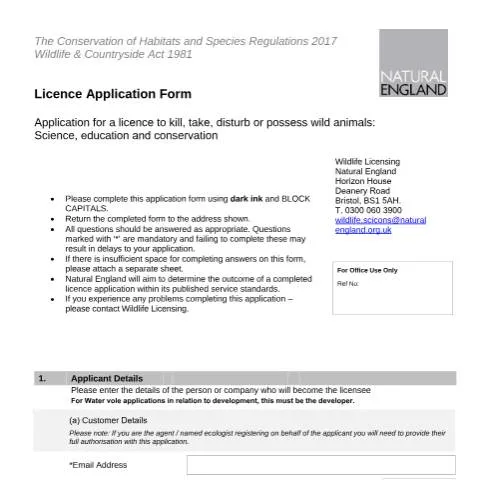
When Research Meets Conservation Law: Navigating Wildlife Licence Requirements
The boundary between scientific advancement and wildlife protection creates a complex regulatory landscape that researchers, educators, and conservationists must navigate with precision. Under the Conservation of Habitats and Species Regulations 2017 and the Wildlife and Countryside Act 1981, certain activities involving protected species require explicit authorisation from Natural England, regardless of their beneficial intent.
The A29 licence application represents a critical gateway for legitimate scientific work that would otherwise constitute illegal interference with protected wildlife. Whether you're conducting population surveys of great crested newts, educational demonstrations involving birds of prey, or conservation translocation of endangered species, this licence transforms potentially criminal activity into lawful research under strict regulatory oversight.
The Legal Framework Behind Protected Species Licensing
The regulatory structure governing wildlife licences stems from both domestic legislation and international obligations. The Conservation of Habitats and Species Regulations 2017 transpose European directives into UK law, creating a robust framework for species protection that continues post-Brexit under the retained EU law provisions.
Natural England operates within this framework as the statutory nature conservation body for England, wielding considerable discretion in licence determination. The organisation must balance competing interests: enabling legitimate scientific advancement whilst ensuring that protected species populations remain viable and undisturbed.
Scope of Protected Species Coverage
The licensing regime covers an extensive range of species across multiple taxonomic groups. European Protected Species include all bat species, great crested newts, sand lizards, smooth snakes, dormice, otters, and wildcats. Schedule 1 birds encompass rare breeding species and their dependent young, whilst Schedule 5 animals and Schedule 8 plants provide additional protection layers.
Understanding which species require licensing proves crucial before commencing any research activity. A field study involving apparently common species may inadvertently encounter protected individuals, particularly in biodiverse habitats where multiple protected species coexist.
Decoding the Application Structure: Section by Section Analysis
Applicant Details and Professional Credentials
The opening section demands comprehensive personal and professional information, extending beyond basic contact details to encompass professional memberships and organisational affiliations. Natural England scrutinises these credentials carefully, as they indicate the applicant's competence to undertake proposed activities safely and effectively.
For water vole applications relating to development, the form specifically requires developer details, recognising the distinct regulatory context where conservation licensing intersects with planning obligations. This provision reflects the reality that development-related wildlife work often involves different risk profiles and stakeholder interests compared to pure research activities.
The customer type classification—farmer, householder, ecologist—influences how Natural England assesses applications. Professional ecologists typically face more streamlined evaluation processes, whilst private individuals may require additional scrutiny regarding their competence and motivations.
Agent and Named Ecologist Provisions
The agent/named ecologist section acknowledges the complex professional relationships underpinning much wildlife work. Ecological consultancies often employ multiple staff members with varying levels of experience and licensing authority, necessitating clear designation of responsible individuals.
| Role | Responsibilities | Licensing Implications |
|---|---|---|
| Named Ecologist | Direct fieldwork supervision, species identification, method implementation | Must hold appropriate class licence or demonstrate equivalent competence |
| Agent | Application submission, correspondence handling, administrative coordination | No specific licensing requirements but must maintain detailed project knowledge |
| Alternative Contact | Backup communication channel during primary contact absence | Should understand project scope and licensing conditions |
When appointing agents or named ecologists, applicants must provide full authorisation documentation. This requirement prevents unauthorised individuals from making binding commitments regarding protected species activities.
Critical Timing Considerations and Seasonal Constraints
Protected species licensing operates within biological realities that cannot be circumvented through administrative processes. Natural England's published service standards indicate determination periods, but these represent minimum timeframes rather than guaranteed delivery schedules.
Species-Specific Temporal Windows
Many protected species exhibit pronounced seasonal behaviour patterns that fundamentally constrain when licensed activities can occur. Bat surveys require specific temperature and weather conditions during the active season (April to October), whilst great crested newt work must accommodate breeding cycles and terrestrial hibernation phases.
Bird protection legislation adds further complexity, with the nesting season (March to August for most species) creating extended periods when disturbance licences become essential for any potentially disruptive activities near protected breeding sites.
Application Processing Realities
Standard applications typically require 15 working days for determination, though complex proposals or incomplete submissions can extend this considerably. Natural England may request additional information, site visits, or stakeholder consultations, each adding weeks to the overall timeline.
Urgent applications receive expedited handling, but applicants must demonstrate genuine emergency circumstances rather than poor project planning. Development-related work rarely qualifies for urgent processing, as such projects should incorporate licensing requirements into their initial timelines.
Documentation Requirements and Evidence Standards
The licence application demands substantial supporting documentation beyond the completed form itself. Natural England requires evidence of professional competence, project necessity, and methodological soundness before granting authorisation.
Competence Demonstration
Applicants must prove their ability to identify target species accurately, implement proposed methods safely, and respond appropriately to unexpected situations. This evidence typically includes:
- Formal qualifications from recognised training providers
- Professional membership of bodies such as CIEEM (Chartered Institute of Ecology and Environmental Management)
- Previous licensing history demonstrating successful completion of similar projects
- Continuing professional development records showing current knowledge maintenance
Method Statements and Risk Assessments
Detailed method statements must describe proposed activities with sufficient precision to enable Natural England's assessment of potential impacts. Generic approaches prove inadequate; applicants must tailor their methods to specific site conditions, target species, and project objectives.
Risk assessments should address both species welfare and human safety considerations. Protected species work often occurs in challenging environments or involves potentially dangerous animals, requiring comprehensive hazard identification and mitigation planning.
Post-Application Processing and Licence Conditions
Successful applications result in licences containing detailed conditions that legally bind licence holders. These conditions typically specify permitted activities, temporal restrictions, reporting requirements, and emergency procedures.
Monitoring and Reporting Obligations
Most licences require detailed monitoring data collection and regular reporting to Natural England. These obligations serve multiple purposes: tracking cumulative impacts on protected populations, gathering data for future policy development, and ensuring licence holders remain accountable for their activities.
Reporting deadlines are typically inflexible, with late submissions potentially affecting future licence applications. Electronic submission systems facilitate data transfer, but applicants must ensure they understand reporting formats and requirements before commencing fieldwork.
Licence Modification and Renewal Processes
Changing circumstances during licensed activities may necessitate licence modifications. Natural England can authorise minor amendments through simplified procedures, whilst substantial changes require fresh applications with associated delays and costs.
Long-term projects often require licence renewals, with Natural England expecting evidence of adaptive management based on monitoring results from previous licence periods. Successful renewal applications demonstrate learning and improvement rather than mere repetition of previous approaches.
Common Pitfalls and Application Weaknesses
Natural England regularly encounters recurring deficiencies in licence applications that delay determination or result in refusal. Understanding these common issues enables applicants to avoid predictable obstacles.
Insufficient Justification for Proposed Activities
Applications must demonstrate clear imperative reasons of overriding public interest for activities affecting European Protected Species. Vague statements about "scientific interest" or "educational value" prove inadequate without specific objectives and expected outcomes.
Conservation projects require evidence of favourable conservation status maintenance or enhancement. Natural England expects detailed population assessments and impact predictions, supported by peer-reviewed methodologies where available.
Inadequate Alternative Assessment
Legislation requires consideration of alternatives before authorising protected species interference. Applications must demonstrate that no satisfactory alternative exists to achieve legitimate objectives without protected species impacts.
This assessment should encompass alternative locations, methodologies, and timing options. Superficial consideration of alternatives frequently leads to application refusal or requests for additional information.
Enforcement Consequences and Compliance Monitoring
Operating without appropriate licences or breaching licence conditions constitutes criminal offences under wildlife protection legislation. Natural England maintains enforcement capabilities including site inspections, prosecution powers, and licence revocation authority.
Penalties for wildlife offences can include substantial fines, imprisonment, and professional disqualification. Beyond legal consequences, conviction for wildlife crimes can permanently damage professional reputations and exclude individuals from future licensing eligibility.
Compliance Monitoring Systems
Natural England employs various monitoring approaches to ensure licence compliance. These range from routine report analysis to unannounced site visits and stakeholder notifications. Modern technology increasingly supports remote monitoring through GPS tracking, camera surveillance, and digital reporting platforms.
Licence holders should maintain comprehensive records of all activities, even those seemingly peripheral to licensed work. Detailed documentation provides essential evidence during compliance investigations and demonstrates professional competence during future applications.
The A29 application process, whilst demanding, serves essential conservation purposes by ensuring that legitimate scientific, educational, and conservation activities proceed within appropriate regulatory frameworks. Success requires thorough preparation, professional competence, and genuine commitment to protected species welfare alongside research objectives.
Licence Conditions and Compliance Framework
Natural England imposes specific conditions on A29 licences that licensees must understand thoroughly before commencing any activities. These conditions typically fall into several categories: site-specific restrictions, temporal limitations, monitoring requirements, and reporting obligations.
Site access conditions often require prior landowner consent, even when the licence itself has been granted. For instance, if your research involves studying great crested newts in a private woodland, you'll need both the A29 licence and written permission from the landowner. Some licences restrict activities to specific grid references or designated areas within a broader site, particularly in Areas of Outstanding Natural Beauty or Sites of Special Scientific Interest (SSSIs).
Temporal restrictions frequently align with species' breeding cycles or seasonal sensitivities. Bat survey licences typically prohibit roost inspections during hibernation periods (November to March for most species), whilst bird ringing licences may exclude activities during peak breeding seasons unless specifically justified. These timeframes can vary significantly between species and geographical regions within England.
Monitoring conditions require detailed record-keeping of all licensed activities. This includes GPS coordinates of capture locations, environmental conditions during surveys, individual animal measurements or markings applied, and any adverse incidents. Some licences mandate the use of specific data recording formats or submission to national databases such as the Bat Conservation Trust's National Bat Monitoring Programme.
Educational licences often include additional safeguarding requirements when working with young people. These may specify minimum instructor-to-participant ratios, mandatory risk assessments for each session, or requirements for enhanced DBS checks for all supervising staff. University-based licences frequently require oversight by named academic supervisors who must also hold appropriate qualifications.
Breach of licence conditions constitutes a criminal offence under the Wildlife and Countryside Act 1981, with potential penalties including unlimited fines and up to six months' imprisonment. Natural England takes compliance seriously and conducts both scheduled and unannounced inspections, particularly for licences involving highly protected species or sensitive sites.
Species-Specific Application Considerations
Different protected species groups require distinctly different approaches when completing Form A29, reflecting their varying conservation statuses, legal protections, and ecological sensitivities. Understanding these nuances significantly improves application success rates and demonstrates professional competence to Natural England assessors.
For European protected species such as bats, great crested newts, and dormice, applications must demonstrate 'favourable conservation status' will be maintained. This requires detailed population assessments, habitat quality evaluations, and mitigation strategies where disturbance is unavoidable. Bat licence applications particularly benefit from acoustic survey data, roost characterisation studies, and detailed methodology descriptions for handling procedures. Common pipistrelle licences are generally more straightforward than those for rarer species like Bechstein's bats or barbastelles.
Schedule 1 bird species applications demand exceptional justification due to their elevated protection status. Species like bitterns, golden eagles, or stone curlews require evidence that conventional survey methods are inadequate and that the proposed research addresses significant conservation knowledge gaps. Ringing applications must demonstrate familiarity with British Trust for Ornithology protocols and often require endorsement from relevant species specialist groups.
Marine species licences, covering seals, dolphins, and marine turtles, involve additional complexity due to overlapping jurisdictions with Marine Management Organisation responsibilities. These applications often require coordination with local Wildlife Trust marine teams and consideration of seasonal fishing restrictions or shipping lane impacts.
Invertebrate licences, whilst less commonly required, present unique challenges due to limited baseline knowledge for many species. Applications involving rare beetles, butterflies, or moths must often include detailed habitat surveys and may require collaboration with specialist recording schemes or natural history societies. The Biological Records Centre provides valuable guidance for invertebrate survey protocols.
Plant species licences require botanical expertise and often involve complex taxonomic considerations. Applications for rare orchids, ferns, or bryophytes must demonstrate appropriate identification skills and understanding of population dynamics. Some plant licences require specific timing to coincide with flowering periods or spore release cycles.
Regional Variations and Local Considerations
England's diverse landscapes and regional conservation priorities create significant variations in licence requirements and processing approaches. Natural England's area teams possess detailed local knowledge that influences application assessment, making early consultation particularly valuable.
Upland regions, including the Peak District, Lake District, and Yorkshire Dales, often involve additional considerations around grazing management, public access rights, and traditional land uses. Applications in these areas may require consultation with National Park authorities, commoners' associations, or local farming communities. Moorland species like red grouse, curlew, or mountain hares may have specific restrictions related to shooting seasons or agricultural practices.
Coastal applications face unique challenges from tidal access restrictions, coastal erosion, and seasonal tourist pressures. Seabird colonies, saltmarsh vegetation, or marine mammal studies require careful timing around breeding seasons and weather windows. Some coastal sites have restricted access during military training exercises or due to unexploded ordnance risks, particularly along the South Coast.
Urban and peri-urban applications increasingly common as wildlife adapts to developed landscapes. These licences often involve complex stakeholder management, including local authorities, developers, residents' groups, and utility companies. Urban bat roost surveys may require coordination with building maintenance schedules, whilst urban bird studies might need consideration of noise pollution impacts on survey methodology.
Ancient woodland and old-growth forest sites receive particular scrutiny due to their irreplaceable nature. Applications involving these habitats must demonstrate minimal impact protocols and often require longer-term monitoring commitments. Some sites may have seasonal access restrictions to protect vulnerable soils during wet periods or to avoid disturbance during critical wildlife periods.
Former industrial sites, including brownfield land, quarries, and coastal installations, present opportunities for studying species that have colonised these novel habitats. However, applications may require additional health and safety considerations, contaminated land assessments, or liaison with site remediation programmes.