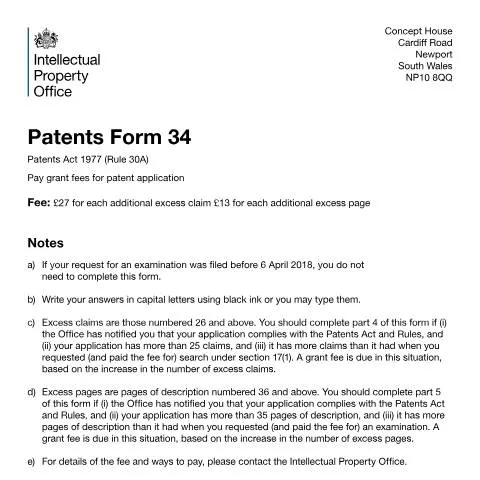
When Patent Grant Fees Come Due: Understanding Form PF34
The moment your patent application receives that crucial notification from the Intellectual Property Office stating it complies with the Patents Act and Rules, you might assume the financial obligations are behind you. Not necessarily. For applications with more than 25 claims or more than 35 pages of description, additional fees may still be lurking—particularly if your application has grown since your initial search or examination request. Form PF34 exists specifically to collect these grant fees, which apply only when your application has expanded beyond its original scope during the prosecution process.
This isn't about penalising successful applicants, but rather ensuring fair cost distribution. The logic is straightforward: if your patent application has become more substantial since you initially paid for search or examination services, the additional work required by IPO examiners justifies supplementary fees. These charges—£27 per additional excess claim and £13 per additional excess page—reflect the extra scrutiny your expanded application demands.
The Critical Timeline: Pre-2018 Applications and Modern Requirements
A fundamental distinction shapes who must use Form PF34: the date when examination was originally requested. Applications where examination was sought before 6 April 2018 are entirely exempt from these grant fees, regardless of how many claims or pages they eventually contain. This cut-off date reflects changes in IPO fee structures and represents a grandfathering provision for applications already in the system.
For post-2018 applications, the timeline becomes more nuanced. The form only becomes relevant at a specific moment in the patent prosecution process: when the IPO has completed its examination and formally notified you that your application meets all statutory requirements. This notification triggers a window during which you must assess whether grant fees are due and, if so, submit Form PF34 promptly.
The comparison point for calculating these fees isn't your current application state versus some arbitrary threshold, but rather the difference between your application now versus when you initially requested search under section 17(1) or examination services. This temporal comparison is crucial because it means applications that started large aren't penalised—only those that grew during prosecution face additional charges.
Excess Claims: Counting Beyond the Standard Allowance
Patent applications receive an allowance of 25 claims before excess fees apply. However, Form PF34 doesn't simply count your total claims—it focuses on the increase in excess claims since your original search request. This distinction matters enormously for calculating the correct fee.
Consider a practical scenario: your original application contained 30 claims when you requested search under section 17(1). At that time, you paid excess claim fees for 5 claims (numbers 26-30). During prosecution, responding to examiner objections and refining your invention's scope, your application now contains 40 claims. The calculation for Form PF34 isn't based on all 15 excess claims (26-40), but only on the 10 additional excess claims beyond what you originally had.
This approach prevents double-charging while ensuring that expanded applications contribute fairly to examination costs. Claims numbered 26 and above are considered "excess claims" for fee purposes, but the grant fee applies only to the numerical increase since your initial search request.
| Scenario | Original Claims | Current Claims | Additional Excess Claims | Grant Fee Due |
|---|---|---|---|---|
| No increase | 30 | 30 | 0 | £0 |
| Moderate expansion | 20 | 35 | 10 | £270 |
| Significant growth | 25 | 50 | 25 | £675 |
| Reduction case | 40 | 30 | 0 | £0 |
Description Pages: When Detailed Explanations Carry Costs
The 35-page allowance for patent descriptions follows similar logic to claim counting, but with its own distinct calculation method. Pages of description numbered 36 and above trigger excess fees, but again, Form PF34 only addresses increases since your original examination request—not the total number of excess pages.
This distinction proves particularly relevant for complex technical inventions where applicants often need to expand their descriptions during prosecution. Perhaps the examiner required additional technical details, or you needed to incorporate material from continuation applications. The description might grow from 40 pages at examination request to 60 pages at grant, representing a 20-page increase in the excess category, resulting in £260 in additional fees.
Unlike claims, which can be renumbered and restructured relatively easily, description pages represent more fundamental content additions. When calculating excess pages, count only the actual description content—not claims, abstract, or drawings. The IPO's numbering system typically places description pages sequentially, making the count straightforward, but applicants should verify their page numbering aligns with IPO conventions.
Strategic Considerations for Page Management
Experienced patent attorneys often advise clients about description length early in the process, knowing that substantial additions later will trigger grant fees. However, the balance between comprehensive disclosure and fee management shouldn't compromise patent strength. A robust description that adequately supports your claims remains more valuable than modest fee savings achieved through inadequate disclosure.
Multiple Payment Channels: Choosing Your Preferred Method
Form PF34 accommodates various payment preferences, each with distinct advantages and processing implications. The IPO's secure online payment system offers immediate confirmation and faster processing, providing a 10-character reference code that serves as payment proof. This digital approach eliminates postal delays and reduces administrative errors.
For applicants with established IPO deposit accounts, direct deduction provides seamless payment without manual intervention. This method particularly benefits patent attorneys and corporate filers managing multiple applications, as it streamlines the payment process and provides automatic record-keeping through account statements.
Traditional payment methods remain available for those preferring them. Cheques should be made payable to 'Intellectual Property Office' and typically take longer to process than electronic payments. Bank transfers require specific reference information—ideally your IPO deposit account number, though application numbers or names suffice for identification purposes.
Payment Timing and Processing Considerations
The IPO emphasises that paper forms submitted by post experience longer processing times than electronic submissions. Given that patent prosecution often operates on tight deadlines, the speed advantage of email submission to [email protected] becomes significant. However, ensure your PDF is properly completed and legible before submission, as unclear forms may require resubmission, negating the speed advantage.
Completing Form PF34: Essential Details and Common Oversights
Form PF34's structure reflects the IPO's emphasis on clear, black-ink completion using capital letters. While typing is permitted, handwritten forms must meet specific legibility standards to avoid processing delays. The application number field proves critical—errors here can misdirect your payment and delay grant procedures.
Part 4 of the form addresses excess claims calculations, requiring careful attention to the increase since your original search request rather than total excess claims. Similarly, Part 5 handles excess pages based on increases since examination request. These calculations demand precision because incorrect figures can result in underpayment, triggering additional correspondence, or overpayment, requiring refund processing.
The authorisation section requires both a tick and date, confirming your authority to submit the form. This seemingly minor detail carries legal weight, as unauthorised submissions can invalidate the filing. For patent attorneys or agents, this section confirms their continued authority to act on behalf of the applicant.
Contact details prove essential for IPO queries about your submission. Providing both telephone and email ensures multiple communication channels, reducing potential delays if clarification becomes necessary. The IPO's helpline (0300 300 2000) offers assistance with form completion, though peak periods may involve waiting times.
Integration with Patent Prosecution Strategy
Form PF34 represents more than administrative compliance—it reflects strategic decisions made throughout patent prosecution. Applications that expand significantly during examination often indicate thorough prosecution, where applicants and examiners work together to clarify invention scope and ensure adequate protection.
The fee structure encourages applicants to consider their final application scope early in the process. While you shouldn't limit legitimate claim scope to avoid fees, understanding the cost implications of major expansions helps inform prosecution strategy. Some applicants prefer filing continuation applications rather than extensively amending existing applications, partly to manage fee implications.
Corporate vs Individual Considerations
Large corporations with extensive patent portfolios often integrate Form PF34 submissions into broader intellectual property management systems. The relatively modest fees (£27 per excess claim, £13 per excess page) rarely influence their strategic decisions, but the administrative burden of multiple submissions requires systematic handling.
Individual inventors and smaller entities may find these fees more significant, particularly for applications that have grown substantially during prosecution. However, the fees remain modest compared to overall patent prosecution costs, and robust patent protection typically justifies the investment.
Post-Submission Procedures and Patent Grant
Once Form PF34 is submitted with appropriate payment, the IPO processes your grant fee payment alongside final patent grant procedures. Successful payment clears the final administrative hurdle before patent grant, triggering the preparation of your patent certificate and official publication.
Payment confirmation typically arrives within days for electronic submissions, though postal submissions may take longer. The IPO's systems automatically link your payment to your application number, updating internal records and triggering the next stage of grant processing.
If payment issues arise—insufficient funds in deposit accounts, unclear bank transfer references, or incorrect fee calculations—the IPO contacts applicants using the details provided on Form PF34. Quick resolution of such issues prevents grant delays, emphasising the importance of accurate contact information and prompt response to IPO correspondence.
The completion of Form PF34 procedures marks a significant milestone in patent prosecution. With examination complete, compliance confirmed, and grant fees paid, your application moves into the final administrative stages before becoming a granted patent. This transition represents the culmination of months or years of prosecution effort, with Form PF34 serving as the final administrative step before receiving your patent rights.
Fee Reduction and Exemption Schemes
The Intellectual Property Office operates several fee reduction schemes designed to make patent protection more accessible to qualifying applicants. Understanding these schemes can significantly reduce your overall patent costs, particularly for small entities, educational institutions, and individual inventors.
Small Entity Status
Small entities benefit from substantial fee reductions across most patent application stages. To qualify as a small entity, you must meet specific criteria regarding employee numbers and annual turnover. The IPO defines a small entity as having fewer than 25 employees and an annual turnover not exceeding £6.5 million, or a balance sheet total not exceeding £5 million.
Small entity discounts typically reduce fees by 75% for most application procedures. For instance, whilst a large entity pays the full examination fee, small entities pay only a quarter of this amount. This reduction applies to filing fees, search fees, examination fees, and most post-grant maintenance fees during the patent's lifetime.
Documentation requirements for small entity status include completing Form 9A alongside your application. You must provide evidence of your qualifying status, such as recent accounts or a statutory declaration confirming employee numbers and financial thresholds. The IPO may request additional verification documents, particularly for companies approaching the size thresholds.
Micro Entity Provisions
Micro entities receive even more generous fee reductions, paying just 25% of small entity fees in many cases. Qualification requires meeting stricter criteria: fewer than 10 employees and either an annual turnover or balance sheet total not exceeding £2 million.
Individual inventors often qualify automatically for micro entity status, provided they haven't assigned rights to a larger organisation. This status proves particularly valuable for independent inventors and very small startups developing innovative technologies without substantial commercial backing.
The micro entity declaration process involves Form 9B submission with supporting documentation. Unlike small entity status, micro entity qualification requires annual confirmation for renewal fees, ensuring continued eligibility throughout the patent's term.
Educational Institution Concessions
Universities, colleges, and recognised educational institutions benefit from specific fee structures designed to encourage academic research and innovation. These institutions often qualify for small entity rates regardless of their actual size, recognising their non-commercial research focus.
Student inventors working on university projects may access institutional fee arrangements, though ownership and filing responsibilities typically rest with the educational institution rather than individual students. Joint university-industry projects require careful consideration of entity status, as commercial partnerships may affect eligibility for reduced fees.
Research councils and publicly funded institutions often qualify for preferential treatment, though specific arrangements vary depending on the funding source and institutional structure. The IPO maintains updated guidance for different types of educational and research organisations.
International Filing Strategies and Cost Implications
Patent protection often extends beyond UK borders, requiring strategic planning for international applications. The Patent Cooperation Treaty (PCT) route and direct national filings each present distinct cost structures and timing considerations that significantly impact your overall budget planning.
PCT Application Route
Filing a PCT application through the IPO as receiving office involves specific fee structures combining international and national elements. The international filing fee, currently set by the World Intellectual Property Organization, must be paid in addition to transmittal and search fees to the IPO.
UK applicants benefit from reduced international fees when using the IPO as receiving office, compared to filing directly with WIPO. The IPO transmittal fee covers administrative processing and forwarding to the International Bureau. Additionally, if you request the IPO to conduct the international search, search fees apply according to current IPO rates.
Priority document fees become relevant when claiming priority from an earlier UK application. The IPO charges for preparing and transmitting priority documents to international authorities, with costs varying depending on document preparation requirements and transmission methods.
PCT national phase entry into the UK requires separate fee payments 31 months after the priority date. These fees include translation costs if your PCT application wasn't filed in English, plus standard UK national phase processing fees. Planning these costs early helps avoid cash flow problems during the critical national phase deadline period.
European Patent Office Coordination
Many UK applicants simultaneously pursue European patent protection through the European Patent Office. While Brexit has affected some procedural aspects, the fundamental relationship between UK and European applications remains significant for cost planning.
Designation fees for the UK within European applications continue applying during the transitional period, though post-grant validation procedures have evolved. Understanding these changes helps determine whether separate UK filing or European designation offers better value for your specific circumstances.
Translation requirements for European patents validated in the UK can substantially increase costs. Professional translation fees for technical patent documents often exceed the basic official fees, particularly for complex inventions requiring precise technical terminology.
Direct National Filing Considerations
Direct filing in multiple countries requires coordinating various national fee structures and deadlines. Each jurisdiction maintains distinct fee schedules, payment methods, and timing requirements that affect your international strategy.
Currency fluctuations can significantly impact international filing costs, particularly for applicants planning multi-jurisdictional protection. Some applicants hedge currency risks or time their filings to minimise exchange rate impacts, though patent deadlines ultimately dictate timing constraints.
Professional representation requirements vary between jurisdictions, with some countries mandating local attorney involvement. These representation costs often exceed official fees, making professional budget planning essential for international applications.
Post-Grant Fee Management and Renewal Strategies
Patent maintenance extends far beyond initial application fees, with renewal fees representing the largest long-term cost component. Strategic renewal management helps optimise patent portfolios while controlling ongoing expenses throughout the patent term.
Annual Renewal Fee Structure
UK patents require annual renewal fees from the fifth year onwards, with fees increasing progressively throughout the patent term. The fee structure encourages early decisions about patent value, as later years become significantly more expensive to maintain.
Renewal fees follow a stepped progression, with modest increases in early years accelerating substantially in later periods. Years 5-10 remain relatively affordable, whilst years 15-20 require careful commercial justification given the substantially higher costs involved.
Payment timing allows some flexibility, with a six-month grace period available after each renewal date. However, late payments incur additional fees, making timely payment planning financially advantageous. The IPO sends renewal reminders, but ultimate responsibility for timely payment remains with the patent proprietor.
Portfolio Rationalisation Strategies
Commercial patent portfolios benefit from regular review processes to identify patents suitable for abandonment. Not all patents justify renewal costs throughout their full term, particularly where market conditions or technology developments have reduced commercial value.
Technology lifecycle considerations influence renewal decisions, with patents covering rapidly evolving technologies often becoming obsolete before their natural expiry. Conversely, patents covering fundamental technologies may justify renewal throughout their full term despite increasing costs.
Licensing revenue streams can justify renewal costs even where direct commercialisation has ceased. Patents generating licensing income often warrant maintenance provided renewal costs remain below licensing returns, though market analysis should inform these decisions.
Corporate Restructuring Implications
Company mergers, acquisitions, and restructuring events affect patent ownership and fee payment responsibilities. Proper documentation of ownership transfers ensures continued fee payment obligations are clearly understood and managed.
Multiple entity ownership requires careful coordination of renewal responsibilities, particularly where patents are jointly owned or subject to complex licensing arrangements. Clear agreements regarding fee payment obligations help avoid inadvertent lapses due to coordination failures.
Insolvency procedures create particular challenges for patent maintenance, as administrators may need to evaluate patent assets and decide whether renewal fees represent appropriate use of limited resources. Early engagement with administrators helps preserve valuable patent rights during corporate restructuring.