Understanding the Patent Application Fee: When the Initial Payment Gets Overlooked
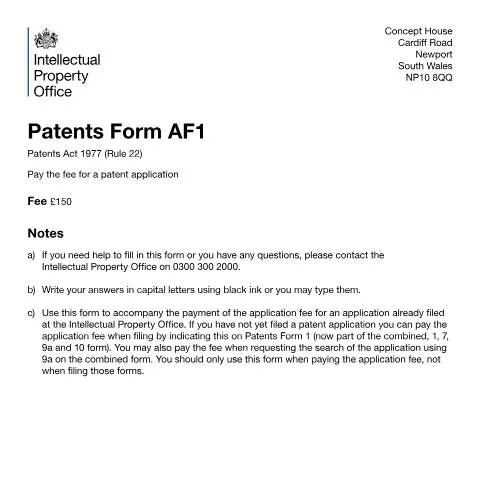
Patent applications in the UK follow a structured timeline where applicants must navigate various fees at different stages. The Patents Form AF1 emerges as a crucial document when the initial application fee of £150 hasn't been paid during the original filing process. This scenario occurs more frequently than many inventors realise, particularly when applicants focus intensely on preparing their technical documentation whilst overlooking the payment mechanics.
Under the Patents Act 1977, specifically Rule 22, the Intellectual Property Office requires this fee to secure your application's processing status. Without it, even the most innovative invention remains in administrative limbo. The AF1 form serves as your financial lifeline, allowing you to rectify this oversight and maintain your filing date priority—a critical advantage in the competitive world of intellectual property.
This payment mechanism becomes essential when applicants initially submit their patent application using the combined Forms 1, 7, 9a, and 10 without completing the payment section, or when they've filed a basic application intending to pay fees separately. The Intellectual Property Office's system accommodates this flexibility, recognising that inventors often work under tight deadlines or may need to secure funding approval before committing to application fees.
Navigating the Two-Stage Payment Architecture
The UK patent system operates on a bifurcated payment structure that can initially confuse applicants familiar with other jurisdictions. When filing a patent application, you encounter two primary fee payment opportunities: during the initial filing process or as a subsequent standalone transaction using Form AF1.
The integrated approach allows payment when submitting the combined patent forms, where applicants can indicate their intention to pay the application fee directly on Patents Form 1. This streamlined method suits inventors who have their financial arrangements prepared and prefer completing all administrative requirements simultaneously.
However, the standalone AF1 route serves distinct scenarios. Research institutions often need internal approval processes before releasing funds, whilst individual inventors may require time to secure financing. Small businesses frequently need to coordinate payment timing with their cash flow cycles. The AF1 form accommodates these practical realities without jeopardising the application's legal standing.
| Payment Timing | Form Used | Typical Applicant Profile | Key Advantage |
|---|---|---|---|
| During filing | Combined Forms 1, 7, 9a, 10 | Established companies, well-funded inventors | Single transaction completion |
| Post-filing | Form AF1 | Research institutions, cash-constrained inventors | Flexible timing, maintained priority date |
| With search request | Form 9a (combined) | Strategic filers seeking preliminary assessment | Coordinated fee payment timing |
Applicant Categories and Their Distinct Requirements
Form AF1 serves diverse applicant profiles, each presenting unique administrative considerations. Individual inventors represent the largest user category, often filing personally without legal representation. These applicants must provide their full name, complete address including postcode, and confirm their authorisation to submit the form—a seemingly straightforward requirement that nonetheless requires careful attention to ensure the Intellectual Property Office can match the payment to the correct application.
Corporate applicants face additional complexity when multiple entities hold joint ownership or when subsidiaries file on behalf of parent companies. The form accommodates multiple applicants through its comprehensive name and address section, but requires precise identification matching the original application details. Any discrepancies between the AF1 applicant information and the original filing can trigger administrative queries, potentially delaying processing.
International applicants encounter specific challenges with the AF1 form, particularly regarding address formatting and payment methods. The Intellectual Property Office expects UK postal conventions, including proper postcode formatting, whilst payment options may be limited for overseas bank accounts. The SWIFT code and IBAN details provided facilitate international bank transfers, though applicants should verify their bank's compatibility with these routing specifications.
Research institutions and universities often operate through technology transfer offices, creating a layer of administrative complexity. The person completing Form AF1 may differ from the named inventors, requiring careful completion of the contact details section to ensure correspondence reaches the appropriate administrative handler rather than the technical inventor who may have limited involvement in patent prosecution matters.
Mastering the Payment Methods: Strategic Considerations Beyond Convenience
Form AF1 presents four distinct payment pathways, each carrying operational implications that extend beyond mere convenience. The online card payment system through the IPO's secure website offers immediate processing confirmation via a 10-character reference code that applicants must transcribe onto the form. This method provides the fastest processing turnaround whilst creating an electronic audit trail that simplifies record-keeping for both applicants and the Intellectual Property Office.
The IPO deposit account option serves frequent filers who maintain ongoing relationships with the patent office. This prepaid account system eliminates individual transaction processing delays whilst providing preferential administrative handling. Deposit accounts particularly benefit patent attorneys, corporate IP departments, and research institutions managing multiple applications simultaneously. Account holders simply reference their deposit account number, triggering automatic deduction without additional payment processing requirements.
Cheque payments, whilst traditional, introduce processing delays that can extend overall application timelines. The Intellectual Property Office requires cheques payable to 'Intellectual Property Office' with proper crossing and signature verification. International applicants should note that foreign cheques may incur additional processing fees and extended clearing periods that could impact application deadlines.
Bank transfer considerations: The provided SWIFT code BARCGB22 and IBAN GB92 BARC 2018 2380 5317 66 facilitate international transfers, but applicants must include proper reference information—either their IPO deposit account number, application number, or full name—to ensure payment attribution. Incomplete references can result in unallocated payments requiring manual intervention to resolve.
Critical Timing Windows and Administrative Deadlines
The Patents Act 1977 establishes specific timeframes within which application fees must be paid to maintain patent rights. Form AF1 becomes particularly crucial when applicants approach these deadlines, as late payment can result in application abandonment regardless of the invention's merit. The Intellectual Property Office operates on strict administrative schedules that don't accommodate delays caused by payment processing issues.
Patent applications filed without immediate fee payment typically receive a compliance notice specifying the deadline for fee submission. This period generally allows two months from the filing date to submit the application fee, though extensions may be available under specific circumstances. Applicants using Form AF1 must ensure their payment reaches the Intellectual Property Office before this deadline expires.
The choice of payment method significantly impacts timing considerations. Online card payments provide immediate confirmation, making them suitable for last-minute submissions. Bank transfers, particularly international ones, may require 3-5 business days for processing and should be initiated well before deadlines. Postal submissions add additional transit time that applicants must factor into their timeline calculations.
Weekend and holiday considerations affect processing schedules, particularly for postal submissions and bank transfers. The Intellectual Property Office's Newport facility operates on standard UK business hours, meaning Friday afternoon submissions may not receive processing until the following Monday. International applicants should account for time zone differences when calculating submission deadlines.
Emergency Payment Scenarios
Urgent situations occasionally arise where patent applications face imminent abandonment due to unpaid fees. Form AF1 accommodates emergency payments through its online card payment system, which processes immediately during business hours. However, applicants should contact the Intellectual Property Office directly at 0300 300 2000 when facing critical deadlines to confirm receipt and processing status.
Documentation Requirements and Record-Keeping Protocols
Form AF1 demands specific documentation standards that ensure proper processing and legal compliance. The patent application number field requires exact transcription from the original filing acknowledgment, as any discrepancy can prevent payment allocation to the correct application. This number follows the IPO's standardised format and serves as the primary identifier linking the payment to the specific patent file.
The applicant information section must mirror the details provided in the original patent application exactly. Name variations, abbreviated addresses, or formatting differences can trigger administrative queries requiring clarification. Corporate applicants should ensure the company name appears precisely as registered, including any legal designations such as 'Limited' or 'plc' that may affect legal standing.
Personal reference numbers, whilst optional, provide valuable tracking capabilities for applicants managing multiple patents. Law firms typically use client matter numbers, whilst corporations may employ internal project codes. These references appear on IPO correspondence, facilitating internal administration and billing allocation.
The authorisation confirmation section requires both signature and dating, establishing legal responsibility for the submission. This element carries particular importance for corporate applicants where multiple individuals may have authority to commit company resources. The date field should reflect the actual completion date rather than any backdated or future date.
Contact Information Strategy
The contact details section serves dual purposes: immediate query resolution and ongoing correspondence management. Applicants should provide contact information for the person most qualified to address administrative questions rather than necessarily the technical inventor. Email addresses ensure rapid communication, whilst telephone numbers enable urgent clarification when deadlines approach.
Post-Submission Procedures and Response Management
Once submitted, Form AF1 enters the Intellectual Property Office's processing workflow, typically generating acknowledgment within 5-10 business days for postal submissions or immediately for online payments. The IPO's system automatically matches payments to applications using the provided application number and applicant details, updating the patent file status accordingly.
Successful processing triggers several administrative actions: the application advances to examination status, official correspondence resumes, and any compliance deadlines related to unpaid fees are satisfied. Applicants receive confirmation through their designated correspondence address, including updated patent file status and next procedural steps.
Processing complications can arise when payment details don't match application records exactly. Common issues include name spelling variations, address formatting differences, or incorrect application numbers. The Intellectual Property Office's examination staff typically contact applicants directly to resolve these discrepancies, but resolution delays can impact overall application timelines.
Payment allocation failures represent the most serious post-submission complication. When the IPO cannot match a payment to a specific application, funds may be held in a suspense account whilst staff attempt manual reconciliation. Applicants should respond promptly to any IPO queries requesting clarification, as prolonged resolution delays can jeopardise application status.
Tracking and Verification Procedures
The IPO's online patent information system reflects payment status updates, allowing applicants to verify successful processing. Account holders can access detailed transaction histories, whilst public searches show basic application status changes. This transparency enables applicants to confirm their AF1 submission has achieved its intended result without requiring direct IPO contact.
Integration with Broader Patent Prosecution Strategy
Form AF1 represents just one element within the comprehensive patent prosecution timeline that extends from initial filing through potential grant and maintenance. Understanding its position within this broader sequence helps applicants coordinate their intellectual property strategy effectively whilst managing associated costs and deadlines.
The application fee paid through AF1 secures the foundational right to patent examination but doesn't cover subsequent fees such as search fees, examination fees, or grant fees. Strategic applicants often coordinate AF1 submission with their search fee payment using Form 9a, streamlining administrative handling whilst maintaining cash flow control.
Patent portfolio management becomes particularly complex for applicants filing multiple related applications or pursuing international protection through the Patent Cooperation Treaty route. Form AF1's payment timing can affect priority date preservation and coordinate with international filing deadlines under the Paris Convention's 12-month priority period.
The financial implications extend beyond the immediate £150 application fee to encompass the total cost of patent prosecution, which can reach several thousand pounds through grant. Applicants should view AF1 as their initial financial commitment within a larger investment strategy that includes professional fees, official fees, and potential maintenance costs over the patent's 20-year maximum term.
Data privacy considerations under the Data Protection Act 2018 and UK GDPR govern how the Intellectual Property Office processes personal information submitted through Form AF1. Applicants retain rights regarding their personal data whilst the IPO maintains administrative records necessary for patent prosecution. The privacy notice referenced in the form provides comprehensive details about data handling procedures and applicant rights.