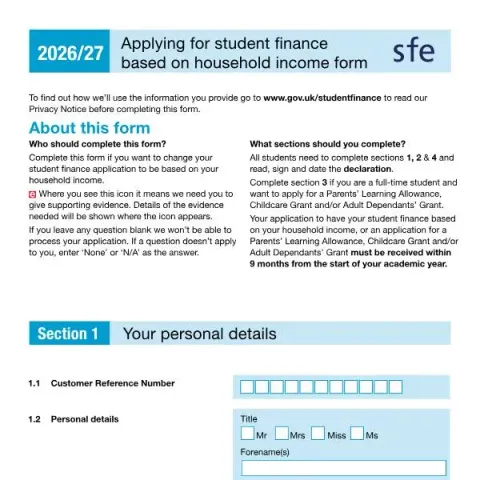
The Household Income Assessment Transformation for Part-Time Students
Part-time students in England face a pivotal decision during their academic journey: whether to shift from an income-independent financial assessment to one that considers their household circumstances. This transition, formalised through the Student Loans Company's household income form, represents more than a simple administrative change—it can fundamentally alter the level of financial support available throughout their studies.
The Applying for student finance based on household income form serves as the gateway for students who initially applied without declaring family financial circumstances but later recognise that household-based assessment might yield more favourable funding outcomes. This strategic pivot often occurs when students discover that their personal income alone may not reflect their genuine financial need, particularly in situations involving dependent children, low-earning partners, or complex family arrangements.
Understanding when and how to deploy this form requires careful consideration of timing, eligibility criteria, and the specific grants that become accessible through household income assessment. The Student Loans Company processes these applications within strict timeframes, making the timing of submission as crucial as the accuracy of the information provided.
Navigating the Eligibility Landscape: Who Benefits from Household Assessment
The decision to switch to household income assessment isn't suitable for every part-time student. The form specifically targets students whose financial circumstances suggest that family-based evaluation would be more advantageous than individual assessment. This typically applies to students with dependent children, those supporting adult dependants, or individuals whose personal income doesn't accurately reflect their household's financial capacity to contribute to educational costs.
Students already in receipt of means-tested benefits often find household assessment beneficial, as their personal income may appear minimal on paper whilst their actual financial responsibilities remain substantial. Similarly, students whose partners have fluctuating or seasonal income patterns may discover that household assessment provides a more stable foundation for financial planning throughout their academic year.
| Student Profile | Household Assessment Benefits | Key Considerations |
|---|---|---|
| Parents with dependent children | Access to Childcare Grant and Parents' Learning Allowance | Must provide Child Benefit evidence for all children |
| Students supporting adult dependants | Adult Dependants' Grant eligibility | Dependant must meet specific income thresholds |
| Low personal income with working partner | Combined household assessment may reduce expected contribution | Partner's income will be fully assessed |
| Students with unearned income sources | More comprehensive financial picture considered | All investment and property income must be declared |
The form accommodates various family structures, recognising that modern households don't always conform to traditional models. Students in civil partnerships, those with shared custody arrangements, or individuals supporting elderly relatives can all benefit from household assessment, provided they meet the specific criteria outlined in the application guidance.
Decoding the Financial Information Requirements
Section 2 of the form demands comprehensive disclosure of the student's financial circumstances, extending far beyond basic employment income. The unearned income section requires careful attention, as many students underestimate the breadth of income sources that must be declared. This includes bank interest, rental income from property, dividends from investments, and any sponsorship arrangements related to their studies.
The distinction between taxable and non-taxable income proves crucial for accurate completion. Students must exclude certain payments that might initially appear relevant, such as ISA returns, armed forces reservist bounties, and importantly, any existing maintenance loan or grant payments they're already receiving. This exclusion prevents double-counting of student finance within the assessment process.
For students with dependent children, the form requires detailed financial information about each child's circumstances. This includes not only their personal income from employment or investments but also evidence of Child Benefit, Child Tax Credit, or Universal Credit child elements. The Student Loans Company uses this information to calculate the actual financial burden each child represents, rather than applying standard assumptions about dependency costs.
Employment-related questions delve into the relationship between work and study, particularly where employers provide study leave or contribute to educational costs. Students whose employers release them for academic activities must declare any payments received during study periods, as these can affect the overall assessment of financial need. Similarly, pension contributions made by either the student or their employer during the academic year must be disclosed, as these represent additional financial resources that could theoretically be redirected toward educational expenses.
The Specialised Grants Gateway: Section 3 Decoded
Full-time students completing this form gain access to a range of specialised financial support mechanisms through Section 3, which covers Parents' Learning Allowance, Childcare Grant, and Adult Dependants' Grant. Each grant serves distinct purposes and carries specific eligibility criteria that extend beyond simple household income thresholds.
The Childcare Grant represents one of the most valuable yet complex elements of student financial support. Students cannot simultaneously claim Childcare Grant alongside other government childcare support mechanisms, including the childcare element of Working Tax Credit or Universal Credit, Tax-Free Childcare from HMRC, or NHS Childcare Allowance. This exclusivity rule means students must carefully evaluate which support mechanism provides the greatest benefit before applying.
For students under 25 living with a partner, additional income disclosure requirements apply. The form requires separate income declarations for both partners, including specific details about Child Tax Credit or Universal Credit child elements received by each party. This granular approach ensures that the Student Loans Company can accurately assess the household's genuine financial capacity while avoiding double-counting of support already received through other government channels.
The Adult Dependants' Grant targets students supporting financially dependent adults, typically elderly parents or disabled family members. The criteria for adult dependency extend beyond simple cohabitation, requiring evidence that the dependant relies substantially on the student for financial support and meets specific income thresholds that demonstrate genuine financial need.
Strategic Timing and the Nine-Month Window
The Student Loans Company imposes a strict nine-month deadline from the start of the academic year for household income applications, creating a critical window that demands strategic planning. This timeframe isn't arbitrary—it reflects the administrative complexity of reassessing financial support mid-academic year and ensures that any adjustments can be implemented before the following year's funding cycle begins.
Students who miss this deadline face significant consequences, as late applications cannot be processed for the current academic year regardless of their merit. The nine-month window typically runs from September through to the following May, though the exact dates depend on individual course start dates. Students beginning their studies in January or at other non-standard times must calculate their deadline accordingly.
The timing strategy becomes particularly crucial for students whose financial circumstances change during the academic year. A student who becomes a parent, takes on responsibility for an elderly relative, or experiences a significant change in partner circumstances may find household assessment becomes beneficial partway through their studies. However, they must weigh the benefits of switching against the administrative complexity and potential delays in processing.
Early submission within the nine-month window provides several advantages beyond simply meeting the deadline. The Student Loans Company processes applications more efficiently during periods of lower volume, typically in the first few months after the academic year begins. Students submitting early also have more time to provide additional evidence if requested and can resolve any queries without the pressure of approaching deadlines.
Evidence Requirements and Documentation Standards
The household income form triggers substantial evidence requirements that extend well beyond the information provided on the form itself. Each financial declaration must be supported by official documentation, and the Student Loans Company maintains strict standards for acceptable evidence formats and timeframes.
For students with dependent children, the evidence requirements are particularly comprehensive. Child Benefit documentation must be provided for every child named on the application, regardless of whether the student personally receives these payments. This requirement catches many applicants off-guard, particularly those in shared custody arrangements where Child Benefit may be claimed by the other parent.
Income evidence for children requires careful attention to the specified tax year—typically the year preceding the application. Students must provide documentation showing their children's income from all sources after income tax and National Insurance deductions, including employment, savings interest, investments, and any maintenance payments received. The complexity increases for students with children who have part-time employment or investment income, as multiple evidence sources may be required for a single child.
Unearned income documentation follows HMRC standards, requiring official statements or certificates rather than informal records. Bank statements showing interest payments, rental income records, dividend statements, and investment portfolio summaries must all be current and clearly identify the income recipient. Property income requires particular attention, as students must provide evidence of gross rental income before any allowable deductions for maintenance, insurance, or mortgage interest.
The Student Loans Company accepts both original documents and certified copies, but maintains strict requirements for certification standards. Photocopies without proper certification are routinely rejected, causing processing delays that can extend well beyond the standard assessment timeframe.
Processing Pathways and Administrative Journey
Once submitted, household income applications follow a complex administrative pathway within the Student Loans Company's assessment framework. The initial processing stage involves data validation, where submitted information is cross-referenced against existing student records and external databases including HMRC income data and DWP benefit records.
Fill in your form directly online
No printing: type your details into the boxes of the official form, tick, then download the PDF ready to send.
- 1Type into the form boxes
- 2Tick in one click
- 3Save and download the PDF
The assessment process differs significantly from standard student finance applications due to the additional complexity of household financial evaluation. Experienced assessment officers manually review each application, as the varied nature of household circumstances prevents full automation of the decision-making process. This manual element explains why household income assessments typically take longer than standard applications, often requiring 6-8 weeks for completion even when all required evidence is provided initially.
Students can monitor their application progress through their online student finance account, where status updates appear as the assessment moves through different stages. However, the status indicators for household income applications are less detailed than those for standard applications, reflecting the more complex evaluation process involved.
Communication during processing follows established protocols, with the Student Loans Company requesting additional evidence or clarification through official correspondence. Students have specified timeframes to respond to such requests, typically 28 days, and failure to respond within these deadlines can result in application rejection regardless of the underlying merit.
The outcome notification process includes detailed breakdown of any adjusted funding entitlements, including explanations of how household income assessment has affected individual grant calculations. Students receiving negative decisions have defined appeal rights, though appeals must be lodged within strict timeframes and must demonstrate either procedural errors or material changes in circumstances since the original assessment.
Integration with Broader Student Finance Architecture
The household income form operates within the broader ecosystem of student financial support, creating interconnections with various other Student Loans Company processes and external government systems. Understanding these relationships proves essential for students seeking to optimise their overall financial support package.
Students switching to household income assessment may discover that their maintenance loan entitlement changes significantly, as household assessment can either increase or decrease the expected family contribution depending on circumstances. This adjustment affects not only the current academic year but potentially influences future year calculations, as the Student Loans Company maintains household assessment status unless explicitly changed.
The interaction with Universal Credit and other means-tested benefits requires careful consideration. Students receiving Universal Credit must report changes in their student finance entitlements to DWP, as increased grants or loans may affect their ongoing benefit calculations. The timing of these notifications can be crucial, as delays may result in overpayment recovery demands from DWP.
For students progressing to postgraduate study, household income assessment status carries forward, influencing eligibility for postgraduate financial support. The financial information provided through this form creates a baseline for future assessments, making accuracy particularly important for students planning extended academic careers.
The form also integrates with HMRC systems for tax year calculations and income verification. Students should be aware that discrepancies between declared income and HMRC records can trigger additional verification processes, potentially delaying not only the current application but also affecting future student finance assessments.
Regional variations add another layer of complexity, as students studying in different parts of the UK may find that equivalent support mechanisms operate under different criteria and assessment processes. Students relocating between England, Wales, Scotland, or Northern Ireland during their studies must navigate these jurisdictional differences carefully to maintain optimal financial support.