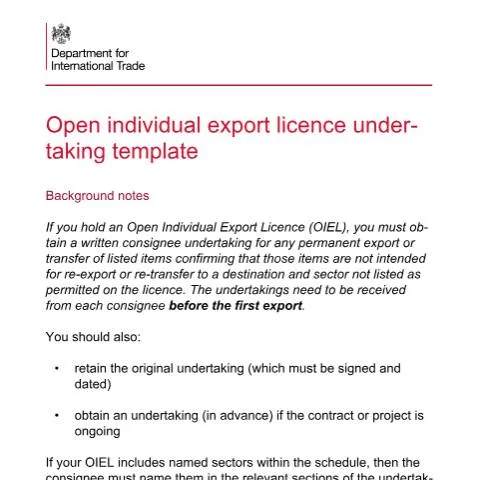
When Export Licences Demand Written Guarantees: The OIEL Undertaking Process
Securing an Open Individual Export Licence (OIEL) from the Export Control Joint Unit marks just the beginning of your compliance journey. Each permanent export or transfer of controlled items under this licence triggers a crucial administrative requirement: obtaining a formal written undertaking from your consignee. This document serves as your legal safeguard and the government's assurance that sensitive goods, software, or technology won't find their way to unauthorised destinations or prohibited end-uses.
The undertaking template represents a critical checkpoint in the export control framework, bridging the gap between licence approval and actual shipment. Without this signed commitment from your overseas recipient, your OIEL becomes effectively unusable for that particular transaction, regardless of how comprehensive your original licence application might have been.
The Strategic Role of Consignee Undertakings in Export Control
The OIEL undertaking system addresses a fundamental challenge in international trade: maintaining oversight over dual-use items once they leave UK shores. Unlike standard commercial contracts, these undertakings carry regulatory weight, forming part of the government's due diligence framework for preventing the proliferation of sensitive technologies.
Three distinct undertaking pathways accommodate different commercial scenarios. The first covers items for the consignee's own use with no intention of re-export—typical for manufacturing equipment or technical components integrated into the recipient's operations. The second addresses commercial resale situations where the consignee acts as a distributor to bona fide customers within specified sectors and destinations. The third pathway handles government contracts, requiring explicit reference to purchase order numbers and governmental end-users.
Each pathway demands specific language and certifications, reflecting the varying risk profiles associated with different types of transactions. The template's structured approach ensures consistency whilst accommodating the commercial realities of international trade relationships.
Navigating the Twelve-Month Validity Window
The twelve-month validity period creates both opportunity and obligation for exporters managing ongoing supply relationships. This timeframe typically aligns with annual contract cycles, but requires careful diary management to prevent compliance gaps.
Strategic timing considerations become crucial for multi-shipment arrangements. Obtaining an undertaking too early in contract negotiations risks expiry before all shipments complete, whilst waiting until the last moment may delay critical deliveries. Many experienced exporters request renewals at the ten-month mark, providing a two-month buffer for administrative processing.
| Undertaking Status | Action Required | Timeline |
|---|---|---|
| Initial request | Send template to consignee | Before first export |
| Active undertaking | Monitor expiry date | Valid for 12 months |
| Approaching expiry | Request renewal | 2-3 months before expiry |
| Expired undertaking | Halt exports until renewal | Immediate cessation required |
The Export Control Joint Unit's compliance audits specifically examine undertaking validity dates against actual shipment records. Auditors frequently identify cases where exporters continued shipping against expired undertakings, leading to potential licence violations and enforcement action.
Sectoral Specifications and Named Entity Requirements
OIELs featuring named sectors within their schedules impose additional complexity on the undertaking process. The consignee must explicitly identify these sectors within their signed commitment, demonstrating awareness of the licence's specific parameters and their role within the approved framework.
This requirement reflects the government's risk-based approach to export licensing. Higher-risk sectors—such as aerospace, defence, telecommunications, or energy—warrant enhanced scrutiny and explicit acknowledgment from receiving parties. The named sector requirement ensures consignees understand both the sensitivity of the items and their responsibilities under UK export control regulations.
Conversely, OIELs without named sectors streamline the undertaking process, reflecting lower risk profiles or broader commercial applications where sector-specific restrictions prove unnecessary or impractical.
Documentation Standards and Compliance Auditing
The Export Control Joint Unit's insistence on original signed undertakings reflects the document's legal significance within the licensing framework. Scanned copies serve as temporary measures only, permissible for no more than three months whilst original documents travel through international postal systems or courier networks.
Compliance audits routinely examine undertaking files, assessing both document authenticity and procedural adherence. Auditors verify signatures against corporate records, check dates against shipment documentation, and confirm that undertaking language matches OIEL conditions. The requirement for consignee-headed notepaper adds another authentication layer, preventing generic or template-based submissions that might indicate insufficient due diligence.
English-language requirements eliminate interpretation ambiguities whilst ensuring UK authorities can review undertakings without translation delays. This standard applies regardless of the consignee's primary language or local business practices, reflecting the UK-centric nature of the licensing regime.
Weapons of Mass Destruction and End-Use Certifications
Every undertaking must incorporate specific certifications regarding weapons of mass destruction (WMD) and nuclear activities, regardless of the items' apparent civilian applications. These clauses reflect international non-proliferation commitments and the dual-use nature of many controlled technologies.
The WMD certification encompasses chemical, biological, and nuclear weapons, plus their delivery systems. This broad scope acknowledges that seemingly innocuous items—precision machine tools, specialised software, or advanced materials—might contribute to weapons programmes when combined with other technologies or expertise.
Nuclear-specific certifications address both explosive and fuel cycle activities. The International Atomic Energy Agency (IAEA) safeguards framework provides the reference standard, with undertakings explicitly prohibiting involvement in unsafeguarded nuclear facilities or activities. These provisions extend beyond obvious nuclear technologies to encompass dual-use items with potential nuclear applications.
Embargo Compliance and Sanctions Alignment
Undertakings must confirm compliance with UN, EU, UK, and OSCE embargo measures, creating a multi-layered sanctions framework. This comprehensive approach reflects the UK's continued alignment with international sanctions regimes despite Brexit, maintaining consistency with allied export control policies.
The dynamic nature of sanctions regimes requires exporters to verify current embargo lists at the time of each shipment, not merely when obtaining initial undertakings. The government's export licensing guidance provides updated embargo information, but exporters bear responsibility for ensuring ongoing compliance throughout the undertaking's validity period.
Corporate Authority and Signatory Requirements
The requirement for partner or principal officer signatures reflects the undertaking's legal significance and ensures appropriate corporate authority backs these commitments. This standard prevents junior staff from inadvertently committing their organisations to obligations they may not fully understand or have authority to accept.
Acceptable signatories typically include company directors, partners in partnerships, or senior executives with explicit authority over international trade matters. The Export Control Joint Unit may request evidence of signatory authority during compliance reviews, particularly for large corporations with complex organisational structures.
Individual traders and sole proprietorships face simpler requirements, with the business owner providing their personal signature and accepting direct responsibility for undertaking compliance. This arrangement eliminates corporate structure complexities whilst maintaining personal accountability for regulatory commitments.
Integration with Broader Export Control Obligations
OIEL undertakings form part of a comprehensive export control framework extending beyond individual transactions to encompass ongoing compliance monitoring and reporting obligations. Exporters must maintain detailed records linking undertakings to specific shipments, creating audit trails that demonstrate regulatory adherence over time.
The Export Control Joint Unit's compliance approach emphasises systems and processes rather than individual transaction reviews. Effective undertaking management demonstrates organisational competence and reduces the likelihood of enhanced regulatory scrutiny or licence restrictions.
Record-keeping obligations extend throughout the OIEL's validity period and beyond, with the government expecting exporters to maintain comprehensive files supporting their licensing activities. These records prove essential during compliance audits, licence renewal applications, or investigations into suspected violations.
The undertaking system also interfaces with customs procedures and freight forwarding arrangements. Customs authorities may request evidence of valid undertakings during export clearance processes, whilst freight forwarders increasingly require confirmation of export control compliance before accepting sensitive shipments.
Specific Conditions and Restrictions by Export Category
The OIEL undertaking template incorporates specific conditional clauses that vary significantly depending on the nature of goods being exported. For dual-use items covered under Schedule 3 of the Export Control Order 2008, undertakings must explicitly address end-use verification protocols. This includes mandatory provisions for conducting periodic site visits to verify that controlled goods remain at declared locations and are used solely for stated commercial purposes.
When exporting military or dual-use technology, the undertaking template requires detailed technical safeguards sections. These must specify how technical data will be protected during transmission, storage requirements for classified specifications, and protocols for handling any derivatives or modifications of the original technology. The template mandates inclusion of specific clauses addressing technology transfer restrictions, particularly where software or technical assistance forms part of the export package.
For strategic goods under ML categories (Military List), undertaking templates incorporate enhanced security provisions. These include mandatory reporting of any changes to end-user circumstances, requirements for advance notification of any re-export intentions, and detailed inventory tracking obligations. The template specifically addresses scenarios where goods may transit through multiple jurisdictions, requiring confirmation of transit licensing compliance in intermediate countries.
Cryptographic items (Category 5A002 and related entries) trigger additional template sections covering key management protocols, encryption algorithm specifications, and mandatory notification procedures for any software updates or patches. The undertaking must detail how cryptographic capabilities will be restricted or disabled for certain export destinations, with specific technical implementation methods clearly documented.
Recent template updates have introduced specific provisions for emerging technologies, including artificial intelligence components, quantum computing elements, and advanced materials. These sections require detailed descriptions of technology applications, potential military uses, and specific measures to prevent unauthorised access or reverse engineering.
Documentation Requirements and Supporting Evidence
The OIEL undertaking template mandates comprehensive supporting documentation that extends well beyond basic commercial contracts. End-user certificates must be accompanied by detailed facility descriptions, including site layouts, security arrangements, and personnel security clearances where applicable. The template requires specific formatting for these certificates, including mandatory fields for facility coordinates, operational capacity details, and contact information for responsible security officers.
Technical specifications submitted with undertakings must follow prescribed formats outlined in the template appendices. For controlled software, this includes source code escrow arrangements, detailed functional specifications, and comprehensive user documentation. Hardware exports require detailed technical drawings, component specifications, and maintenance documentation that demonstrates compliance with declared end-use purposes.
The template incorporates specific requirements for financial documentation, including proof of legitimate commercial relationships, banking references, and evidence of payment arrangements. For high-value strategic exports, additional financial guarantees may be required, with template sections specifying acceptable forms of security deposits or performance bonds.
Third-party verification reports form a critical component of undertaking documentation. The template outlines requirements for independent technical assessments, security evaluations, and compliance audits. These reports must be conducted by recognised organisations and follow specific methodologies outlined in the template guidance notes.
For exports involving multiple end-users or complex supply chains, the undertaking template requires detailed organisational charts, ownership structures, and relationship maps. This documentation must clearly identify all parties with access to controlled goods, their roles and responsibilities, and specific security clearances or authorisations held.
The template also addresses ongoing documentation obligations, specifying requirements for periodic compliance reports, incident notifications, and change management procedures. These sections outline specific timescales for reporting various types of changes, from minor administrative updates to significant operational modifications that might affect export control compliance.
Monitoring, Compliance Verification and Amendment Procedures
The OIEL undertaking template establishes comprehensive monitoring frameworks that extend throughout the licence validity period. These frameworks require licence holders to implement systematic tracking procedures, with specific template sections outlining mandatory record-keeping requirements, audit trail documentation, and periodic compliance attestations.
Verification site visits represent a key compliance mechanism detailed within the template. The document specifies that ECJU officers may conduct announced or unannounced inspections, with undertaking signatories required to provide unrestricted access to controlled goods, associated documentation, and relevant personnel. The template outlines specific cooperation requirements, including provision of technical experts, translation services where necessary, and access to electronic records and systems.
The template incorporates detailed provisions for compliance reporting schedules that vary according to goods sensitivity and destination countries. High-risk exports may require quarterly compliance reports, while lower-risk categories might operate on annual reporting cycles. Each reporting template section specifies required data points, acceptable evidence formats, and submission deadlines aligned with the broader OIEL review schedule.
Incident reporting procedures outlined in the template cover various scenarios from minor administrative errors to serious security breaches. The document specifies mandatory reporting timescales, ranging from immediate notification for security incidents to 10-day reporting windows for administrative changes. Template sections detail required information for each incident type, including impact assessments, corrective actions taken, and preventive measures implemented.
The template addresses amendment procedures for situations where undertaking conditions require modification during the licence period. This includes specific processes for requesting condition changes, required supporting documentation, and ECJU assessment criteria. Amendment requests must demonstrate continued compliance with original licence objectives while addressing changed circumstances or operational requirements.
Technology transfer monitoring receives particular attention in template sections covering ongoing obligations. This includes requirements for tracking any derivatives or improvements developed using controlled technology, notification procedures for personnel changes affecting technology access, and specific measures for protecting intellectual property throughout the export process.
The template establishes clear procedures for licence suspension or revocation scenarios, outlining licence holder obligations in such circumstances. This includes requirements for secure storage or return of controlled goods, notification of affected end-users, and cooperation with any subsequent investigations or compliance actions undertaken by ECJU.