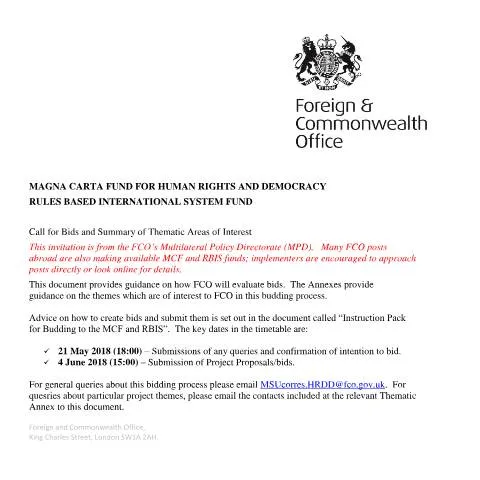
Understanding the Magna Carta Fund: A Gateway to Human Rights Initiatives
The Magna Carta Fund (MCF) represents a significant opportunity for organisations focused on human rights and democracy projects. This funding initiative, overseen by the Foreign & Commonwealth Office (FCO), invites bids for innovative projects that align with its thematic areas of interest. For many organisations, the MCF can mean the difference between the continuation of critical work or the need to scale back efforts aimed at promoting fundamental rights and freedoms. The importance of understanding how to navigate this funding opportunity cannot be understated.
Who Should Engage with the Magna Carta Fund?
Potential bidders for the MCF span a wide array of organisations, including but not limited to non-governmental organisations (NGOs), community groups, and academic institutions. However, not every organisation will find itself eligible or ideally suited for this funding. Understanding the profiles of eligible bidders is crucial.
Organisations Eligible to Apply
- Non-Governmental Organisations: Established charities and NGOs focused on human rights are primary candidates.
- Community Interest Companies (CICs): These entities must demonstrate a clear social purpose in alignment with MCF goals.
- Academic Institutions: Universities with research projects centred on human rights are also encouraged to apply, although they must ensure alignment with the MCF's objectives.
- Collaborative Partnerships: Joint bids from organisations, especially if they can introduce diverse perspectives, are welcomed and often more competitive.
Exceptions and Special Cases
While general eligibility seems straightforward, there are exceptions. The FCO may decide not to fund projects that:
- Do not align with stated thematic areas of interest.
- Are located in countries with existing human rights violations, where funds may be misappropriated.
- Are from entities or individuals who have not complied with previous FCO funding regulations.
Timeline: The Journey from Intention to Approval
Navigating the bidding process demands adherence to a strict timeline. Understanding each phase can significantly enhance an organisation’s chances of success. Below, we outline the key dates associated with the MCF bidding process:
| Key Date | Milestone |
|---|---|
| 11 May 2018 | Publication of the Call for Bids on GOV.UK |
| 21 May 2018 (18:00) | Deadline for confirmation of intention to bid and submission of questions |
| 4 June 2018 (15:00) | Deadline for submission of project proposals/bids |
| 18 June 2018 | Announcement of results and feedback to all bidders |
| 1st July 2018 | Contract signature and project commencement |
By being aware of these pivotal dates, bidders can better position themselves to meet all requirements and submit competitive proposals.
Decoding the Proposal: Key Sections of the Application
Completing the proposal is perhaps the most critical aspect of the bidding process. Each component of the application must be carefully considered and articulated. The following sections are integral to the bid:
1. Project Description
- Clarity of Objectives: Clearly outline what the project aims to achieve. Ambiguity can lead to disqualification.
- Alignment with MCF Themes: The project must specifically align with the thematic areas detailed in the MCF documentation.
2. Financial Model
The financial model is a significant part of the assessment. Bidders should pay particular attention to:
- Whole Life Costs: Indicative breakdown of all costs associated with the project.
- Resource Plan: Detailing the human and material resources required to implement the project.
3. Value for Money Assessment
Bidders need to demonstrate how their proposals deliver value for money. This assessment is based on factors such as:
- Economy and Efficiency: Illustrating how the project will make optimal use of resources.
- Effectiveness: Defining how the project will achieve its stated objectives.
4. Project Management and Delivery
The success of a project often hinges on effective management and delivery methods. Thus, bidders should address:
- Experience and Expertise: Highlighting past experiences that showcase the capacity to deliver similar projects.
- Risk Management Strategies: Identifying potential risks and outlining mitigation strategies will demonstrate foresight and capability.
Navigating Potential Pitfalls: Common Errors to Avoid
While attention to detail in crafting a proposal is crucial, common errors can undermine even the best-prepared applications. Here are some pitfalls to avoid:
- Overlooking Thematic Alignment: Proposals that do not explicitly address the MCF’s areas of interest may be rejected outright.
- Inadequate Financial Justification: Failure to provide a clear and detailed financial model can lead to low scores in the assessment phase.
- Poorly Defined Objectives: Vague project goals can raise red flags during evaluation, making it essential to be specific and measurable.
After Submission: What to Expect
Upon submission, bidders can anticipate several key outcomes:
Evaluation Feedback
All bidders will receive feedback on their proposals, regardless of the outcome. Understanding the strengths and weaknesses of your submission can inform future bids.
Contract Signing and Project Implementation
Successful bidders will be contacted to sign a contract. Following this, the project can commence, typically within a month of announcement. During implementation, maintaining communication with the FCO is essential for addressing any issues that may arise.
Maximising the Impact of Your Project
Once funded, organisations must focus on delivering impactful outcomes. This involves:
- Regular Reporting: Frequent updates to the FCO are crucial to ensure transparency and accountability.
- Evaluating Outcomes: Implementing a robust evaluation strategy to measure the project's impact against the initial objectives.
Ultimately, the success of a project funded by the MCF not only contributes to the objectives of the MCF but also builds a track record for future funding opportunities.
Future Opportunities and Continuous Engagement
Successful engagement with the MCF can open doors for future funding through other initiatives from the FCO. Keeping abreast of new calls for bids and maintaining relationships with the FCO contacts can be advantageous.
Conclusion
The Magna Carta Fund provides an invaluable resource for organisations committed to advancing human rights. By understanding the intricacies of the bidding process, from eligibility to proposal preparation, organisations can enhance their chances of securing funding and making a meaningful impact in their fields.
Understanding the Magna Carta Fund: Objectives and Priorities
The Magna Carta Fund for Human Rights and Democracy was established as part of the UK’s commitment to promoting and protecting human rights globally. Launched by the Foreign, Commonwealth & Development Office (FCDO), the fund aims to support projects that enhance the rule of law, promote democratic governance, and advocate for human rights. During the 2018 to 2020 funding period, the FCDO sought bids for initiatives that aligned with these objectives, focusing particularly on fragile states and vulnerable populations.
One of the primary goals of the Magna Carta Fund is to strengthen civic space and empower local communities to engage in decision-making processes. This includes providing support to civil society organisations that promote accountability, transparency, and respect for human rights. Bidders were encouraged to propose innovative projects that address the unique challenges faced by marginalized groups such as women, children, and ethnic minorities.
Each project funded by the Magna Carta Fund was expected to have measurable outcomes and clear impacts on the communities served. Bidders were advised to outline how their initiatives would contribute to long-term sustainability and foster partnerships with local stakeholders. The fund also prioritised projects that incorporated local knowledge, expertise, and capacities, ensuring that interventions were contextually relevant and culturally sensitive.
Application Process for the Magna Carta Fund: Steps and Considerations
Applying for funding from the Magna Carta Fund required careful planning and strategic alignment of project objectives with the fund’s priorities. Potential bidders needed to follow a structured application process, which included several critical steps to ensure a successful proposal.
Firstly, interested organisations were required to register their interest by submitting a preliminary proposal outlining their project idea. This initial submission allowed the FCDO to evaluate the alignment of the proposed initiatives with the fund's objectives. Following this, successful candidates were invited to submit a full bid, which required detailed project plans, budgets, and monitoring and evaluation frameworks.
In preparing their bids, applicants were advised to consider various factors, including the political, social, and economic context of the project area. The FCDO emphasised the importance of stakeholder engagement, and bidders were encouraged to demonstrate how they would collaborate with local partners and beneficiaries. Furthermore, consideration of gender equality and the inclusion of underrepresented groups were crucial aspects that could enhance a proposal's viability.
Once bids were submitted, they underwent a thorough review process, evaluating criteria such as feasibility, coherence, and potential impact. Applicants were also advised to address how their projects would mitigate risks and respond to any challenges that might arise during implementation. Successful bidders were notified and subsequently entered into a formal agreement with the FCDO, outlining the terms and conditions of funding support.
Impact Assessment and Legacy of the Magna Carta Fund
A significant aspect of the Magna Carta Fund involved rigorous impact assessment to evaluate the effectiveness of funded projects. The FCDO established frameworks to assess both qualitative and quantitative outcomes, ensuring that projects not only met their immediate objectives but also contributed to broader systemic changes in governance and human rights.
Impact assessments were designed to capture the voices and experiences of beneficiaries, allowing for a participatory approach to evaluation. This approach not only provided valuable insights into the success of individual projects but also helped the FCDO identify best practices and lessons learned for future funding cycles. Regular reporting and feedback mechanisms enabled continuous improvement and adaptation of strategies to better meet the evolving needs of target communities.
The legacy of the Magna Carta Fund extends beyond the projects funded; it serves as a catalyst for ongoing dialogue about human rights and democracy in the UK and internationally. By funding innovative initiatives and supporting grassroots activism, the fund has played a crucial role in reinforcing the UK's commitment to upholding democratic values and protecting fundamental freedoms.
In summary, the Magna Carta Fund represents a significant investment in promoting human rights and strengthening governance worldwide. Through strategic funding, comprehensive support for project implementation, and robust evaluation practices, the FCDO aimed to foster sustainable change and empower communities to advocate for their rights and freedoms effectively.