Understanding the Madrid Protocol Gateway for UK Trademark Protection
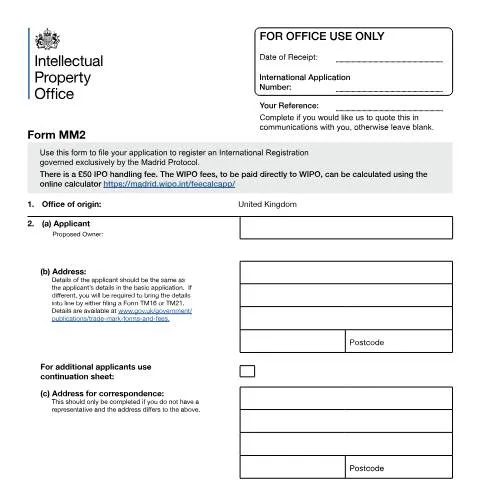
When British businesses seek to protect their trademarks across multiple international markets, they encounter a sophisticated yet streamlined system known as the Madrid Protocol. The Application to register an International trade mark (Form MM2) serves as the UK's gateway to this global trademark registration network, administered by the World Intellectual Property Organisation (WIPO). Rather than filing separate applications in dozens of countries, this single form enables trademark owners to extend their UK protection to up to 126 member territories through one consolidated application process.
The Madrid Protocol system fundamentally transforms international trademark strategy. A successful UK application or registration becomes the foundation upon which international protection is built, creating what trademark professionals term a "home base" requirement. This dependency relationship means that applicants must already possess either a pending UK application or a granted UK registration before they can access the international system.
Navigating the Basic Application Foundation
Section 5 of Form MM2 demands precise reference to your underlying UK trademark application or registration, known as the "basic application." This foundational requirement operates under strict rules that catch many applicants off guard. The application or registration number and filing date must correspond exactly to records held by the Intellectual Property Office, as WIPO will cross-reference these details during processing.
The timing element proves particularly crucial for strategic planning. Applications must be filed within six months of the basic application to maintain any priority claims, though the international application itself can be filed at any point while the basic application remains active. However, practitioners often recommend filing international applications promptly after securing a UK priority date, as this approach maximises the duration of international protection.
| Basic Application Status | International Application Timing | Strategic Considerations |
|---|---|---|
| Pending UK Application | Can file immediately after UK filing | Maintains priority date across all territories |
| Registered UK Mark | File within registration validity period | Stronger foundation but may lose priority benefits |
| Series Application | Must select single mark variant | Requires separate international applications for each variant |
When dealing with series applications, applicants face a significant limitation. The international system cannot accommodate the UK's series mark concept, where multiple similar variants are protected under a single application. Section 7(a)(ii) specifically addresses this scenario, requiring applicants to select one mark only from their series for international protection. Coverage for remaining series variants necessitates separate MM2 applications, each incurring its own fees and processing requirements.
Establishing Territorial Connection and Entitlement Rights
Section 3 establishes the applicant's entitlement to use the UK as their Madrid Protocol gateway, employing three alternative criteria that reflect international treaty requirements. The most straightforward route involves UK nationality, but the system accommodates broader commercial realities through domicile and establishment provisions.
UK domicile extends beyond simple residence to encompass the applicant's principal place of business operations. For individuals, this typically means their primary residential address, while companies must demonstrate their registered office or central management location within UK territory. The real and effective industrial or commercial establishment criterion offers the most flexibility, allowing foreign entities with substantial UK operations to access the Madrid system.
This establishment test requires genuine commercial activity rather than mere administrative presence. WIPO examines factors including staff numbers, business premises, manufacturing facilities, and revenue generation within the UK. A subsidiary company with active operations qualifies, but a simple postal address or dormant company typically fails this test.
Address Requirements and Cross-Border Complications
The form's address sections reveal subtle but important distinctions. Section 2(b) captures the applicant's primary address, which must align with details in the basic UK application. Discrepancies trigger mandatory correction procedures using Forms TM16 or TM21, potentially delaying international filing by several weeks.
Section 2(c) addresses correspondence arrangements for unrepresented applicants whose business address differs from their preferred communication address. This provision proves particularly valuable for companies with multiple locations or individuals who prefer correspondence at their professional rather than registered address. However, WIPO maintains strict email requirements from February 2021 onwards, making electronic communication mandatory regardless of postal arrangements.
Decoding Mark Representation and Technical Specifications
Section 7 presents the application's most technically demanding requirements, where precise mark representation determines the scope of international protection. The "same as basic application" option in Section 7(a)(i) offers simplicity for straightforward word marks, automatically importing the representation from the UK filing. However, this convenience comes with limitations for marks containing graphical elements or specific formatting.
Series applications create particular complexity in Section 7(a)(ii). Since international applications cannot accommodate multiple variants, applicants must provide an exact representation of their chosen mark variant within the designated square. This representation becomes definitive for international purposes, regardless of how other variants appear in the UK series.
The standard characters declaration in Section 7(c) carries significant implications for mark protection scope. Claiming standard character status means the mark receives protection regardless of font, style, or colour variations, but this flexibility comes at the cost of losing protection for specific design elements. Conversely, rejecting standard character status locks the mark to its exact visual appearance but provides stronger protection against similar designs.
Colour Claims and Visual Elements
Section 8 addresses colour protection, a frequently misunderstood aspect of trademark law. Claiming specific colours as distinctive features limits protection to those exact colour combinations but can strengthen the mark's distinctiveness in certain contexts. The requirement to specify which mark elements appear in each claimed colour reflects WIPO's need for precise protection parameters.
For marks consisting entirely of colour combinations without figurative elements, Section 7(d) requires explicit declaration. Such marks face heightened scrutiny during examination, as colour-only trademarks must demonstrate acquired distinctiveness through extensive commercial use.
Representative Arrangements and Communication Protocols
Section 4 establishes representation arrangements that significantly impact application management. The "Representative same as UK" option automatically imports details from the basic application, streamlining the process for applicants who maintain consistent representation across jurisdictions. However, this convenience assumes that UK representatives possess appropriate international expertise and WIPO communication procedures.
WIPO's mandatory email requirements from February 2021 represent a fundamental shift in international trademark administration. Both applicants and representatives must provide functional email addresses, as WIPO increasingly relies on electronic communication for status updates, examination reports, and deadline notifications. Applications lacking valid email addresses face automatic refusal, regardless of other merits.
The communication language selection in Section 2(e) influences not only correspondence but also examination procedures. While English represents the most common choice for UK applicants, selecting French or Spanish can occasionally provide strategic advantages in specific territorial designations where examiners show greater familiarity with those languages.
Priority Claims and Strategic Timing Considerations
Section 6 enables priority claims that can prove invaluable for competitive trademark landscapes. The six-month priority window from the earliest filing date allows applicants to secure international protection with retroactive effect, potentially overcoming conflicting applications filed during the interim period.
Priority claims operate on a goods-and-services-specific basis, enabling partial claims where international applications cover fewer categories than the priority application. This flexibility proves particularly valuable for budget-conscious applicants who wish to prioritise core business categories while potentially expanding coverage later through subsequent applications.
The priority claim type selection determines examination procedures in designated territories. Some jurisdictions offer expedited examination for priority applicants, while others impose additional documentation requirements. Understanding these territorial variations enables more informed priority claiming strategies.
Documentation and Evidence Requirements
Priority claims require supporting documentation that varies by priority country and application type. UK priority applications typically need certified copies of filing receipts and application details, while foreign priorities may demand additional authentication procedures. WIPO maintains specific formatting requirements for priority documents, including language translations and official certification standards.
Fee Structure and Financial Planning
The MM2 application involves a two-tier fee structure that requires careful financial planning. The UK IPO charges a £50 handling fee for processing the application and forwarding it to WIPO, while WIPO levies its own international fees calculated according to complex territorial and classification-based formulas.
WIPO fees vary significantly based on several factors including the number of designated territories, mark type, and goods/services classifications. The online fee calculator at madrid.wipo.int/feecalcapp/ provides precise calculations, but applicants should factor in potential currency fluctuations and additional territorial fees that some countries impose during the national phase.
Payment timing differs between the two fee components. The IPO handling fee accompanies the MM2 submission, while WIPO fees are paid directly to the International Bureau following application acceptance. This split payment system requires coordination to avoid processing delays, as WIPO will not examine applications until all fees are settled.
Processing Pathways and Administrative Outcomes
Upon submission, Form MM2 enters a multi-stage processing pathway involving both UK IPO and WIPO examination phases. The IPO conducts initial compliance checks, verifying basic application details, entitlement criteria, and form completion standards. This preliminary review typically concludes within two weeks, though complex cases or peak filing periods may extend processing times.
Successful UK IPO processing triggers forwarding to WIPO's International Bureau in Geneva, where substantive examination occurs according to Madrid Protocol standards. WIPO examines formal requirements, fee calculations, and basic application correspondence before issuing the international registration certificate or raising examination objections.
The international registration, if granted, initiates an 18-month examination period in each designated territory. National trademark offices conduct independent examinations according to local law, potentially raising objections that require separate responses in each territory. This decentralised examination system means that international registration success does not guarantee protection in all designated countries.
Applicants receive detailed status updates throughout the process via WIPO's Madrid Monitor system, accessible through the International Bureau's online portal. This tracking system provides real-time updates on examination progress, fee payments, and territorial status changes, enabling proactive case management across multiple jurisdictions.
Trademark Classification and Specification Requirements
The classification system forms the backbone of your international trademark application, determining both the scope of protection and the associated fees. Under the Nice Classification system, goods and services are categorised into 45 distinct classes—34 for goods and 11 for services. Each class requires a separate application fee, making strategic classification crucial for cost management.
When specifying goods or services, precision matters significantly. Broad terms like "computer software" may face objections from examining authorities, whereas specific descriptions such as "mobile application software for financial planning and budget management" provide clearer protection boundaries. The Intellectual Property Office maintains detailed guidance on acceptable terminology within each class, and examiners may request amendments if your specification lacks clarity or exceeds the class scope.
Class 9 covers electronics and software, but distinguishes between downloadable software applications and software as a service (which falls under Class 42). Class 35 encompasses advertising and business services, yet excludes financial services (Class 36) and professional consultancy (Class 42). These distinctions become particularly relevant when your business operates across multiple sectors or offers hybrid products combining physical goods with digital services.
Fill in your form directly online
No printing: type your details into the boxes of the official form, tick, then download the PDF ready to send.
- 1Type into the form boxes
- 2Tick in one click
- 3Save and download the PDF
Consider filing in multiple classes if your trademark applies to different product categories. A restaurant brand might require Class 43 (restaurant services), Class 29 (processed foods), and Class 32 (beverages). However, each additional class increases costs substantially, so evaluate your immediate commercial needs versus future expansion plans. Some businesses file initially in core classes, then extend protection through subsequent applications as their operations grow.
The Madrid Protocol allows you to designate different goods and services for different countries, acknowledging varying market strategies. Your application to the UK Intellectual Property Office can specify certain classes, while your designations for European Union or United States markets might cover additional or alternative categories. This flexibility proves valuable for businesses with region-specific product lines or regulatory constraints affecting certain jurisdictions.
Managing Multi-Jurisdictional Trademark Strategies
International trademark registration involves navigating diverse legal systems, examination procedures, and cultural considerations across your designated countries. Each jurisdiction maintains sovereign authority over trademark law interpretation, creating potential variations in how identical applications are assessed. Understanding these differences helps anticipate challenges and develop responsive strategies.
Examination timelines vary considerably between countries. The UK Intellectual Property Office typically completes initial examination within four to six months, while some jurisdictions may take twelve to eighteen months or longer. These variations affect your overall timeline for securing protection and can influence business launch schedules, particularly for time-sensitive products or seasonal markets.
Opposition procedures differ significantly across jurisdictions. The UK maintains a two-month opposition period following publication, with established procedures for evidence submission and hearings. Other countries may have longer opposition periods, different evidence requirements, or varying standards for assessing likelihood of confusion. Some jurisdictions permit third-party observations without formal opposition proceedings, creating additional uncertainty during the registration process.
Language requirements present practical considerations for multi-jurisdictional strategies. While your international application uses English, French, or Spanish, individual countries may require translations for examination purposes or subsequent proceedings. Professional translation costs can accumulate substantially across multiple jurisdictions, particularly for complex technical specifications or when responding to examination reports.
Currency fluctuations affect international filing costs, as individual designation fees are typically denominated in local currencies. Exchange rate movements between your initial application and subsequent fee payments can impact your overall investment. Some applicants choose to pay designation fees promptly after filing to minimise currency exposure, while others may prefer to stagger payments based on examination outcomes.
Maintenance requirements vary between jurisdictions, with different renewal periods, grace periods, and use requirements. The UK operates on a ten-year renewal cycle with six-month grace periods, but other countries may have different schedules or stricter use requirements. Coordinating renewal deadlines across multiple jurisdictions requires systematic record-keeping and often benefits from professional trademark management services.
Post-Registration Enforcement and Portfolio Management
Securing international trademark registration marks the beginning, not the end, of your intellectual property strategy. Effective enforcement requires ongoing vigilance, strategic decision-making, and coordinated action across jurisdictions. The strength of your trademark rights depends significantly on how actively you monitor and defend your registrations.
Monitoring services help identify potential infringements across your designated countries, but the quality and coverage vary substantially between jurisdictions. The UK maintains comprehensive online databases through the Intellectual Property Office, enabling relatively straightforward monitoring of new applications and registrations. However, some countries have less accessible records or delayed publication schedules, creating monitoring challenges.
When identifying potential infringement, your response options depend on the jurisdiction and the nature of the conflict. The UK offers relatively efficient opposition and cancellation procedures through the Intellectual Property Office, with structured timelines and established precedents. Other jurisdictions may require court proceedings from the outset, involving higher costs and longer timelines but potentially offering broader remedies including damages and injunctive relief.
Use requirements present ongoing obligations in many jurisdictions. While the UK does not impose specific use requirements during the first five years following registration, subsequent renewal periods require evidence of genuine use. Other countries may have more stringent use requirements or shorter grace periods. Maintaining appropriate use evidence across multiple jurisdictions requires systematic documentation of sales, marketing materials, and commercial activities.
Portfolio rationalisation becomes increasingly important as your trademark portfolio grows. Regular review of your registrations helps identify underutilised marks, overlapping protections, or marks that no longer align with business strategy. Abandoning unnecessary registrations reduces ongoing maintenance costs and administrative burden while focusing resources on commercially valuable protection.
Licensing and assignment strategies require careful coordination across jurisdictions to maintain consistent ownership and control. The Madrid Protocol facilitates certain administrative changes, but complex licensing arrangements or corporate restructuring may require individual country filings. Professional advice becomes particularly valuable when managing international portfolio changes affecting multiple registrations simultaneously.
Technology platforms increasingly support trademark portfolio management, offering centralised monitoring, deadline tracking, and renewal management across multiple jurisdictions. However, the effectiveness of these platforms depends on reliable data sources and regular updates reflecting changes in local trademark laws and procedures. Many businesses combine technological solutions with professional trademark management services to ensure comprehensive coverage and expert guidance on complex enforcement decisions.