When Agricultural Imports Meet Bureaucracy: The Import Licence Gateway
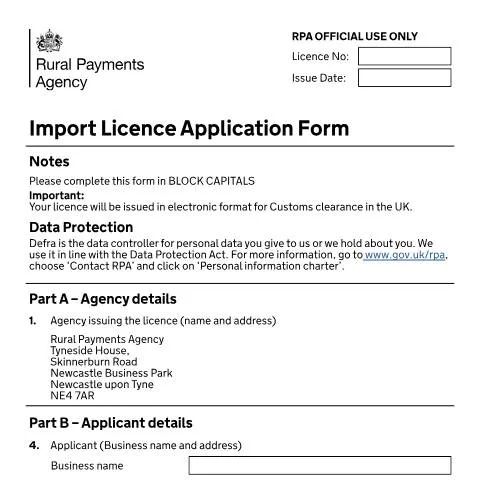
The agricultural import trade between the UK and international markets operates under a complex licensing system that can make or break time-sensitive commercial operations. The Rural Payments Agency's import licence application form (il1ap v6.0) serves as the mandatory gateway for businesses seeking to bring agricultural products into the UK market, transforming what might seem like straightforward international trade into a detailed regulatory exercise requiring precision, foresight, and thorough documentation.
This electronic licensing system reflects the UK's post-Brexit approach to agricultural trade controls, where every agricultural import requires prior authorisation regardless of the product's origin or the importer's track record. The form's version number—currently v6.0 as of December 2025—indicates ongoing refinements to accommodate evolving trade relationships and regulatory requirements.
Decoding the Business Identity Requirements in Parts A and B
The application process begins with establishing clear business credentials, a step that proves more nuanced than simply providing a company name. Part B demands multiple identification numbers that serve different regulatory purposes and must align perfectly across government databases.
The trader registration number links directly to your business's relationship with HMRC and determines your eligibility for specific import schemes. Your VAT number, while seemingly straightforward, must reflect your current registration status—a recently deregistered business cannot use an expired VAT number, even if reregistration is pending. The EORI (Economic Operators Registration and Identification) number represents perhaps the most critical identifier, as this determines your customs clearance privileges across all UK entry points.
| Business Status | Required Numbers | Additional Considerations |
|---|---|---|
| Established UK trader | All three numbers mandatory | Numbers must be active and cross-referenced |
| New business | EORI essential, VAT if applicable | Trader registration may be provisional |
| Overseas agent | UK EORI required | Special arrangements for representation |
The rights transfer provision in section 6 allows licence benefits to pass to another business entity, but this mechanism operates under strict conditions. The receiving business must hold equivalent registration credentials and cannot be subject to any trade restrictions or ongoing compliance investigations.
Navigating Business Address Complexities
Business addresses require particular attention beyond simple postal accuracy. The RPA cross-references addresses with Companies House records, HMRC registrations, and customs databases. Any discrepancies can trigger verification delays that extend processing times significantly. Businesses operating from multiple locations must specify the address linked to their EORI registration, not necessarily their trading address or registered office.
Country Specifications: Beyond Simple Geography
Parts C sections 7 and 8 address country information with implications extending far beyond geographical accuracy. The distinction between country of import and country of origin carries significant regulatory and commercial consequences that many applicants underestimate.
When declaring the country of import as compulsory, you're committing to source exclusively from that territory, even if identical products become available elsewhere at better terms. This restriction proves particularly challenging for seasonal agricultural products where supply availability fluctuates. Conversely, marking it as non-compulsory provides flexibility but may limit access to certain preferential quota arrangements.
Country of origin declarations affect tariff calculations, quota eligibility, and compliance with specific trade agreements. A product manufactured in Country A but shipped via Country B requires careful consideration—the origin remains Country A, but complex rules of origin may apply if significant processing occurred during transit.
Managing Quota and Preferential Arrangements
Agricultural imports often benefit from quota systems or preferential arrangements with specific countries. The RPA maintains real-time quota monitoring, and applications submitted after quota exhaustion face automatic rejection regardless of application quality. Businesses must monitor quota utilisation through the RPA's online systems and time their applications accordingly.
Security Requirements and Financial Guarantees
Part D addresses the financial security mechanism that underpins the licensing system. The security amount reflects the estimated duty liability and serves as a guarantee against potential non-compliance. Security calculations vary significantly based on product classification, origin country, and the applicant's compliance history.
Payment methods include bank guarantees, cash deposits, or approved security providers. Bank guarantees offer the most flexibility but require pre-arrangement with approved financial institutions. Cash deposits provide immediate processing but tie up working capital for extended periods—typically until customs clearance completion plus any applicable review period.
The payee trader number links your security payment to your specific licence application. Errors in this field can result in payments being allocated incorrectly, causing processing delays while the RPA reconciles financial records. Always verify this number against your most recent RPA correspondence before submission.
Product Classification: The CN Code Challenge
Part E represents the technical heart of the application, where precise product identification determines regulatory treatment. The Combined Nomenclature (CN) code requirement extends to eight digits, demanding specificity that goes well beyond general product categories.
The full CN code description must match official nomenclature exactly—paraphrasing or abbreviations trigger automatic queries. For processed agricultural products, classification depends on the degree of processing, primary ingredients, and intended use. A product that appears obviously agricultural may fall under industrial classifications if processing significantly alters its characteristics.
Quantity Declarations and Unit Considerations
Net quantity declarations in both figures and words serve as a cross-check against transcription errors, but agricultural products present unique measurement challenges. Seasonal products may experience moisture content variations that affect weight calculations. Fresh produce deteriorates during transit, potentially creating discrepancies between licensed quantities and actual imports.
- Bulk commodities: Specify measurement basis (wet weight, dry weight, cleaned weight)
- Packaged goods: Declare net product weight excluding packaging materials
- Live products: Account for natural weight variations during transport
- Processed items: Use finished product weights, not raw material inputs
Special Conditions and Compliance Declarations
Part F addresses quota-specific requirements and additional conditions that apply to particular product categories or trade arrangements. SI (Statutory Instrument) numbers reference specific regulations governing your product category—these change regularly and must reflect current legislation at the time of application.
Order numbers link to specific quota allocations or preferential arrangements. These numbers are time-sensitive and may expire if not used within designated periods. The RPA does not automatically extend order validity, requiring fresh applications for expired allocations.
Additional information fields accommodate product-specific requirements such as organic certification numbers, quality standards compliance, or seasonal import windows. Different agricultural sectors maintain distinct requirements—dairy imports face different conditions than grain shipments or fresh produce.
Electronic Processing and Customs Integration
The shift to electronic licensing reflects broader digitalisation of UK customs processes. Approved licences integrate directly with customs clearance systems, eliminating paper document requirements at ports of entry. However, this integration demands perfect data consistency between your licence application and subsequent customs declarations.
Processing times vary significantly based on application complexity, security arrangement type, and current workload. Standard applications typically process within 10-15 working days, but quota applications or those requiring additional verification can extend considerably longer. Peak season applications face longer processing times due to increased volume.
Tracking and Communication Protocols
The RPA issues electronic confirmations for received applications, but these confirmations don't guarantee approval. Regular status checks through official channels help identify potential issues before they cause critical delays. The agency's trader schemes team handles queries, but responses prioritise urgent compliance matters over general enquiries.
| Application Status | Typical Timeframe | Action Required |
|---|---|---|
| Initial submission | 24-48 hours | Confirmation receipt monitoring |
| Under review | 5-10 working days | Respond promptly to queries |
| Security processing | 3-7 working days | Verify payment allocation |
| Final approval | 1-2 working days | Download electronic licence |
Strategic Considerations for Commercial Success
Beyond regulatory compliance, successful licence applications require strategic thinking about timing, market conditions, and operational flexibility. Agricultural markets operate on seasonal cycles that don't align neatly with administrative processing schedules.
Businesses managing multiple product lines benefit from coordinated application strategies that maximise quota utilisation while maintaining operational flexibility. The RPA's systems allow multiple concurrent applications, but each ties up security deposits and administrative capacity.
Rights transfer mechanisms enable sophisticated trading strategies where licensed import rights become tradeable commodities. However, these transfers must comply with competition law and cannot create market manipulation situations. The RPA monitors transfer patterns and may investigate unusual activity.
Long-term commercial relationships benefit from consistent application practices that build positive compliance history. The RPA maintains trader performance records that influence future application processing, security requirements, and audit frequency. Businesses with strong compliance records often receive expedited processing and reduced security requirements.
Understanding the import licence system as part of broader agricultural trade strategy, rather than merely administrative compliance, enables businesses to navigate regulatory requirements while maintaining commercial competitiveness in increasingly complex international markets.
Specific Requirements for Live Animals and Genetic Material
Import licences for live animals and genetic material represent one of the most complex categories within agricultural imports, requiring coordination between multiple regulatory bodies. The Animal and Plant Health Agency (APHA) oversees veterinary controls, whilst DEFRA manages the licensing framework for endangered species and genetic resources.
For live cattle, sheep, pigs, and poultry, applicants must demonstrate compliance with the Balai Directive requirements, including pre-export isolation periods and veterinary certification from approved establishments in the country of origin. The application must specify the intended use—whether for breeding, production, slaughter, or research purposes—as this determines the applicable health protocols and quarantine arrangements.
Genetic material imports, including semen, embryos, and ova, require additional documentation proving the donor animals' health status and genetic testing results. The Centre for Environment, Fisheries and Aquaculture Science (CEFAS) may require involvement for aquatic genetic resources, particularly for species covered under the Nagoya Protocol on Access and Benefit-sharing.
Quarantine facilities must be pre-approved and registered with APHA before any live animal imports can proceed. The application form requires detailed facility specifications, including biosecurity measures, veterinary supervision arrangements, and contingency plans for disease outbreaks. Import licences typically specify maximum holding periods and movement restrictions during quarantine.
Fill in your form directly online
No printing: type your details into the boxes of the official form, tick, then download the PDF ready to send.
- 1Type into the form boxes
- 2Tick in one click
- 3Save and download the PDF
For endangered or CITES-listed species, applicants must obtain separate permits from the Animal and Plant Health Agency's CITES Management Authority. The application process involves demonstrating that imports will not be detrimental to wild populations and that adequate facilities exist for proper care and containment.
Documentation Requirements and Supporting Evidence
The completeness and accuracy of supporting documentation significantly influence processing times and approval likelihood. Beyond the basic application form, numerous supplementary documents must accompany submissions, each serving specific regulatory purposes and verification requirements.
Health certificates represent the cornerstone of veterinary documentation, but their validity depends on precise completion by authorised veterinarians in the country of origin. These certificates must be issued within specified timeframes—typically 10 days for most products, though some require certification within 48 hours of export. The certificates must be endorsed by the competent authority in the exporting country and may require additional attestations for specific disease-free status.
Laboratory analysis reports become mandatory for many product categories, particularly those with maximum residue level (MRL) requirements or specific contaminant concerns. The testing laboratories must hold appropriate accreditation, and analysis methods must comply with EU standards where these remain applicable post-Brexit. For novel foods or genetically modified organisms, additional scientific assessments may be required from recognised research institutions.
Commercial documentation, including invoices, packing lists, and bills of lading, must demonstrate traceability throughout the supply chain. The Food Standards Agency may require additional chain of custody documentation for high-risk products or shipments from countries with recent food safety concerns. Insurance certificates and financial guarantees may be necessary for high-value shipments or those requiring specialised handling.
For organic products, certification from recognised organic control bodies must accompany applications, along with detailed information about production methods and input materials. The Soil Association and other UK organic certifiers maintain lists of recognised overseas equivalents, though some countries may require case-by-case assessment of their organic standards.
Digital Submission and Authentication
The transition to digital documentation systems has introduced new requirements for electronic signatures and document authentication. The Government Gateway system requires robust identity verification, and applicants must ensure all digital certificates meet the required technical standards. Some supporting documents may still require physical submission, particularly those with official seals or security features that cannot be adequately reproduced digitally.
Post-Approval Compliance and Monitoring Obligations
Securing an import licence represents only the initial step in a comprehensive compliance framework that extends throughout the importation process and often beyond. Licence holders assume ongoing responsibilities that, if neglected, can result in licence suspension, financial penalties, or permanent exclusion from the import scheme.
Border inspection protocols vary significantly based on product risk categories and country of origin. High-risk consignments may face 100% physical inspection rates, whilst established importers with good compliance records might qualify for reduced inspection frequencies through the Authorised Economic Operator (AEO) scheme. However, all agricultural imports remain subject to random sampling and laboratory testing, regardless of their risk classification or the importer's history.
Record-keeping obligations extend far beyond simple transaction documentation. Importers must maintain detailed logs of storage conditions, particularly for temperature-sensitive products, along with distribution records showing the final destination of all imported goods. These records must be readily accessible to inspection authorities and retained for periods ranging from two to seven years, depending on the product category and applicable regulations.
Traceability systems must enable rapid product recall in case of contamination or other safety concerns. The Food Standards Agency requires importers to demonstrate their ability to identify and contact all downstream recipients within specific timeframes—typically four hours for immediate health risks or 24 hours for other safety issues. This requirement often necessitates sophisticated inventory management systems and established communication protocols with distributors and retailers.
Adverse event reporting represents a critical compliance obligation that many importers underestimate. Any incidents involving product contamination, packaging failures, documentation discrepancies, or consumer complaints must be reported to relevant authorities within prescribed timeframes. The Veterinary Medicines Directorate, for instance, requires reports of suspected adverse reactions to imported veterinary products within 15 days of becoming aware of the incident.
License conditions may include specific monitoring and testing obligations that continue throughout the import period. Some licences require regular sampling and laboratory analysis at the importer's expense, with results submitted to regulatory authorities according to predetermined schedules. Failure to conduct required testing or delayed reporting of adverse results can trigger immediate licence suspension and comprehensive facility inspections.
Financial guarantees or insurance requirements may remain in effect throughout the licence validity period, requiring periodic renewal and adjustment based on import volumes or risk assessments. The Rural Payments Agency may require additional financial assurances for importers who exceed specified volume thresholds or who wish to import particularly high-risk products.