Understanding Employment Documentation in Legal Aid Applications
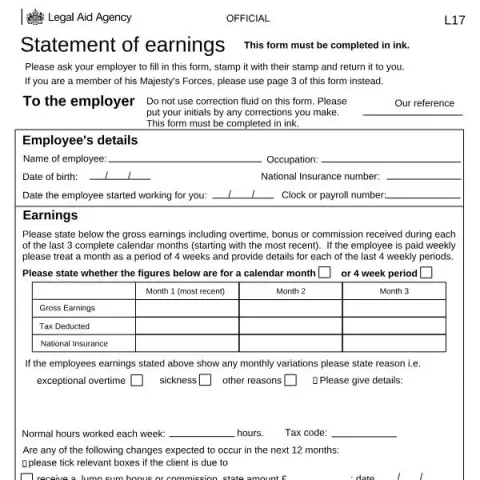
When applying for legal aid in England and Wales, the Legal Aid Agency requires comprehensive financial information to determine eligibility and potential contributions. The L17 Statement of Earnings sits at the heart of this assessment process, serving as the official mechanism for capturing employment income data directly from employers. This three-page document transforms what might otherwise be a complex verification process into a standardised procedure that ensures accurate financial reporting whilst protecting both applicants and the public purse.
Unlike self-declared income statements or payslip copies that applicants might submit independently, the L17 creates a direct communication channel between the Legal Aid Agency and employers. This approach eliminates potential discrepancies and provides the LAA with verified, contemporaneous earnings data that forms the foundation of means testing calculations.
Dual-Track Design: Civilian Employment and Armed Forces Personnel
The L17 demonstrates sophisticated understanding of employment structures across different sectors through its dual-track design. Pages one and two address standard civilian employment relationships, whilst page three specifically accommodates the unique pay structures found within Her Majesty's Forces.
For civilian employees, the form captures straightforward employment patterns including gross earnings, tax deductions, and National Insurance contributions across three complete calendar months. This three-month window provides sufficient data to identify seasonal variations, overtime patterns, and other income fluctuations that might affect legal aid eligibility.
Military personnel face fundamentally different compensation structures involving complex allowance systems, accommodation arrangements, and deployment-related payments. Page three acknowledges these realities by requesting detailed breakdowns of:
- Local overseas allowances and their accommodation-adjusted equivalents
- Separation allowances for personnel serving away from family
- Facility charges and quartering arrangements
- Education allowances for service families
- London weighting and cost-of-living adjustments
This military-specific section requires completion by Pay Office personnel rather than standard HR departments, recognising the specialised knowledge required to accurately report military compensation packages.
Employer Obligations and Verification Protocols
The L17 places specific legal obligations on employers that extend beyond simple form completion. Employers must complete the document in ink, avoiding correction fluid and initialling any amendments they make. These requirements aren't bureaucratic preferences but essential elements of document integrity that support the form's evidential weight in legal aid determinations.
The mandatory employer stamp or alternative proof of business identity creates an additional verification layer. This requirement acknowledges that legal aid fraud occasionally involves fabricated employment relationships, and the stamp requirement makes such deception significantly more difficult to execute successfully.
| Employer Responsibility | Specific Requirement | Legal Significance |
|---|---|---|
| Document Authentication | Official company stamp plus signature | Prevents fraudulent submissions |
| Data Accuracy | Gross earnings for three complete months | Enables accurate means assessment |
| Future Projections | Expected pay rises, bonuses, return dates | Prevents eligibility changes post-grant |
| Contact Verification | Named contact with job title and phone | Enables LAA follow-up verification |
Capturing Income Volatility and Future Changes
One of the L17's most sophisticated elements involves its forward-looking approach to income assessment. Rather than simply recording historical earnings, the form explicitly requests information about anticipated changes within the next twelve months. This prospective element prevents situations where legal aid grants become inappropriate due to predictable income increases.
The form distinguishes between several categories of future changes:
Scheduled Pay Increases: Employers must declare confirmed pay rises with specific dates and amounts. This prevents applicants from receiving legal aid based on current lower salaries when significant increases are imminent.
Bonus and Commission Payments: Many employment contracts include performance-related payments that occur annually or at specific intervals. The L17 captures these anticipated payments, ensuring that legal aid assessments reflect total annual income rather than base salary alone.
Return from Leave: Employees returning from extended sick leave, maternity leave, or other periods of reduced income present particular assessment challenges. The form specifically requests expected return dates, enabling the LAA to calculate eligibility based on full earning capacity rather than temporary reduced circumstances.
Benefits in Kind and Non-Cash Compensation
Modern employment relationships often include significant non-cash benefits that affect an individual's true financial position. The L17 addresses this complexity through its dedicated benefits in kind section, requiring employers to declare and value non-monetary compensation elements.
These benefits might include company cars, private healthcare, accommodation allowances, or educational support. The form requires annual taxable values for such benefits, aligning with HMRC valuation principles whilst ensuring that legal aid assessments reflect genuine financial capacity rather than just cash salary figures.
For military personnel, this becomes particularly complex given the extensive non-cash benefits associated with service life. Accommodation provided at below-market rates, subsidised meals, and various service-specific allowances must all be captured and valued appropriately.
Weekly Pay Structures and Irregular Employment Patterns
The L17 demonstrates awareness that not all employment follows standard monthly pay patterns. For employees paid weekly, the form provides specific guidance treating months as four-week periods and requesting details for the last four weekly periods rather than calendar months.
This accommodation prevents weekly-paid workers from being disadvantaged by assessment methods designed around monthly salaries. It also recognises that many lower-paid workers—who are more likely to need legal aid—often work in sectors using weekly pay cycles.
The form's approach to irregular earnings shows particular sophistication. When monthly variations appear in reported earnings, employers must explain the reasons, choosing from categories including:
- Exceptional overtime beyond normal patterns
- Sickness-related pay reductions
- Seasonal work variations
- Other specific circumstances requiring detailed explanation
Current Absence Protocols and Temporary Income Reduction
A dedicated section addresses employees currently absent from work, recognising that temporary circumstances shouldn't necessarily affect long-term legal aid eligibility. The form distinguishes between paid holiday periods (which don't constitute absence for these purposes) and genuine periods of unpaid leave or sickness.
When employees are currently absent, employers must provide:
- The date absence commenced
- Expected return date (where known)
- Normal monthly earnings during working periods
This information enables the LAA to make nuanced decisions about whether to base eligibility on current reduced income or normal earning capacity. Such decisions might depend on the expected duration of absence and the nature of legal proceedings requiring aid.
Integration with Legal Aid Agency Processing Systems
The L17's design reflects deep integration with broader Legal Aid Agency processes and data protection requirements. The form includes specific reference fields enabling LAA case workers to link employment data with individual applications efficiently.
Under the Data Protection Act 2018 and UK GDPR, the Legal Aid Agency processes employment data solely for legal aid determination purposes. The comprehensive privacy notice accompanying L17 forms explains that financial information collected will be used exclusively for:
- Eligibility determinations based on current Legal Aid, Sentencing and Punishment of Offenders Act 2012 criteria
- Contribution assessments where partial payment is required
- Ongoing case management and potential recovery procedures
Employers completing L17 forms should understand that the information they provide becomes part of legal aid case files subject to specific retention and confidentiality requirements. The LAA may contact employers directly for clarification or additional information, making accurate initial completion essential for efficient processing.
The form's structured approach to capturing employment data supports the Legal Aid Agency's broader commitment to ensuring legal aid reaches those who genuinely need support whilst maintaining appropriate financial controls. By requiring direct employer verification rather than relying solely on applicant-provided information, the L17 helps maintain public confidence in the legal aid system whilst streamlining the assessment process for legitimate applicants.
Understanding the Tax Implications of Your L17 Statement
Your L17 statement carries significant tax implications that extend beyond simple record-keeping. The earnings declared on this document directly influence your annual Self Assessment calculations, particularly if you're completing the SA100 form. HMRC uses the information from L17 statements to cross-reference declared income, making accuracy absolutely crucial.
For higher-rate taxpayers, the timing of L17 earnings can affect which tax year the income falls into. If your statement shows earnings paid between 6 April and 5 April of the following year, these amounts must be declared in that specific tax year's return. This becomes particularly complex when dealing with retrospective payments or adjustments that might span multiple periods.
National Insurance contributions present another layer of complexity. Your L17 statement should clearly show any Class 1 contributions deducted, but if you're also self-employed, you'll need to calculate additional Class 2 and potentially Class 4 contributions based on your total earnings profile. The earnings threshold for Class 2 contributions changes annually, and your L17 income contributes to determining whether you exceed these limits.
Fill in your form directly online
No printing: type your details into the boxes of the official form, tick, then download the PDF ready to send.
- 1Type into the form boxes
- 2Tick in one click
- 3Save and download the PDF
Pension contributions linked to L17 earnings require careful attention, especially if you're contributing to both workplace and personal pension schemes. The annual allowance for pension contributions may be affected by the total earnings shown across all your L17 statements, particularly if you're a high earner subject to the tapered annual allowance rules.
Student loan repayments represent another automatic deduction that should appear on your L17 statement. Plan 1, Plan 2, and Postgraduate Loan repayments are calculated based on earnings above specific thresholds, and these deductions should be accurately reflected. If you hold multiple positions generating L17 statements, you might find that insufficient deductions have been made across your various income sources, potentially resulting in additional payments due through Self Assessment.
L17 Statements in Complex Employment Situations
Modern employment arrangements often create scenarios where L17 statements become particularly intricate. Zero-hours contracts, for instance, can generate multiple L17 statements throughout a single tax year as employment starts and stops. Each cessation triggers a new statement, potentially creating a complex paper trail that requires careful organisation for tax purposes.
Agency workers face unique challenges with L17 statements, especially when working through umbrella companies or multiple agencies. The PAYE treatment can vary significantly depending on whether you're engaged under Chapter 8 of the Income Tax (Earnings and Pensions) Act 2003 or fall under off-payroll working rules. Your L17 statement should clearly indicate the basis of your engagement, as this affects how the income is treated for tax purposes.
Directors of limited companies encounter specific complications when their L17 statements interact with dividend payments and other benefits in kind. The timing of director's remuneration can be manipulated to some extent for tax efficiency, but the L17 statement provides HMRC with a clear record of actual payments made, regardless of when they were formally declared or accrued in company accounts.
Individuals with multiple employments need to understand how their various L17 statements interact with tax code allocations. HMRC typically applies your full personal allowance to your main employment, but secondary employments often operate on a basic rate tax code. This can result in under-collection or over-collection of tax, which becomes apparent only when reviewing all L17 statements collectively.
Expatriate workers returning to the UK face particular complexity when L17 statements need to be reconciled with foreign income and potential double taxation treaty claims. The split-year treatment available to returning UK residents requires careful analysis of when UK employment actually commenced and how this aligns with the period covered by your L17 statement.
Digital Record-Keeping and L17 Statement Management
The shift towards Making Tax Digital has fundamentally altered how L17 statements should be integrated into your record-keeping systems. While HMRC doesn't currently require digital submission of employment income for most taxpayers, maintaining digital copies of your L17 statements has become essential for efficient tax compliance.
Creating a systematic approach to L17 statement storage involves more than simple file organisation. Each statement should be cross-referenced with corresponding payslips, P11D forms for benefits in kind, and any pension contribution certificates. This comprehensive approach ensures that discrepancies can be quickly identified and resolved before they become compliance issues.
The integration of L17 data with personal tax software requires understanding how different platforms handle employment income. Some systems automatically import certain employment data through Government Gateway connections, but L17 statements often require manual input. Ensuring consistency between your digital records and physical L17 statements prevents errors that could trigger HMRC enquiries.
Cloud-based storage solutions offer advantages for L17 statement management, particularly for individuals with complex employment histories. However, compliance with UK GDPR requirements means ensuring that any cloud storage provider offers adequate data protection safeguards. The Information Commissioner's Office provides guidance on acceptable cloud storage arrangements for personal tax documents.
Backup procedures for L17 statements should consider both digital and physical storage methods. HMRC typically requires records to be retained for at least five years after the 31 January submission deadline following the relevant tax year. This extended retention period means your L17 statements from the 2019-20 tax year, for example, should be kept until at least January 2026.
Regular reconciliation routines help identify discrepancies between L17 statements and other tax documents before they become problematic. Monthly checks comparing your latest payslip with year-to-date figures on previous L17 statements can highlight calculation errors or missing payments that need addressing with your employer's payroll department.