Understanding the HM Courts & Tribunals Service Form N210C: A Guide for Respondents
The Form N210C: Acknowledgment of Service is an official document issued by the HM Courts & Tribunals Service within the United Kingdom. It plays a crucial role in legal proceedings related to contempt of court, particularly under Part 81, Section 4 of the Civil Procedure Rules (CPR), or in cases involving applications under section 336 of the Charities Act 2011. This guide aims to clarify the purpose, scope, and essential procedures associated with this form for individuals and entities involved in such cases.
Context and Purpose of Form N210C
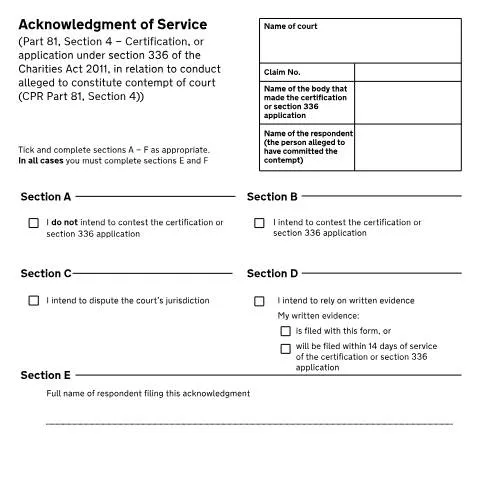
The primary function of the N210C form is to serve as an acknowledgment by the respondent— the individual or organisation alleged to have committed contempt of court — of their participation in the proceedings. It is used either to confirm whether the respondent intends to contest the certification or application or to declare their intention to dispute the court’s jurisdiction or rely on written evidence.
This form is a legal requirement in proceedings where allegations of contempt are made, ensuring that the respondent formally records their position. It also facilitates the court’s management of the case by clarifying the respondent’s intentions and the evidence they intend to rely upon.
Who Needs to Complete the N210C?
The form is relevant for:
- Respondents: The individual or organisation accused of conduct that may constitute contempt of court.
- Legal representatives: Solicitors or legal advisors acting on behalf of the respondent.
- Litigation friends: If the respondent is a child or vulnerable adult, a person authorised to act on their behalf.
The form must be completed and submitted to the court by the respondent or their legal representative within specified timelines, typically within 14 days of service of the certification or application.
Key Sections and Their Significance
Sections A to D: Respondent’s Position
The form provides multiple options for respondents to declare their stance:
- Section A: The respondent does not intend to contest the certification or application.
- Section B: The respondent intends to contest the certification or application.
- Section C: The respondent disputes the court’s jurisdiction.
- Section D: The respondent relies on written evidence, which may be filed with the form or within 14 days of service.
Completion of Sections E and F is mandatory in all cases, where the respondent provides their full name, confirms the truthfulness of the statements, and signs the document under a statement of truth.
Section E: Respondent’s Details
This section captures essential information including the respondent’s full name, the address for correspondence, and contact details such as phone number and email. When communicating with the court, notices should be addressed to the Court Manager, quoting the claim number.
Section F: Statement of Truth
The respondent must affirm that the facts presented are true, understanding that providing false information can lead to legal penalties for contempt of court. The form requires the signature of the respondent or their authorised representative, along with the date and, if applicable, details of their legal representative.
Legal and Procedural Considerations
Completing the N210C accurately and promptly is essential for the proper handling of contempt proceedings. The form is governed by the Data Protection Act 2018 and the UK GDPR, which safeguard personal data processed during the legal process.
Respondents should be aware that making false statements in the acknowledgment can have serious legal consequences, including potential contempt of court charges. Therefore, it is advisable to seek legal advice if there is any uncertainty about the content or implications of the form.
References and Contact Points
For further guidance, respondents should consult the official HM Courts & Tribunals Service resources or seek legal counsel. The court office handling the case is open from 10 am to 4 pm, Monday to Friday, and correspondence should be addressed to the Court Manager, quoting the relevant claim number.
Understanding the purpose and proper completion of the N210C form is vital for ensuring that respondents’ rights are protected and that proceedings are conducted fairly and efficiently within the UK legal framework.