Criminal Legal Aid: When Court Proceedings Demand Financial Scrutiny
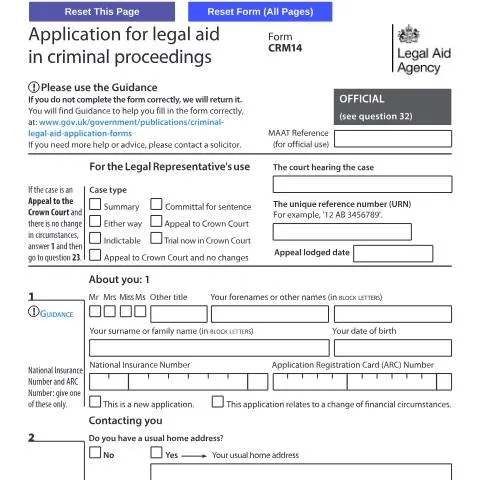
When facing criminal charges in England and Wales, the prospect of mounting legal costs can prove as daunting as the proceedings themselves. The CRM14 criminal legal aid application form serves as the gateway to publicly funded legal representation, but its completion requires careful navigation through detailed financial disclosure requirements that extend far beyond simple income declarations.
This Legal Aid Agency document operates as both a filter and a key—determining not only eligibility for criminal legal aid but also the level of contribution an applicant may need to make towards their defence costs. Unlike civil legal aid applications, the CRM14 process acknowledges the unique pressures facing defendants who may be in custody, on bail, or experiencing restricted circumstances that affect their ability to engage with standard administrative procedures.
Navigating the Eligibility Threshold: When CRM14 Becomes Your Starting Point
The CRM14 form applies specifically to criminal proceedings, distinguishing it from other Legal Aid Agency applications. Summary offences, either way offences, indictable matters, and Crown Court appeals all fall within its remit, though the complexity of financial assessment varies significantly depending on the case type and individual circumstances.
Crucially, the form includes provisions for changes in financial circumstances during ongoing proceedings. This flexibility recognises that criminal cases can span months or even years, during which an applicant's financial position may deteriorate due to loss of employment, custody restrictions, or other case-related impacts.
| Case Type | Assessment Level | Typical Processing Route |
|---|---|---|
| Summary only | Simplified means test | CRM14 completion sufficient |
| Either way proceedings | Full financial assessment | May require CRM15 supplementary form |
| Indictable Crown Court | Comprehensive review | Detailed capital and income analysis |
| Appeal (no change) | Existing assessment | Abbreviated process from question 23 |
Special Circumstances and Expedited Processing
The form accommodates urgent situations through streamlined sections. Applicants whose cases represent appeals to Crown Court with no change in circumstances can bypass substantial portions of the financial assessment, proceeding directly to question 23. This provision prevents unnecessary delays when existing legal aid arrangements remain appropriate.
For defendants of no fixed abode or those whose usual residence has become inaccessible due to bail conditions or remand status, the form provides alternative correspondence arrangements through solicitor addresses, ensuring continuity of communication despite challenging personal circumstances.
Dissecting Financial Disclosure: Beyond Basic Income Assessment
The CRM14's financial sections reflect the Legal Aid Agency's comprehensive approach to means testing. The £12,475 annual income threshold serves as the primary gateway, but the form's structure reveals multiple pathways that can trigger requirement for the more detailed CRM15 supplementary assessment.
Automatic Passporting Benefits
Certain benefits provide automatic eligibility, bypassing detailed financial scrutiny:
- Income-Related Employment and Support Allowance (ESA)
- Income-Based Jobseeker's Allowance (JSA) with recent signing-on confirmation
- Income Support
- Guarantee State Pension Credit
- Universal Credit (subject to specific conditions)
The form requires precise dating for JSA claims, requesting the last sign-on date to verify active entitlement and prevent fraudulent applications based on lapsed benefits.
Complex Income Sources and Hidden Triggers
Beyond employment income, the CRM14 captures diverse revenue streams that might otherwise escape notice. Student grants and loans require declaration, as do informal arrangements such as board payments from family members or financial support from friends and relatives. These provisions prevent circumvention of means testing through non-traditional income arrangements.
Property ownership, even partial interests, immediately triggers referral to the CRM15 process. This includes overseas assets, reflecting the Legal Aid Agency's recognition that defendants may hold wealth in jurisdictions beyond England and Wales. Similarly, restraint orders and freezing orders affecting assets require detailed examination through supplementary documentation.
Partner Financial Assessment: Navigating Relationship Complexities
The CRM14's treatment of partner finances reflects sophisticated understanding of domestic arrangements and potential conflicts of interest. The form distinguishes between married couples, civil partnerships, and cohabiting relationships, applying consistent financial assessment principles across different legal arrangements.
Conflict of Interest Exclusions
Critical exceptions apply when partners occupy conflicting roles within the criminal proceedings. Where a partner serves as a victim, prosecution witness, or co-defendant with conflicting interests, their financial circumstances become irrelevant to the applicant's legal aid assessment. This prevents situations where domestic relationships could compromise either the legal aid application or the integrity of criminal proceedings.
For co-defendants sharing legal representation without conflicts, joint assessment may apply, potentially affecting both parties' contribution obligations and choice of legal representatives.
Separation and Relationship Breakdown
The form accommodates relationship changes through specific separation provisions, requiring precise dating of relationship breakdown. This temporal element proves crucial for determining relevant assessment periods and preventing inappropriate inclusion of former partner finances in current applications.
Self-Employment and Business Interests: Complexity Triggers
Business involvement immediately escalates CRM14 applications to full CRM15 assessment. The form captures various commercial arrangements including sole trading, business partnerships, company directorships, and private company shareholdings. This broad definition prevents avoidance of detailed financial scrutiny through complex business structures.
The Legal Aid Agency's approach recognises that business assets and income streams require specialist evaluation beyond the scope of standard employment assessment. Directors and shareholders may hold significant wealth through company structures while declaring minimal personal income, necessitating comprehensive business analysis.
Age-Related Provisions and Simplified Assessment Routes
Applicants under 18 years benefit from streamlined processing, proceeding directly to question 23 after basic identification. This reflects recognition that juvenile defendants typically lack independent financial resources and complex asset arrangements requiring detailed assessment.
However, the form maintains capability for comprehensive assessment where young applicants demonstrate unusual financial circumstances, such as inheritance, trust arrangements, or business involvement that might affect their legal aid entitlement.
Evidence Requirements and Documentation Standards
The CRM14 includes specific evidence requirements throughout its financial sections, though these appear selectively rather than universally. Employment evidence, benefit confirmation, and other income verification receive particular emphasis, reflecting areas where the Legal Aid Agency has identified frequent discrepancies or attempted misrepresentation.
The form's guidance emphasises accuracy over speed, warning that incorrect completion results in form return and processing delays. This approach prioritises first-time accuracy over rapid turnaround, recognising that criminal proceedings often operate under tight time constraints where administrative delays can prove particularly damaging.
Digital Integration and Processing Efficiency
Reference to online guidance at gov.uk/government/publications/criminal-legal-aid-application-forms indicates the Legal Aid Agency's commitment to supporting accurate completion through accessible resources. This hybrid approach combines paper-based applications with digital guidance, accommodating varying technological capabilities among applicants while maintaining comprehensive support materials.
The MAAT reference system (Means Assessment Administration Tool) provides unique case tracking, enabling efficient processing and reducing administrative errors through systematic case management.
Strategic Timing and Application Coordination
The CRM14's design acknowledges the dynamic nature of criminal proceedings, where legal aid requirements may evolve alongside case developments. Committal for sentence, either way proceedings, and Crown Court transfers each present distinct assessment requirements that the form addresses through flexible routing mechanisms.
For appellants, the form provides expedited processing where circumstances remain unchanged, preventing unnecessary duplication of assessment work while maintaining appropriate oversight of public funding decisions. This balance between efficiency and accountability reflects the Legal Aid Agency's dual obligations to provide accessible justice while protecting public resources.
Understanding these operational nuances proves essential for both applicants and their legal representatives, enabling strategic timing of applications and appropriate preparation of supporting documentation. The CRM14 thus serves not merely as an application form but as a comprehensive framework for navigating the intersection between criminal justice requirements and public funding constraints.
Eligibility Assessment: Understanding Financial Thresholds and Means Testing
The CRM14 application triggers a comprehensive means test that evaluates your financial circumstances against statutory thresholds set by the Legal Aid Agency. Your eligibility hinges on both your gross annual income and disposable income calculations, which follow strict guidelines outlined in the Legal Aid, Sentencing and Punishment of Offenders Act 2012.
For magistrates' court proceedings, you'll automatically qualify for legal aid if your gross annual income falls below £12,475. However, if your income exceeds this threshold but remains under £22,325, you'll undergo a full means assessment. The LAA examines your disposable income after deducting allowable expenses including housing costs, childcare payments, National Insurance contributions, and income tax. Your disposable monthly income must not exceed £315 to qualify for non-contributory legal aid.
Crown Court cases follow different parameters. Regardless of your financial position, you can apply for a representation order, though you may face contribution requirements if your disposable income exceeds certain bands. The LAA calculates contributions using a sliding scale: those with disposable income between £315 and £740 monthly typically pay graduated contributions over six months.
Special circumstances can override standard financial assessments. If you receive Universal Credit, Income Support, income-based Jobseeker's Allowance, or Pension Credit guarantee credit, you automatically pass the means test without further financial scrutiny. Similarly, applicants under 18 years old generally qualify without means testing, though parental income may be considered in specific circumstances.
Capital assets also factor into eligibility calculations. The LAA disregards your main residence's value and the first £100,000 of capital for Crown Court matters, or £30,000 for magistrates' court cases. However, excessive capital holdings—particularly liquid assets like savings accounts or investment portfolios—can disqualify your application regardless of income levels.
Recent legislative changes have introduced hardship provisions for borderline cases. If standard calculations suggest ineligibility but legal aid refusal would cause exceptional hardship, you can request discretionary assessment. This requires detailed justification demonstrating how paying privately would compromise your basic living standards or access to justice.
Navigating Complex Case Types and Procedural Requirements
Different criminal charges trigger distinct procedural pathways within the CRM14 framework, each carrying specific documentation requirements and processing timelines. Understanding these variations proves crucial for ensuring your application addresses the correct legal aid scheme and meets appropriate deadlines.
Indictable-only offences—serious crimes like murder, rape, or robbery that must be heard in Crown Court—generally attract automatic legal aid eligibility subject to means testing. However, your solicitor must still submit the CRM14 within strict timeframes, typically within 21 days of your first court appearance. These cases often involve complex evidence disclosure requirements, making early legal representation essential for proper case preparation.
Either-way offences present more nuanced challenges. Crimes like theft, fraud, or assault can be heard in either magistrates' or Crown Court, depending on severity and your plea election. The venue decision significantly impacts your legal aid entitlement and potential financial contributions. Magistrates' court proceedings generally involve lower legal costs but more restrictive eligibility criteria, while Crown Court cases offer broader representation scope but potentially higher contribution requirements.
Summary-only offences—minor matters like traffic violations or minor public order offences—face the strictest legal aid restrictions. The interests of justice test becomes paramount, requiring compelling evidence that legal representation is essential. Common qualifying factors include potential imprisonment, substantial community penalties, or cases involving complex legal arguments that exceed reasonable self-representation capabilities.
Appellate proceedings require separate CRM14 applications with additional justification requirements. Appeals against conviction or sentence must demonstrate reasonable prospects of success and that continued representation serves justice interests. The LAA scrutinises these applications particularly carefully, often requesting detailed grounds of appeal and case law precedents supporting your position.
Multi-defendant cases introduce coordination complexities. Each defendant must submit individual CRM14 applications, though the LAA may consolidate processing for efficiency. Conflicts of interest between co-defendants can necessitate separate representation, potentially affecting overall case costs and individual contribution assessments. Your solicitor must clearly outline representation arrangements and potential conflict scenarios within the application.
Cases involving vulnerable defendants—those with mental health conditions, learning difficulties, or substance abuse issues—benefit from enhanced legal aid provisions. The CRM14 should highlight vulnerability factors supported by medical evidence or social services reports. These circumstances often strengthen interests of justice arguments and may influence means testing discretionary decisions.
Post-Application Procedures and Rights of Review
Once submitted, your CRM14 application enters the Legal Aid Agency's processing system, triggering a series of assessment stages that can significantly impact your case timeline and representation arrangements. Understanding these procedures helps you anticipate potential delays and prepare for various outcomes.
Initial processing typically takes 10-15 working days for straightforward applications, though complex cases or incomplete submissions can extend this considerably. The LAA may request additional documentation during assessment, issuing formal information requests that specify required materials and deadlines. Failure to respond promptly can result in application refusal or processing delays that potentially compromise your court preparation time.
Provisional refusal notifications outline specific grounds for rejection and provide 14-day windows for submitting additional evidence or clarifications. Common refusal reasons include insufficient financial documentation, failure to meet interests of justice criteria, or procedural errors in form completion. Your solicitor should review refusal letters carefully and identify whether additional submissions might address LAA concerns.
Successful applications generate representation orders specifying approved solicitors, case scope limitations, and any contribution requirements. These orders carry legal significance—they formally authorise your solicitor to act and establish the LAA's funding commitment. However, representation orders can include restrictions limiting work types or requiring prior authority for certain activities like expert witness instructions or additional counsel appointments.
Financial contribution arrangements require careful attention to payment schedules and reporting obligations. The LAA typically collects contributions through direct debit arrangements over six monthly instalments, though alternative payment methods may be available for specific circumstances. Missing contribution payments can jeopardise your legal aid certificate and potentially leave you liable for full legal costs.
Review and appeal mechanisms provide important safeguards against incorrect decisions. You can request internal LAA reviews within 21 days of adverse decisions, submitting new evidence or challenging assessment methodologies. Independent adjudicator reviews offer further appeal routes for complex disputes, though these processes can take several months to complete.
Changes in circumstances during proceedings require prompt notification through formal variation procedures. Significant income changes, new dependants, or altered housing costs can affect eligibility and contribution requirements. The LAA may conduct periodic reviews for lengthy cases, potentially adjusting arrangements based on updated financial assessments.
Case conclusion triggers final accounting procedures where the LAA reconciles actual legal costs against initial estimates. Unused legal aid funds return to the agency, while cost overruns may require additional approvals or client contributions. Understanding these final procedures helps you anticipate potential additional liabilities and ensures proper case closure.