Deciphering the Purpose of the CoC Revalidation Document
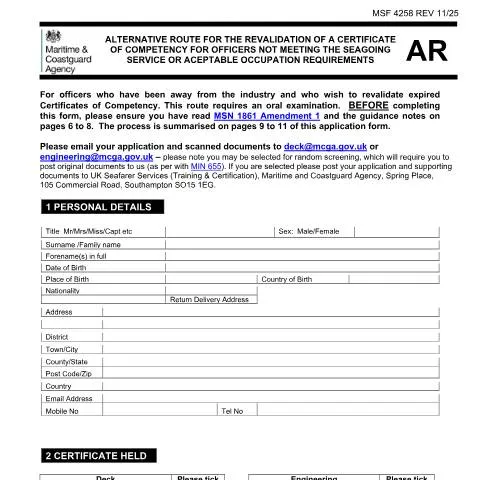
Imagine a seasoned mariner returning to the sea after a hiatus, eager to resume their career but faced with the challenge of revalidating their Certificate of Competency (CoC). This document from the Maritime and Coastguard Agency (MCA) outlines the specific route for officers who do not meet the usual seagoing service requirements of the STCW (Standards of Training, Certification, and Watchkeeping). Unlike straightforward applications, this alternative route requires not only written submissions but also an oral examination, making it a unique process within the maritime certification landscape.
Understanding the Legal Framework Behind CoC Revalidation
The regulatory backdrop to the CoC revalidation process is anchored in the Merchant Shipping (Training and Certification) Regulations 2021. This legal framework evolved to ensure that maritime professionals maintain the skills and knowledge necessary for safe and efficient operations at sea. Specifically, the MSN 1861 Amendment 1 provides essential guidelines for the revalidation process, laying out the requirements for those applying through this alternative route. It is crucial for applicants to be well-versed in these regulations to avoid unnecessary delays and complications.
Essential Steps to Navigate the Application Process
- Preparation: Before starting the application, it’s vital to gather all required documents, including a valid medical fitness certificate (ENG1), proof of previous qualifications, and endorsements.
- Filling Out the Form: The application form should be completed meticulously, including all personal details and relevant certificates. This form must be sent either via email to the designated addresses or through traditional mail if selected for random screening.
- Oral Examination: After the submission, applicants must prepare for the oral examination, which is a decisive component of the revalidation process.
- Post-Submission Monitoring: Applicants should keep track of their application status and be prepared to provide additional documents if requested by the MCA.
Choosing the Right Submission Method
Understanding the channels through which one can submit their application is critical. The MCA allows for both online and postal submissions. While emails are convenient, applicants should note that, if selected for a screening process, they will need to mail original documents to:
UK Seafarer Services (Training & Certification) Maritime and Coastguard Agency Spring Place 105 Commercial Road Southampton SO15 1EGThis requirement for original documents can lead to delays, so it’s advisable to confirm the method of submission at the outset.
Chronological Journey: From Application to Revalidation
The revalidation journey follows a structured timeline which can be broken down as follows:
- Initial Application: All relevant documentation is submitted along with the application form.
- Verification: The MCA reviews the application to ensure all documents are in order.
- Examination Scheduling: Upon successful verification, applicants are notified regarding their examination schedule.
- Oral Examination: Applicants participate in the oral assessment which tests their knowledge and competency.
- Decision Notification: The MCA communicates the outcome of the application and examination.
Addressing Potential Challenges: What If Something Goes Wrong?
Life is unpredictable, and sometimes, issues arise during the application process. Here’s what applicants should know:
- In Case of a Refusal: If your application is denied, the MCA will provide reasons for the refusal. An appeal process may be available depending on the circumstances.
- Missing Documents: If any documents are missing or incomplete, the MCA will request these before proceeding. It’s critical to respond promptly.
- Errors on the Form: Minor errors can often be corrected with a simple notification, but substantial inaccuracies may lead to delays or rejections.
Special Circumstances: Navigating Unique Situations
Applicants from diverse backgrounds may find themselves facing unique challenges. For instance:
- International Applicants: If applying from outside the UK, additional scrutiny may be applied, particularly regarding medical fitness certificates and equivalency of training.
- Holders of Older Certificates: Those with certificates predating the STCW amendments must provide additional evidence of training and may need to undergo further assessments.
- Urgent Applications: In certain cases, expedited processes may be available, especially for those seeking to re-enter the workforce quickly.
Who Needs to Apply: Profiles of Potential Applicants
The revalidation process is tailored for a specific group of maritime professionals:
- Seasoned Officers: Individuals who have been out of the industry for a significant period and whose CoCs have expired.
- Deck and Engineering Officers: Those holding specific types of CoCs who seek to revalidate under the alternative route due to lack of sufficient sea time.
- Varying Capacity Levels: The requirements may differ based on whether the officer is a Master, Chief Mate, or Engineer, each having their own set of additional documentation requirements.
Final Reminders for a Successful Application
As the application process unfolds, keeping the following points in mind can enhance the likelihood of a smooth experience:
- Stay Informed: Regularly check the MCA website for updates on regulations or requirements that may affect your application.
- Document Everything: Keep copies of all submitted documents and correspondence with the MCA for your records.
- Prepare for the Exam: Review relevant materials and practice competency questions to ensure you are well-prepared for the oral examination.
By following these steps and understanding the unique complexities of the CoC revalidation process, applicants can navigate this critical procedure with greater confidence and clarity.