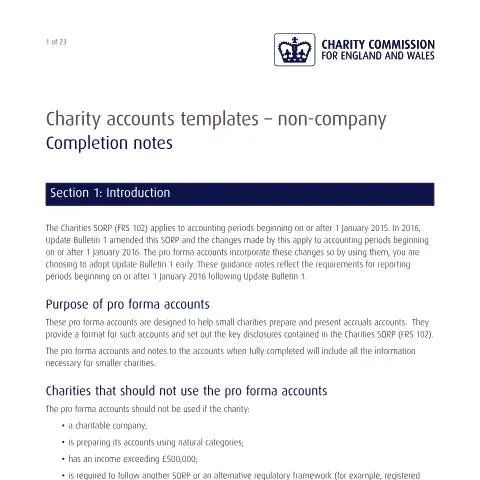
The Essential Template for Smaller Charities Navigating Complex Accounting Standards
When the Charities SORP (FRS 102) introduced new accounting standards beginning 1 January 2015, many smaller charities found themselves grappling with significantly more complex reporting requirements. The CC17 accruals accounts template emerged as The Charity Commission's practical response to this challenge, providing a structured pathway for non-company charities to prepare compliant accounts without requiring extensive accounting expertise.
This template represents more than just a convenience tool—it's a carefully crafted framework that translates the sophisticated requirements of FRS 102 into manageable sections for charities with annual income under £500,000. The template incorporates Update Bulletin 1 amendments that apply to accounting periods beginning on or after 1 January 2016, ensuring organisations using it automatically adopt the latest standards.
Eligibility Boundaries: Understanding When This Template Applies
The CC17 template serves a specific segment within the charity sector, and understanding its boundaries is crucial for proper application. The template is designed exclusively for non-company charities preparing accruals accounts using functional categories rather than natural categories of expenditure.
Income Threshold and Organisational Structure
The most straightforward eligibility criterion is the £500,000 annual income threshold. Charities exceeding this amount require more detailed reporting that the template cannot accommodate. However, income alone doesn't determine eligibility—the organisational structure plays an equally important role.
Charitable companies must follow different reporting frameworks entirely, as their accounts serve both charity law and company law requirements. Similarly, charities operating as registered social landlords fall under alternative regulatory frameworks that supersede the standard charity accounting requirements.
Complex Financial Arrangements That Exclude Usage
Several financial circumstances automatically disqualify charities from using this template. Investment fund charities, including common deposit funds and pooling scheme funds, require specialised reporting that reflects their unique operational model. Charities with material subsidiary undertakings, joint ventures, or associated trading operations need consolidated accounting approaches beyond the template's scope.
Organisations operating defined benefit pension schemes face particular complexity, unless they can account for such schemes as defined contribution arrangements due to inability to ascertain their share of underlying assets and liabilities.
| Exclusion Category | Specific Circumstances | Alternative Approach Required |
|---|---|---|
| Financial Complexity | Non-basic financial instruments under FRS 102 | Full SORP compliance with professional guidance |
| Endowment Management | Permanent endowment using total return approach | Specialised endowment accounting framework |
| Group Structure | Preparing group or linked accounts | Consolidated accounting standards |
Structural Components: Dissecting the Template Framework
The CC17 template transforms the comprehensive Charities SORP (FRS 102) into digestible sections that smaller charities can navigate systematically. Each component serves a specific function in creating compliant accounts while maintaining the true and fair view requirement.
Statement of Financial Activities Architecture
The template's statement of financial activities follows the functional categories approach, separating incoming resources and resources expended according to their charitable purpose. This structure requires charities to analyse their activities by function rather than simply listing expenditure by type—a distinction that often challenges smaller organisations accustomed to simpler bookkeeping approaches.
Incoming resources are categorised into voluntary income, activities for generating funds, investment income, and incoming resources from charitable activities. Each category requires specific disclosure levels, with particular attention to restricted funds and their application.
Balance Sheet Presentation Requirements
The balance sheet component incorporates FRS 102's asset and liability classification requirements while maintaining accessibility for non-specialist preparers. Fixed assets require depreciation policies and methods disclosure, whilst current assets and liabilities need careful classification to ensure compliance with accruals accounting principles.
The template addresses common areas where smaller charities struggle, such as distinguishing between restricted and unrestricted funds, properly accounting for designated funds, and ensuring creditor classifications align with FRS 102 requirements.
Materiality Principles and Precision Standards
One of the template's most valuable features is its practical guidance on materiality—a concept central to FRS 102 but often misunderstood by smaller charities. The template clarifies that materiality depends on whether an item's inclusion or exclusion would likely change a reader's understanding of the accounts.
Quantitative Materiality Guidelines
The guidance provides concrete examples: amounts under £1 can always be ignored, whilst a £500 tangible fixed asset might be material for a charity with £10,000 gross income but less significant for one with £250,000 income. This proportional approach helps trustees make informed decisions about disclosure levels.
Certain items remain material regardless of charity size, particularly amounts paid to trustees for expenses or remuneration, and transactions with related parties. These require disclosure even when amounts are relatively small, reflecting the heightened scrutiny such transactions warrant.
Rounding and Netting Conventions
The template establishes clear rounding conventions—accounts prepared in whole pounds with amounts rounded to the nearest pound. This seemingly minor detail ensures consistency across charity accounts and simplifies preparation for non-specialist preparers.
The prohibition on netting off requires all incoming resources and resources expended to be shown gross rather than net of related costs. This transparency requirement, whilst increasing apparent complexity, provides stakeholders with clearer insights into charity operations.
Scottish Charity Considerations and Dual Registration Implications
Charities registered in both England/Wales and Scotland face additional complexity when using the CC17 template. The Office of the Scottish Charity Regulator may require supplementary information beyond the template's standard provisions, necessitating careful review of dual jurisdiction requirements.
Scottish charity law differences can affect disclosure requirements, particularly around public benefit reporting and certain governance matters. Trustees must ensure their completed template accounts satisfy both jurisdictions' requirements, potentially requiring additional notes or supplementary statements.
Professional Guidance Integration and Complex Transaction Handling
The template acknowledges its limitations regarding complex transactions unusual for smaller charities. When charities encounter such situations, the template directs trustees to the full Charities SORP or professional accountant advice, maintaining the balance between accessibility and compliance.
When Professional Input Becomes Essential
Complex transactions requiring professional guidance include unusual investment arrangements, significant grants with complex conditions, major asset disposals with restrictions, or transactions involving trustees beyond routine expense reimbursements. The template's completion notes help trustees identify when they've reached the boundaries of self-preparation.
Professional accountants familiar with the Charities SORP can adapt the template for borderline cases or supplement it with additional notes addressing charity-specific circumstances not covered in the standard format.
Approval Processes and Trustee Responsibilities
The template emphasises trustee responsibility for account approval, requiring at least one trustee signature on the balance sheet as evidence of approval—though the guidance recommends two signatures for enhanced governance. This requirement reinforces trustees' legal accountability for account accuracy and compliance.
Trustees must ensure the completed template provides all information necessary for a true and fair view of their charity's activities and financial position. Where the standard template proves insufficient, trustees bear responsibility for adding supplementary notes or disclosures to meet this fundamental requirement.
Legal Compliance Assurance
When properly completed with accurate information from charity accounting records, the template meets legal requirements for annual accounts preparation. This assurance provides valuable certainty for smaller charities concerned about compliance with increasingly complex regulatory frameworks.
The template's design incorporates mandatory disclosure requirements whilst providing flexibility for charity-specific circumstances. Trustees can confidently use the template knowing it reflects current regulatory expectations whilst remaining adaptable to their organisation's particular needs.
Evolution and Future-Proofing Through Update Mechanisms
The CC17 template's incorporation of Update Bulletin 1 demonstrates The Charity Commission's commitment to maintaining current standards within the template framework. This approach allows smaller charities to benefit from regulatory updates without requiring extensive technical knowledge of accounting standard changes.
Future updates to the Charities SORP will likely trigger corresponding template revisions, ensuring continued relevance for the smaller charity sector. Charities using the template can expect periodic updates that reflect regulatory developments whilst preserving the accessibility that makes the template valuable.
The template represents a significant evolution in charity regulation, bridging the gap between sophisticated accounting standards and practical charity management. By translating complex requirements into manageable formats, it enables smaller charities to maintain compliance whilst focusing resources on their charitable purposes rather than administrative complexity.
Navigating Complex Income Recognition Under FRS 102 SORP Requirements
Income recognition presents particular challenges for charities preparing accruals accounts under FRS 102 SORP, especially when dealing with restricted funds, multi-year grants, and conditional donations. The CC17 template requires careful consideration of when income should be recognised and how it should be categorised across unrestricted, restricted, and endowment funds.
Grant Income and Performance-Related Conditions
Performance-related grants must be recognised as income only when the charity has entitlement to the funds, which typically occurs when performance conditions are met rather than when the grant agreement is signed. For multi-year grants with annual performance milestones, income should be recognised incrementally as each milestone is achieved. The CC17 template requires disclosure of any unspent grant balances carried forward, which should be shown as creditors if the charity has not yet earned entitlement to the funds.
Where grants contain clawback provisions, trustees must assess whether recognition criteria are fully met. If there remains a realistic possibility that funds might need to be returned due to non-performance, recognition may need to be deferred until uncertainty is resolved. This assessment requires careful documentation to support the trustees' judgement, particularly for grants spanning multiple accounting periods.
Donated Goods and Services Valuation
The SORP requires recognition of donated goods and services where they have a quantifiable financial value and would otherwise have been purchased by the charity. Professional services donated by solicitors, accountants, or consultants should be valued at the amount the charity would reasonably expect to pay for equivalent services. However, volunteer time is generally not recognised unless it involves specialist skills that would otherwise require paid professionals.
Donated facilities present particular valuation challenges. Where premises are provided rent-free or at below market rates, the benefit should be measured as the difference between the amount paid (if any) and the estimated rental value. This requires obtaining appropriate evidence of market rates, often through professional valuation or comparison with similar properties in the local area.
Investment Income and Gains
Investment income must be allocated between unrestricted and restricted funds according to the underlying fund designation of the investments. Where investments are held as part of a mixed fund, allocation should reflect the fund balances represented by the investment portfolio. Realised and unrealised gains on investments follow similar allocation principles, with movements clearly shown in the Statement of Financial Activities.
For charities holding social investments, the CC17 template requires separate disclosure of any programme-related investment returns. These investments, made primarily to further charitable purposes rather than generate financial return, may produce below-market returns that need careful explanation in the trustees' annual report.
Managing Fund Accounting Complexities in Charitable Financial Reporting
Fund accounting represents one of the most distinctive aspects of charity financial reporting under FRS 102 SORP. The CC17 template requires clear segregation between unrestricted funds, restricted funds, and endowment funds, each with different rules governing their use and reporting treatment.
Restricted Fund Management and Reporting
Restricted funds arise from donations or grants given for specific purposes defined by the donor. The CC17 template requires detailed analysis of fund movements, showing opening balances, incoming resources, resources expended, transfers between funds, and closing balances for each material restricted fund. Trustees must ensure that restricted funds are only used for their designated purposes and that any unspent balances are properly carried forward.
Where restricted funds become deficit, this typically indicates expenditure has been incurred in anticipation of future restricted income. Such deficits should only arise where trustees have reasonable expectation of receiving sufficient restricted income to cover the expenditure. The deficit represents a temporary funding arrangement that must be clearly explained in the notes to the accounts.
Transfers between funds require careful justification and must comply with charity law requirements. Transfers from restricted to unrestricted funds are only permitted where the restricted purpose has been fulfilled or where the transfer represents a reasonable allocation of support costs. All transfers must be clearly disclosed in the Statement of Financial Activities with adequate explanation in the notes.
Endowment Fund Complexities
Permanent endowments must be maintained in perpetuity, with only the income available for charitable application. The CC17 template requires separate identification of permanent endowments and expendable endowments, where the capital may eventually be spent on charitable purposes. Investment gains and losses on permanent endowments are typically added to or deducted from the endowment fund unless the governing document specifies otherwise.
Total return investment for permanent endowments allows charities to treat capital gains as available for spending, subject to maintaining the real value of the endowment. This requires careful calculation and disclosure of the unapplied total return, representing the amount available for future allocation to income. The Charity Commission's guidance CC14 provides detailed requirements for charities adopting total return investment policies.
Designated Fund Considerations
Designated funds represent unrestricted funds earmarked by trustees for particular purposes. Unlike restricted funds, designations can be removed by trustee decision, providing important flexibility in financial management. The CC17 template encourages disclosure of significant designations, particularly where these represent substantial portions of unrestricted reserves.
Common designations include fixed asset funds (representing funds tied up in operational assets), project funds (for specific initiatives), and general reserves (for operational contingencies). The designation policy should be clearly explained in the trustees' annual report, demonstrating how reserves support the charity's strategic objectives and risk management.
Compliance Obligations and Regulatory Interface Requirements
Charities preparing accruals accounts face multiple compliance obligations beyond basic financial reporting. The CC17 template must satisfy not only accounting standards but also charity law requirements, Charity Commission expectations, and potential scrutiny from other regulators including HMRC for tax purposes.
Charity Commission Annual Return Integration
The annual accounts prepared using the CC17 template must align with information submitted in the charity's annual return to the Charity Commission. Key figures including total income, expenditure, assets, and liabilities must correspond between documents. Discrepancies often arise from timing differences in preparation, requiring careful reconciliation and explanation.
The Charity Commission pays particular attention to significant movements in reserves, unusual transactions, and compliance with spending requirements for charitable companies. Trustees must ensure that the trustees' annual report adequately explains any matters that might prompt regulatory enquiry, including substantial grant payments to connected parties or significant changes in charitable activities.
Where charities operate in multiple jurisdictions, additional complexity arises from ensuring compliance with relevant regulations in each territory. Scottish charities must also satisfy requirements of the Office of the Scottish Charity Regulator (OSCR), while Northern Ireland charities report to the Charity Commission for Northern Ireland, each with specific formatting and disclosure expectations.
Tax Compliance and HMRC Interface
Charitable tax exemptions depend on proper application of funds for charitable purposes exclusively. The CC17 accounts must demonstrate this through clear fund accounting and adequate disclosure of any non-charitable expenditure. Trading activities conducted through subsidiary companies require consolidated accounts where materiality thresholds are exceeded.
VAT registration requirements may apply where gross income exceeds statutory thresholds, even for exempt charities. The accounts must properly reflect VAT treatment of different income streams, with irrecoverable VAT included in the relevant expenditure categories. Gift Aid claims must be supported by appropriate donor declarations and proper accounting records linking donations to tax reclaims.
Corporation tax may apply to non-charitable trading activities or investment income falling outside charitable exemptions. The CC17 template requires adequate disclosure of tax provisions and any disputes with HMRC regarding charitable status or tax treatment of particular activities.
Audit and Independent Examination Requirements
Charities with gross income exceeding £1 million must generally obtain statutory audit, while smaller charities may opt for independent examination. The CC17 template must accommodate the different reporting requirements for audited versus independently examined accounts, particularly regarding going concern assessments and risk disclosures.
Auditors must report on compliance with charity law as well as accounting standards, potentially identifying reportable matters for Charity Commission attention. The management letter process often highlights areas for improvement in financial controls and accounting procedures, requiring trustee consideration and response.
Independent examiners have more limited scope but must still report any matters of material significance affecting the charity's compliance with regulatory requirements. The examination report becomes part of the public record, requiring careful consideration of any qualified opinions or emphasis of matter paragraphs that might affect stakeholder confidence.