Understanding the Parental Responsibility Agreement under Section 4ZA of the Children Act 1989
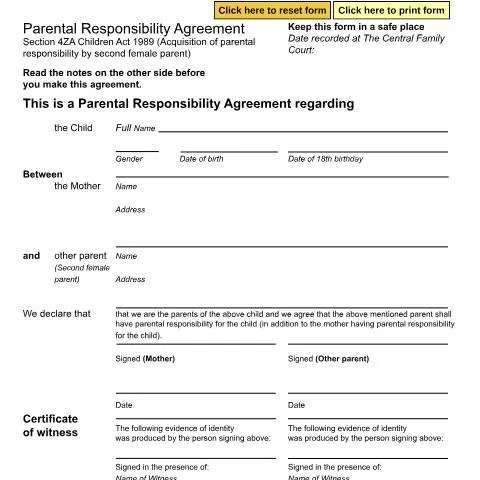
The Parental Responsibility Agreement outlined in Form C(PRA3) is a legal document used within the United Kingdom to formalise the agreement of parental responsibility for a child. This guide aims to clarify the purpose, application, and process involved in making such an agreement, especially for the second female parent, in accordance with the provisions of the Children Act 1989 and related legislation.
Purpose and Scope of the Parental Responsibility Agreement
The primary objective of this agreement is to legally recognise the parental responsibility of a second female parent who is not automatically granted such rights under the law. Typically, parental responsibility confers rights and responsibilities regarding the child's upbringing, including decisions about education, health, and welfare.
This form is specifically designed for cases where the second female parent is a parent by virtue of section 43 of the Human Fertilisation and Embryology Act 2008, often in situations involving assisted reproduction or non-traditional family arrangements. The agreement provides a formal mechanism to establish legal parental rights without the need for court proceedings.
Who Can Use This Agreement?
- The mother of the child, who already holds parental responsibility.
- The second female parent, who seeks to acquire parental responsibility through an official agreement.
Both parties must be willing to enter into the agreement and should consider seeking legal advice beforehand. This ensures that both understand the legal implications, including how the agreement can be ended or altered in the future.
The Process of Making a Parental Responsibility Agreement
Preparation
Before completing the form, the parents should gather essential documents:
- The child's full birth certificate, to prove parentage.
- Proof of identity for both parents, such as passports or official photographic ID.
It is important to fill out the form using black ink, and only one child's details should be included per form. If there are multiple children, separate agreements are necessary for each.
Signing and Witnessing
The agreement must be signed in the presence of an authorized witness, such as a Justice of the Peace, a justices' clerk, or an officer of the court authorized to administer oaths. The witness will confirm the identity of the signatories and sign the certificate of witness accordingly.
Both parents should bring their proof of identity to the court. The mother must also present the child's full birth certificate as proof of her identity and relationship to the child.
Submission and Recording
Once signed and witnessed, the agreement must be submitted to a local family court or the Central Family Court at First Avenue House, London. The court will record the agreement, keep the original form, and send stamped copies back to each parent at the addresses provided.
The agreement does not take effect until it has been officially recorded by the court. It remains valid until the child turns 18, unless terminated earlier through a court order or mutual agreement.
Legal Effect and Termination of the Agreement
Creating a parental responsibility agreement influences the legal rights and responsibilities of both parents regarding the child's upbringing. It provides clarity and formal recognition of parental roles outside of traditional biological parentage.
The agreement can be ended under specific circumstances:
- By court order following an application by a person with parental responsibility or the child, with court permission.
- Automatically when the child reaches the age of 18.
Important Considerations for Parents
Both parents are advised to seek legal counsel before entering into the agreement to understand fully the implications. Legal aid may be available depending on circumstances, and guidance can be obtained from legal professionals, Citizens Advice Bureaux, or Law Centres.
Making an informed decision ensures that the best interests of the child are prioritized and that both parents are aware of their rights and responsibilities under UK law.
Summary
The Parental Responsibility Agreement under Section 4ZA of the Children Act 1989 provides a formal process for a second female parent to acquire parental rights. It involves signing a legally binding document in the presence of an authorized witness, submitting it to the court, and ensuring proper legal advice is sought beforehand. This process helps clarify parental roles and supports the child's welfare within the framework of UK family law.