Understanding the Parental Order Agreement under Section 54 of the Human Fertilisation and Embryology Act 2008
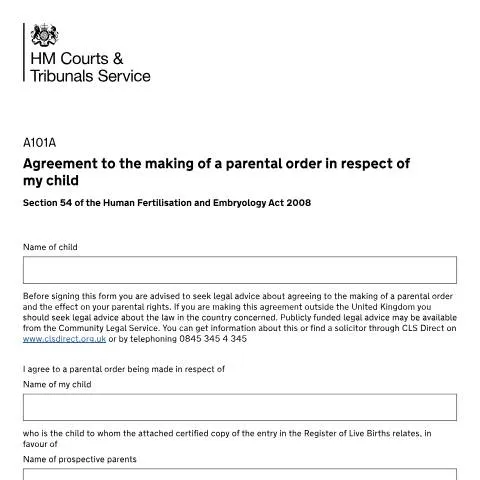
The Agreement to the making of a parental order in respect of my child (Form A101A) is a formal legal document used within the framework of UK family law, specifically under Section 54 of the Human Fertilisation and Embryology Act 2008. This form is designed for individuals who wish to consent to a parental order, which effectively transfers parental rights from the birth parent to the intended parents, often in cases involving assisted reproduction or surrogacy arrangements.
Purpose and Scope of the Form
The primary purpose of this form is to record the voluntary agreement of a birth parent (or a person with parental responsibility) to the making of a parental order in favour of the prospective parents. A parental order legally reassigns parental rights, making the child a legal member of the applicants' family, and terminating the birth parent's parental rights and responsibilities.
This form is applicable in situations where the child was born as a result of assisted reproductive technology, such as IVF, or through surrogacy arrangements, where the legal transfer of parenthood is necessary. It is an essential document in the legal process of formalising parental responsibility in accordance with UK law.
Legal Considerations and Advice
Before signing this agreement, individuals are strongly advised to seek independent legal advice. The form explicitly recommends consulting a solicitor or legal advisor to understand the implications of consenting to a parental order, including the loss of parental rights and the child's legal status. For those outside the UK, legal advice should be obtained in the relevant jurisdiction, as laws regarding parental orders may differ.
Legal advice can be obtained through publicly funded services such as the Community Legal Service. Information about accessing legal aid or finding qualified solicitors can be found via the Legal Aid Agency or the Legal Services Commission.
Content and Key Provisions of the Form
Parties Involved
- The child: Identified by their full name and a certified copy of the birth register entry.
- The prospective parents: The individuals who seek to become the child's legal parents through the parental order.
Declaration of Consent
The birth parent declares their agreement to the parental order, understanding that this will transfer parental rights to the applicants. They acknowledge that they may withdraw their consent at any point prior to the court’s final decision, but must do so through the court and not directly with the applicants.
Confirmation of No Payment
The form includes a statement affirming that the birth parent has not received any payment or reward related to the arrangements for the parental order, ensuring compliance with legal restrictions on payments for reproductive material or surrogacy.
Legal Formalities and Witnessing
For the agreement to be valid, the form must be signed by the birth parent in the presence of an authorized witness. In England and Wales, this witness must be an officer of the Children and Family Court Advisory and Support Service (Cafcass). In Wales, the witness should be a Welsh family proceedings officer.
The witness must complete their details, including their name, address, and signature, and confirm that they observed the signing process. This ensures the authenticity of the agreement and adherence to legal protocols.
Implications of Signing the Agreement
By signing this form, the birth parent unconditionally agrees to the making of a parental order, fully understanding the legal consequences. Once the court grants the parental order, the child's legal parentage is transferred to the applicants, and the birth parent’s parental rights are extinguished.
This process is a vital step in formalising parental responsibility, especially in complex family arrangements involving assisted reproduction or surrogacy, ensuring the child's best interests are protected under UK law.
Summary
The Agreement to the making of a parental order is a legally significant document that facilitates the transfer of parental rights in accordance with the Human Fertilisation and Embryology Act 2008. It emphasizes the importance of legal advice, proper witnessing, and understanding the implications of such an agreement. Individuals involved in this process should ensure they are fully informed and seek appropriate legal guidance to navigate this complex legal area effectively.