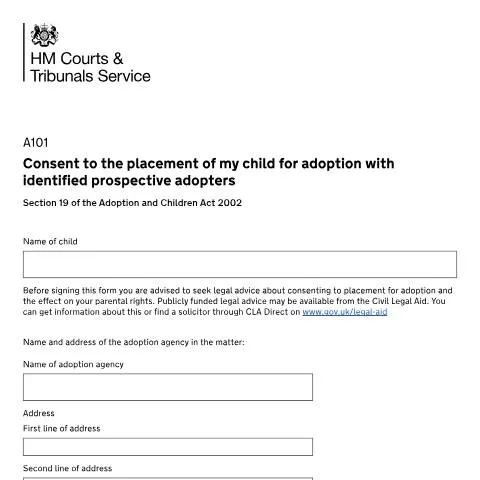
Understanding the Official UK Document: Consent to the Placement of a Child for Adoption with Identified Prospective Adopters
This guide provides an overview of the official UK form titled Consent to the placement of my child for adoption with identified prospective adopters, which is based on Section 19 of the Adoption and Children Act 2002. It aims to clarify its purpose, who it concerns, and the key legal considerations involved in the process of giving consent for a child's adoption placement.
Purpose and Legal Context
The form is an official document used within the framework of UK adoption law, specifically under Section 19 of the Adoption and Children Act 2002. Its primary purpose is to record a parent’s voluntary consent to the placement of their child with specific prospective adopters. This consent is a critical step in the adoption process, as it signifies the parent’s agreement that the child can be placed with the identified adopters, and it involves the transfer of parental rights and responsibilities.
Legal advice is strongly recommended before signing this form, as it has significant implications for parental rights and responsibilities. Publicly funded legal advice may be available through the Civil Legal Aid scheme, and individuals can find a solicitor or obtain further information via official government channels.
Who Is Concerned by This Document?
This form is intended for parents or guardians who are considering or have agreed to the placement of their child for adoption with specific prospective adopters. It is also relevant for adoption agencies that facilitate the process, as they oversee the legal and procedural aspects of consent and placement.
Additionally, the form involves the prospective adopters identified for the child, as their role and parental responsibility become legally recognized once consent is given and the placement proceeds.
Key Points and Considerations
Voluntary Consent and Its Implications
- By signing the form, the parent consents to the child's placement with specific adopters, acknowledging that they will no longer have legal parental rights once the child is placed.
- The parent understands that the adoptive parents will assume parental responsibility, and their own parental rights will be restricted accordingly.
- Once consent is given, the parent’s right to change their mind is limited, and the child cannot be removed from the placement without legal permission or court approval.
Withdrawal of Consent
- The parent may withdraw consent at any time before the prospective adopters initiate a court application for an adoption order.
- If withdrawal occurs before the placement, the child's return to the parent is generally expected within seven days, unless a court orders otherwise.
- If the child has already been placed with adopters and the application for an adoption order is underway, the parent’s ability to withdraw consent is limited, and the court’s permission may be required for the child's return.
Legal and Contact Rights
- Post-placement, the parent will typically lose contact rights unless arrangements are made through the court or the adoption agency.
- The parent retains the right to apply for contact through legal channels at any time, with the court determining what arrangements are appropriate.
Legal and Procedural References
This form is a statutory requirement under the Adoption and Children Act 2002, and its use is regulated by the UK legal system. The form must be witnessed by an authorized officer, such as a Children and Family Court Advisory and Support Service (Cafcass) officer in England, a Welsh family proceedings officer in Wales, or equivalent judicial figures in Scotland and Northern Ireland.
It is important to understand that signing this form is a serious legal act, indicating full understanding and voluntary agreement to the placement of the child for adoption. The process ensures that the parent’s decision is informed and that legal procedures are properly followed to protect the child’s welfare and the rights of all parties involved.
Conclusion
The Consent to the placement of my child for adoption with identified prospective adopters form is a vital document within the UK adoption framework. It formalizes a parent’s agreement to the child's placement and transfer of parental responsibility to the adoptive family. Given its legal significance, parents are advised to seek appropriate legal counsel before signing, to fully understand the implications and ensure their rights and the child's best interests are safeguarded throughout the process.