Understanding the Official Consent Form for Child Adoption Placement in the UK
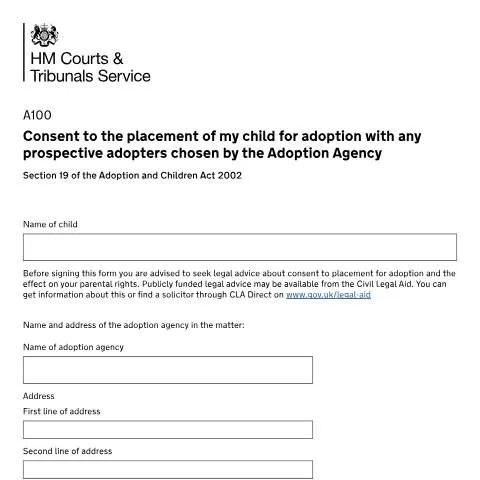
The Consent to the placement of my child for adoption with any prospective adopters chosen by the Adoption Agency form, known as Form A100, is an essential legal document under Section 19 of the Adoption and Children Act 2002. It serves as a formal declaration by a parent or guardian regarding their consent to the placement of a child for adoption with individuals selected by an approved adoption agency. This guide provides a detailed overview of the purpose, legal implications, and procedural aspects associated with this form, aimed at parents and guardians involved in the adoption process in England and Wales.
Purpose and Scope of the Form
The primary purpose of Form A100 is to obtain a parent's or guardian's informed consent for the placement of their child for adoption. It confirms that the individual understands the legal consequences of giving such consent, including the transfer of parental responsibility to the adoption agency and prospective adopters. The form is a critical step in ensuring that all parties are aware of their rights and obligations before the child is placed with new carers.
This form is used specifically in cases where the adoption agency has identified prospective adopters for the child, and the parent or guardian agrees to the placement. It does not, however, signify the completion of the adoption process; rather, it authorizes the initial placement, which may later be subject to court approval.
Who Is Concerned by This Form?
The form is intended primarily for biological parents or guardians of a child who are considering or have agreed to the child's placement for adoption. It is also relevant for legal representatives or those acting in a parental capacity who need to formally record their consent. The process is applicable in cases where the child's future carers are to be selected by an approved adoption agency, and the parent wishes to formalize their agreement to this arrangement.
Key Points and Legal Considerations
Legal Effect of Consent
- By signing the form, the parent or guardian agrees that their child will be placed with prospective adopters chosen by the adoption agency.
- Once consent is given, the parent’s legal rights are limited; parental responsibility transfers to the adoption agency and prospective adopters once the placement occurs.
- Significantly, the parent’s right to withdraw consent is restricted after the placement begins, especially once the prospective adopters have applied for an adoption order in court.
Withdrawal of Consent
Parents can withdraw their consent at any time before the prospective adopters initiate court proceedings for an adoption order. To do so, they must notify the adoption agency formally. The process of withdrawal involves specific considerations:
- If the child has not yet been placed, the agency will return the child within seven days of notification unless a court has issued a placement order.
- If the child is already placed, and court proceedings are underway, withdrawal may not be possible, and the parent must act through the agency.
Legal Advice and Support
Before signing, parents are advised to seek legal advice to understand the implications fully. Free legal aid may be available through the Civil Legal Aid scheme, and guidance can be obtained via the government’s legal aid resources.
Procedural Aspects and Witnessing
The form must be signed in the presence of an authorized witness—such as a Children and Family Court Advisory and Support Service (Cafcass) officer in England, a Welsh family proceedings officer, or a Justice of the Peace or Sheriff in Scotland. The witness confirms that the signing occurred voluntarily and in an appropriate legal context.
References and Authorities
This form is governed by the provisions of the Adoption and Children Act 2002, which sets out the legal framework for adoption procedures in England and Wales. It aligns with statutory requirements to ensure that the consent process respects the rights of parents while prioritizing the child's welfare.
For further information, individuals should consult the relevant legal guidance or contact their local adoption agency or legal adviser. The form itself is a critical document within the broader legal process of child adoption, ensuring transparency and legality in the placement of children for adoption in the UK.