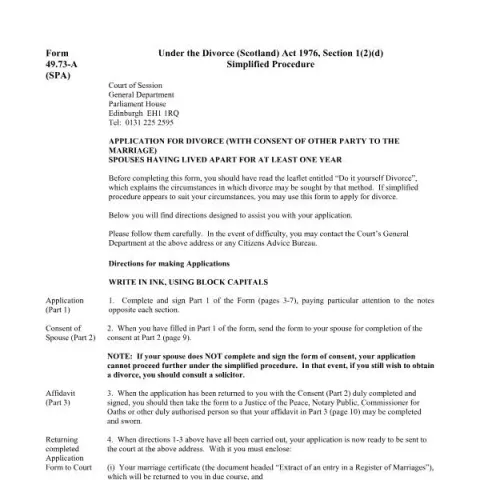
Understanding the Official Application for Divorce in Scotland: Form 49.73-A
The Application for Divorce (with consent of the other party to the marriage) is a formal legal process designed for spouses who have been living apart for at least one year and wish to divorce using the simplified procedure available under Scottish law. This official form, issued by the Scottish Courts and Tribunals Service, is intended for individuals seeking an uncontested divorce where both parties agree to the dissolution of the marriage.
When and Why to Use this Form
This form is suitable if you and your spouse have mutually agreed to divorce and have lived separately for a minimum of one year. It is particularly useful for couples who prefer a straightforward, less costly process without the need for contentious proceedings. Before completing the form, applicants are advised to read the leaflet titled “Do it yourself Divorce,” which explains the eligibility criteria and the circumstances under which this simplified procedure applies.
Key Requirements and Eligibility Criteria
To qualify for this streamlined divorce process, certain legal conditions must be met:
- Separation period: The couple must have lived apart for at least one continuous year immediately prior to the application.
- Mutual consent: Both spouses must agree to the divorce and sign the consent part of the form.
- Residency or domicile: Either the applicant or their spouse must be domiciled or habitually resident in Scotland for the relevant period.
Additionally, the marriage certificate must be submitted with the application, and the applicant must have a clear understanding of the legal process involved.
Step-by-Step Process for Completing the Application
Part 1: Filling Out the Application
Applicants should complete Part 1 of the form using ink and block capitals, providing accurate details about themselves and their spouse, including full names, addresses, and contact information. It is essential to ensure that the names match those on the marriage certificate. The applicant must also specify their domicile or habitual residence in Scotland.
Part 2: Spouse’s Consent
Once Part 1 is completed, the form should be sent to the spouse for their signature and consent in Part 2. The spouse’s consent is crucial; without it, the simplified procedure cannot proceed. If the spouse refuses or does not respond, the applicant may need to consider alternative legal routes through a solicitor.
Part 3: Swearing the Affidavit
After obtaining the spouse’s consent, the applicant must have the form sworn before an authorized person such as a Justice of the Peace, Notary Public, or Commissioner for Oaths. This sworn statement, included as Part 3, confirms the truthfulness of the information provided.
Submitting the Application to the Court
Once all parts are completed and sworn, the applicant must send the full application package to the Court of Session at the address specified in the form. Along with the application, the following must be included:
- Original marriage certificate: The official extract of the marriage registration, not a photocopy.
- Payment: A cheque or postal order for the court fee, payable to the “Scottish Court and Tribunals Service,” or a completed form SP15 claiming exemption.
The court will acknowledge receipt of the application. If the applicant wishes to withdraw the application at any point, they should contact the court immediately.
Points of Attention and Practical Tips
When completing the form, accuracy is essential. Any discrepancies or incomplete information may delay the process. Ensure that the marriage certificate details match the information provided in the application. Keep copies of all documents submitted.
Fill in your form directly online
No printing: type your details into the boxes of the official form, tick, then download the PDF ready to send.
- 1Type into the form boxes
- 2Tick in one click
- 3Save and download the PDF
Applicants should also be aware that if their spouse does not consent or if the process encounters difficulties, they may need to seek legal advice. The simplified procedure is designed for uncontested cases; contested divorces require a different legal process.
Legal and Administrative Support
For assistance, applicants can contact the Court of Session’s General Department or seek guidance from Citizens Advice Bureau. It is recommended to read all accompanying notes and instructions carefully before submitting the application to avoid errors or delays.
This official process offers a clear pathway for eligible couples to dissolve their marriage amicably and efficiently under Scottish law, provided all legal criteria are met and proper procedures followed.