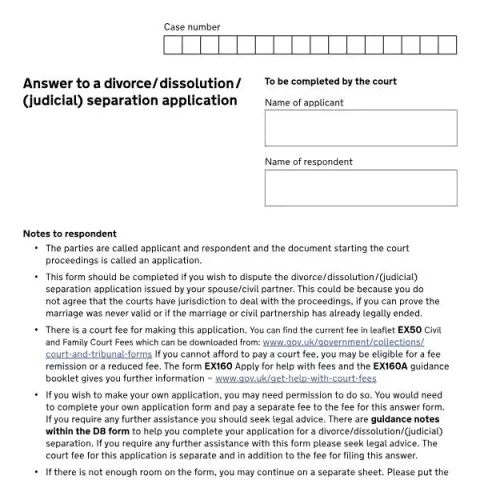
When Your Marriage or Civil Partnership is Under Legal Challenge
Receiving divorce or dissolution papers from your spouse or civil partner can be overwhelming, particularly when you fundamentally disagree with the legal basis of their application. The Form D8B provides a formal mechanism for respondents to challenge family court proceedings, but its use requires careful consideration of specific legal grounds and potentially significant financial implications.
This official response form serves a distinct purpose within England and Wales' family court system, managed by HM Courts & Tribunals Service. Unlike simply acknowledging receipt of proceedings, Form D8B enables you to actively dispute the legal foundation of a divorce, dissolution, or judicial separation application. The form addresses three critical scenarios where challenge may be appropriate: jurisdictional disputes, questions of marriage validity, and cases where the marriage or civil partnership has already been legally terminated.
Understanding when and how to utilise this form can significantly impact the trajectory of family proceedings, particularly given the court fees involved and the potential for complex legal arguments that may require professional representation.
Three Grounds for Disputing Family Court Applications
Form D8B operates within a framework of three specific grounds for disputing proceedings, each requiring distinct evidence and legal arguments. These grounds are not interchangeable and reflect fundamentally different legal challenges to the applicant's case.
Jurisdictional Challenges
Disputes over court jurisdiction typically arise in cases involving international elements. You might challenge jurisdiction if you believe the English or Welsh courts lack authority to hear the case, perhaps because neither party has sufficient connection to the jurisdiction or because proceedings are already underway elsewhere. This ground requires detailed knowledge of international family law principles and EU regulations that may still apply in certain circumstances.
Jurisdictional challenges often involve complex considerations around habitual residence, domicile, and the timing of proceedings in different countries. Evidence might include proof of residence elsewhere, documentation of foreign court proceedings, or detailed timelines establishing your connection to alternative jurisdictions.
Marriage Validity Disputes
Challenging marriage validity represents a fundamental dispute about whether a legally recognised marriage ever existed. This might involve questions about proper legal formalities during the ceremony, issues with capacity to marry at the time, or problems with the legal framework under which the marriage was conducted.
Common validity challenges include marriages conducted without proper legal authority, cases where one party lacked mental capacity, marriages involving underage participants, or situations where legal impediments existed (such as existing marriages that hadn't been properly dissolved). These cases require substantial documentary evidence and often involve detailed legal arguments about the circumstances surrounding the original ceremony.
Prior Legal Termination
The third ground addresses situations where you believe the marriage or civil partnership has already been legally ended through previous court proceedings. This might occur when foreign divorce or dissolution orders exist but haven't been properly recognised, or when there's confusion about the legal status following earlier court proceedings.
Establishing prior termination requires clear documentary evidence of previous court orders, along with legal arguments about their recognition and effect under English and Welsh law. This ground often intersects with complex questions about international recognition of foreign divorces and the proper procedures for establishing their validity.
Completing the Response: Section-by-Section Navigation
Form D8B follows a structured approach that builds your legal challenge systematically, requiring careful attention to detail and supporting evidence at each stage.
Personal Details and Case Identification
The opening sections require full names of both parties and the case number from the original application. Accuracy is crucial here as any discrepancies may cause delays or confusion. The case number links your response directly to the applicant's proceedings and ensures proper court file management.
When providing names, use exactly the same format and spelling as appears on the original application, even if you prefer different versions or have legally changed your name since the original proceedings began.
Grounds Selection and Detailed Explanation
The central section requires you to select your dispute ground and provide detailed explanation. This explanation section is critical and often determines the success of your challenge. The court needs sufficient detail to understand your legal position and the evidence supporting it.
Your explanation should be structured logically, presenting facts chronologically where relevant and clearly linking evidence to legal principles. If space is insufficient, continuation sheets must include proper headings with both parties' names and the relevant section number.
| Dispute Ground | Key Evidence Required | Common Challenges |
|---|---|---|
| Jurisdiction | Residence documents, foreign proceedings evidence | Proving habitual residence elsewhere |
| Marriage validity | Marriage certificate, ceremony documentation | Establishing legal defects in original ceremony |
| Prior termination | Foreign court orders, recognition documentation | Proving recognition under English/Welsh law |
Orders Requested and Alternative Applications
Beyond simply dismissing the applicant's case, Form D8B allows you to request specific court orders or indicate intentions to make your own application. The standard request involves dismissing the original application, but you might seek other orders depending on your circumstances.
If you intend to make your own divorce or dissolution application, this must be done separately with additional fees and forms. The D8B form notes this requirement clearly, emphasising that counter-applications require separate proceedings and court permission in some circumstances.
Previous Proceedings: Mapping Your Legal History
The form requires comprehensive disclosure of any existing or previous court proceedings affecting your marriage or civil partnership, including overseas proceedings. This section serves multiple purposes: it helps the court understand the broader legal context, identifies potential conflicts with foreign proceedings, and ensures compliance with disclosure obligations.
When documenting previous proceedings, include case numbers, participating parties, the nature of proceedings, court locations, and timing. Foreign proceedings require particular detail, including the country, court name, and current status. Even concluded proceedings may be relevant if they affect the current application's legal basis.
This disclosure extends beyond family proceedings to include any court action that might affect marriage validity or legal status. Immigration proceedings, capacity determinations, or criminal matters might all be relevant depending on your dispute grounds.
Service Arrangements and Confidentiality Considerations
Form D8B includes provisions for maintaining address confidentiality through the separate C8 form system. This protection mechanism is crucial in cases involving domestic abuse or safety concerns, allowing you to participate in proceedings without revealing your location to the other party.
If confidentiality isn't required, you must provide complete contact details including postal address, email, and telephone number. The court emphasises email contact for efficiency, but this should differ from any email address provided by the applicant to avoid confusion.
The service address becomes your official contact point for all future court communications, making accuracy essential. Changes to these details must be promptly communicated to the court to ensure you receive important documents and hearing notices.
Electronic Communication Preferences
Modern court administration increasingly relies on electronic communication for efficiency. Providing email addresses and telephone numbers enables faster contact for hearing arrangements, document service, and administrative queries. However, ensure these contact methods are reliable and regularly monitored, as missing court communications can have serious consequences for your case.
Financial Obligations and Fee Arrangements
Form D8B incurs court fees separate from any original application fees, reflecting the additional administrative and judicial resources required to handle disputed proceedings. Current fee information is available through the EX50 leaflet, which provides comprehensive fee schedules for civil and family proceedings.
The form accommodates various payment methods including card payments (processed within 28 days), cheques payable to 'HMCTS', and postal orders. Card payment arrangements involve the court contacting you after submission, with a specific telephone number provided for queries if contact isn't received within the expected timeframe.
Help with Fees Applications
Financial hardship shouldn't prevent access to justice, and the Help with Fees system provides remission or reduction for eligible applicants. You can apply online or through form EX160, with the EX160A guidance explaining eligibility criteria and application procedures.
Help with Fees applications can be submitted before or alongside your D8B form, with reference numbers provided for tracking purposes. Eligibility typically depends on savings levels, benefit receipt, or low income thresholds, with different criteria for partial and full remissions.
The application process requires detailed financial disclosure and supporting documentation. Processing times can affect your D8B submission timeline, so early application is advisable if you anticipate needing fee assistance.
Strategic Timing and Procedural Consequences
Submitting Form D8B initiates a more complex procedural pathway than undefended proceedings, with implications for timelines, costs, and court resources. Understanding these consequences helps inform your decision about whether to dispute proceedings and how to prepare for potential outcomes.
Disputed proceedings typically require court hearings where both parties present evidence and legal arguments. This extends the timeline significantly compared to administrative divorce processes and may involve multiple court appearances depending on the complexity of issues raised.
The court will consider your challenge alongside the applicant's evidence, potentially requiring expert testimony, document authentication, or witness statements. Successful challenges result in dismissal of the original application, but unsuccessful disputes may lead to cost orders against you, adding financial consequences to the procedural delay.
Legal Representation Considerations
While Form D8B can be completed without legal assistance, the complex legal issues involved often benefit from professional advice. Jurisdictional disputes require detailed knowledge of international family law, validity challenges involve technical legal requirements, and prior termination arguments need expertise in recognition procedures.
The form explicitly recommends seeking legal advice, particularly given the separate fees and procedures required for counter-applications. Professional representation becomes more valuable as proceedings become more complex, especially in cases involving international elements or technical legal arguments.
Consider the potential costs of legal representation against the likelihood of success and the consequences of unsuccessful challenges. Some cases may justify representation despite the expense, particularly where substantial financial interests or child welfare issues are at stake.
Special Circumstances and Complex Divorce Scenarios
Form D8B must address various complex situations that can arise during divorce proceedings. If your spouse has cited adultery as grounds for divorce, you'll need to carefully consider your response strategy. You can admit to the adultery, which may expedite proceedings, or contest the allegation if you believe it's unfounded. When contesting adultery claims, provide specific factual counter-evidence rather than emotional responses.
Fill in your form directly online
No printing: type your details into the boxes of the official form, tick, then download the PDF ready to send.
- 1Type into the form boxes
- 2Tick in one click
- 3Save and download the PDF
For cases involving domestic violence or abuse, Form D8B allows you to raise concerns about your safety during proceedings. The family court takes safeguarding seriously and can implement protective measures such as separate waiting areas, video links for hearings, or prohibiting direct contact between parties. If you've previously obtained a non-molestation order or occupation order, reference these in your response as they may influence how the court manages the case.
International elements complicate divorce responses significantly. If you or your spouse are non-UK nationals, or if you've lived abroad during the marriage, jurisdiction questions may arise. The court must establish it has authority to hear your case under Brussels IIa Regulation (retained EU law) or Hague Convention principles. Your D8B response should clarify your current residence status, how long you've lived in England or Wales, and any parallel proceedings in other countries.
Mental health considerations require sensitive handling in your response. If either party lacks mental capacity to participate fully in proceedings, the court may need to appoint a litigation friend. Similarly, if your spouse's mental health issues contributed to the marriage breakdown, this context might be relevant to your response, though avoid making amateur diagnoses or stigmatising language.
When responding to divorce applications involving significant business interests or professional practices, your Form D8B response sets the foundation for complex financial disclosure. If you're a partner in a law firm, medical practice, or own shares in private companies, early identification of these assets helps the court manage the case efficiently. Consider whether you'll need expert valuations for pension schemes, particularly if you have defined benefit schemes or significant SIPP arrangements.
Procedural Timelines and Court Management
Understanding court timelines helps you respond strategically to Form D8B requirements. Once you file your response, the court will typically issue a case management timetable setting out key milestones. The conditional order (formerly decree nisi) usually follows 20 weeks after the initial application, provided no complications arise from your response.
If you're defending the divorce, expect the court to list a case management hearing within 12-16 weeks of your D8B submission. This hearing determines whether the case proceeds as contested or if alternative resolution methods might be appropriate. Contested divorces are increasingly rare, with courts encouraging mediation or collaborative law approaches where possible.
The court's administrative efficiency depends partly on how thoroughly you complete Form D8B. Incomplete responses or unclear statements often trigger requests for further information, delaying proceedings by several weeks. Pay particular attention to the section requesting details of any other court proceedings, including family proceedings in magistrates' courts, County Court claims, or High Court matters involving the same parties.
Digital case management systems now handle most divorce proceedings, meaning your D8B response becomes part of an electronic file accessible to court staff, judges, and legal representatives. Ensure any supporting documents you reference in your response are clearly labelled and properly formatted for digital storage. The court may reject handwritten additions or poorly scanned attachments.
Priority cases, such as those involving children at risk or urgent financial hardship, may receive accelerated timetables. If your situation warrants priority treatment, clearly explain the urgency in your D8B response and provide supporting evidence. However, avoid claiming urgency without genuine grounds, as this may damage your credibility with the court.
Regional variations exist in court processing times and local practices. London divorce centres typically handle cases more quickly due to higher staffing levels, while some regional courts may experience delays during holiday periods or due to judicial availability. Your local family court will provide specific guidance on their current processing times when acknowledging receipt of your D8B form.
Financial Implications and Strategic Considerations
Your Form D8B response significantly impacts the financial aspects of your divorce. If you agree with your spouse's financial proposals, clearly state this to avoid unnecessary court hearings. However, if you disagree with proposed arrangements for property division, spousal maintenance, or pension sharing, your response must outline your position without revealing your full negotiating strategy.
Consider the tax implications of different financial settlements when drafting your response. Capital gains tax relief on matrimonial homes applies only during the tax year of separation and the following three tax years. If your divorce proceedings extend beyond this period, earlier agreement on property transfer becomes financially advantageous. Similarly, pension sharing orders have different tax consequences compared to pension attachment orders.
Business owners face particular challenges when responding to divorce applications. If you operate as a sole trader, partnership, or limited company director, your D8B response should acknowledge the complexity without prematurely disclosing commercial sensitivities. The court may later require detailed financial disclosure through Form E, but your initial response sets expectations about cooperation levels.
Inherited assets and pre-marital property require careful consideration in your response. While these may receive different treatment during financial remedy proceedings, avoid making definitive statements about asset classification in Form D8B. Family courts apply complex criteria when determining what constitutes matrimonial property, considering factors like the length of marriage, contributions made, and future needs.
International assets complicate financial responses significantly. If you own property abroad, have overseas bank accounts, or receive income from foreign sources, your D8B response should acknowledge these without providing detailed valuations. Exchange rate fluctuations and foreign tax obligations affect settlement calculations, requiring specialist advice that goes beyond the scope of your initial response.
Debt responsibility represents another crucial consideration. If your spouse has cited financial irresponsibility as contributing to the marriage breakdown, your response might address this while avoiding admissions that could prejudice later financial negotiations. Joint debts typically remain joint obligations regardless of divorce proceedings, but the court can make orders about who pays what during financial remedy hearings.
Professional indemnity insurance, directors' and officers' insurance, and other professional protections may be relevant to your financial position. If your career involves potential future liabilities, mention this context in your response without creating unnecessary alarm. The court needs to understand the complete financial picture when making long-term orders about spousal maintenance or pension sharing.