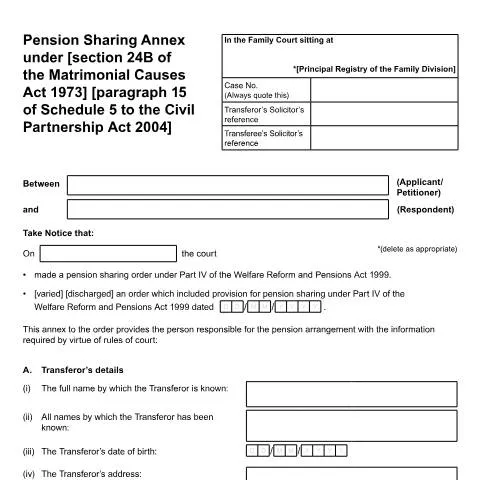
Understanding the Pension Sharing Annex: When Financial Orders Meet Retirement Provision
When a marriage or civil partnership ends, few financial matters prove as complex as dividing pension rights accumulated over years or decades of working life. The Form P1 Pension Sharing Annex serves as the crucial bridge between a court's financial order and its actual implementation by pension scheme administrators. This document transforms judicial decisions into actionable instructions that pension providers must follow, creating new pension rights for the receiving party whilst reducing those of the contributing member.
The form operates under the framework established by Part IV of the Welfare Reform and Pensions Act 1999, which introduced pension sharing as a clean-break alternative to pension attachment orders. Unlike attachment orders that create ongoing dependencies between former spouses, pension sharing creates immediate, independent pension rights. The P1 annex ensures that pension administrators receive all necessary information to discharge their legal obligations within the statutory four-month implementation period.
What distinguishes Form P1 from other family court documents is its dual function: it serves both as a legal notice to pension schemes and as a comprehensive data capture form ensuring no critical information is overlooked. The form's structured approach reflects the technical complexity of pension sharing, where seemingly minor oversights can delay implementation for months or even invalidate the entire arrangement.
Navigating the Legal Framework: From Court Order to Pension Credit
Form P1 operates within a specific legal sequence that begins with either section 24B of the Matrimonial Causes Act 1973 for married couples or paragraph 15 of Schedule 5 to the Civil Partnership Act 2004 for civil partners. The form cannot be completed until the underlying pension sharing order has been made by the Family Court, but crucially, the pension sharing cannot be implemented until both the court order and the decree absolute (or final dissolution order) are in effect.
This timing requirement creates a critical window where preparation becomes essential. Parties should gather all required information whilst awaiting their decree absolute, as the four-month implementation period for pension schemes begins from the later of several trigger dates. The pension scheme's clock starts ticking from whichever occurs last: the order taking effect, or their receipt of all required documentation including the P1 annex, copies of the final divorce order, complete transferor and transferee information, and payment of any outstanding charges.
The form serves as formal notice to the "person responsible for the pension arrangement" – typically the scheme administrator or insurance company managing the pension. This notice creates legal obligations under the Welfare Reform and Pensions Act 1999, making the P1 annex far more than mere paperwork; it triggers statutory duties with defined timeframes and potential penalties for non-compliance.
Transferor Details: Precision in Personal Information
Section A of Form P1 demands comprehensive identification of the transferor – the person whose pension rights are being shared. The requirement for "all names by which the Transferor has been known" reflects the reality that pension records often span decades, during which individuals may have used maiden names, adopted names, or variations in spelling that appeared on employment records.
The National Insurance number serves as the primary identifier, but pension schemes may hold records under slight name variations that could cause matching difficulties. Including all known name variations helps pension administrators locate the correct member record, particularly important for occupational schemes where records might date back decades or where scheme mergers have occurred.
Date of birth verification proves crucial because pension schemes use this as a security check against member records. Any discrepancy between the P1 annex and existing pension records can halt the implementation process whilst queries are resolved. The DD/MM/YYYY format specified reflects UK administrative conventions, and precision here prevents unnecessary delays in an already complex process.
The transferor's current address requirement serves multiple purposes: it provides the pension scheme with contact details for queries, ensures correspondence reaches the correct person, and may be needed for verification against existing member records where addresses have been used as security identifiers.
Transferee Information and the Complexity of Multiple Scheme Membership
Section B captures transferee details with additional complexity reflected in subsection (vi), which addresses situations where "the Transferee is also a member of the pension scheme from which the credit is derived, or a beneficiary of the same scheme because of survivor's benefits". This scenario, more common than might be expected, occurs when both parties worked for the same employer or where the transferee already holds survivor benefits from the transferor's scheme membership.
When the transferee holds existing rights in the same scheme, the membership number becomes crucial for administrators to correctly attribute the pension credit without creating duplicate records or administrative confusion. This situation requires careful handling because the transferee will hold two distinct sets of rights: their original entitlement and the new pension credit derived from the sharing order.
The comprehensive name history requirement for transferees serves similar purposes to transferor identification but carries additional weight because the transferee may be establishing their first relationship with this particular pension scheme. Unlike the transferor, whose records already exist within the scheme, the transferee represents a new data subject requiring accurate record creation from the outset.
Address verification for transferees becomes particularly important for external transfers, where the pension credit will move to a different pension arrangement. The address may be needed for establishing new membership records or for ongoing communication about the implementation process.
Pension Arrangement Identification and the Critical Percentage Calculation
Section C requires precise identification of the pension arrangement subject to sharing, starting with the formal scheme name. This proves more complex than it might appear because many pension schemes operate under trading names that differ from their legal titles, and scheme mergers or transfers can create confusion about the correct legal entity.
The "person responsible for the pension arrangement" typically means the scheme administrator, but identifying the correct entity requires understanding the scheme's governance structure. For occupational schemes, this might be the trustees or a professional administration company. For personal pensions, it could be an insurance company or investment platform. Getting this wrong can direct the P1 annex to the wrong recipient, causing significant delays.
The reference number field demands particular attention because different schemes use varying identification systems. Some use policy numbers, others use membership numbers, and occupational schemes might use employee reference numbers or scheme-specific identifiers. The "such other details to enable the pension arrangement to be identified" provision acknowledges that complex schemes may require additional information such as section numbers, fund codes, or specific plan identifiers.
The specified percentage represents the core of the sharing arrangement – the proportion of the member's Cash Equivalent Value (CEV) to be transferred. This percentage derives from the court's order and reflects negotiations or judicial decisions about fair division. The decimal precision (―.―%) acknowledges that sharing percentages often involve precise calculations rather than round numbers, particularly where multiple pension arrangements are being shared or where the percentage reflects specific monetary amounts converted to percentages of CEV.
| Scheme Type | Typical Reference Format | Additional Details Often Required |
|---|---|---|
| Occupational Defined Benefit | Membership number + NI number | Section number, benefit category |
| Personal Pension | Policy number | Fund codes, plan type |
| SIPP/SSAS | Account reference | Provider platform details |
| State Pension | NI number | Specific weekly amount if applicable |
State Pension Sharing: Special Rules for Post-2016 Cases
Subsection (vi) of Section C addresses State Pension sharing, reflecting significant changes introduced by pension reforms. The specific reference to cases where "the transferor reaches his/her state pension age on or after 6 April 2016 and divorce or dissolution proceedings start on or after that date" captures the transition from the old State Pension system to the new flat-rate State Pension introduced in April 2016.
Under the new system, State Pension sharing operates differently from the previous arrangement. Instead of sharing a percentage of Additional State Pension (S2P/SERPS), the court can order a specific weekly amount to be shared. This "shared weekly amount" becomes a fixed sum that transfers from the transferor's State Pension entitlement to the transferee, creating ongoing reduction for the transferor and ongoing enhancement for the transferee when they reach State Pension age.
The reference to section 49A(3) of the Welfare Reform and Pensions Act 1999 points to the statutory definition of how these weekly amounts are calculated and applied. The calculation considers factors such as the transferor's accrued State Pension rights, the period of marriage or civil partnership, and the court's assessment of fair division. Unlike private pension sharing, State Pension sharing creates lifelong effects that begin when each party reaches State Pension age, potentially decades after the divorce.
For cases involving pre-2016 State Pension rights or where proceedings began before April 2016, different rules apply, and this section would remain blank. The complexity of State Pension sharing often requires specialist advice because the long-term implications extend far beyond the immediate divorce settlement.
Implementation Choices: Internal Versus External Transfer Options
Sections F and G address the fundamental choice facing transferees: whether to retain the pension credit within the original scheme (internal transfer) or move it to a different pension arrangement (external transfer). This decision carries significant long-term implications for investment options, charges, benefits structure, and retirement flexibility.
Internal transfers keep the pension credit within the transferor's original scheme, where the transferee becomes a member with rights derived from the sharing order. This option often provides cost advantages because it avoids transfer charges and may preserve valuable guaranteed benefits or final salary rights that cannot be replicated elsewhere. However, internal transfer may limit the transferee's control over investment decisions and retirement timing.
External transfers move the pension credit to a "qualifying arrangement" chosen by the transferee – typically a personal pension, stakeholder pension, or Self-Invested Personal Pension (SIPP). This option maximises flexibility and control but may involve transfer charges and loss of guaranteed benefits. The transferee must identify a willing receiving scheme before implementation can proceed.
Section G recognises that external transfers require additional coordination between multiple pension providers. The "qualifying arrangement which has agreed to accept the pension credit" must confirm its willingness to receive the transfer, often requiring completion of transfer forms and acceptance procedures before the P1 annex can be finalised. The requirement for a copy of the acceptance letter ensures the original scheme has confirmation that the receiving arrangement is ready to proceed.
The detailed contact information requirements in subsection (iv) reflect the practical reality that external transfers often involve independent financial advisers who coordinate the process on behalf of transferees. These intermediaries become crucial points of contact for resolving queries and ensuring smooth implementation across multiple organisations.
Charges, Documentation and Implementation Safeguards
Section D addresses pension sharing charges – the costs incurred by pension schemes for implementing sharing orders. These charges, which can range from hundreds to thousands of pounds depending on scheme complexity, represent a significant practical consideration that courts must address when making sharing orders.
The form provides two standard approaches: apportionment between the parties according to specified proportions, or assignment of full responsibility to the transferor. Courts typically consider factors such as relative financial resources, the circumstances leading to divorce, and whether the transferor initiated proceedings when determining charge allocation. The decision affects the net value of pension sharing because charges reduce the amount available for transfer.
Section E links to Form D81 (Statement of Information for a Consent Order), which captures the parties' confirmation that they have received required information under the Pensions on Divorce etc (Provisions of Information) Regulations 2000. This regulatory framework ensures parties understand the pension arrangements before agreeing to sharing orders, including valuations, benefit structures, and implementation implications.
The certification requirements in subsection (ii) confirm that "there is power to make an order" under the relevant legislation. This seemingly technical requirement reflects the legal principle that courts can only make pension sharing orders where statutory conditions are met, including the existence of shareable pension rights and compliance with procedural requirements.
Sections H, I, and J address specific circumstances that can complicate implementation:
- Scheme winding-up (Section H) occurs when occupational pension schemes close and transfer members to alternative arrangements, requiring transferees to indicate their preferences for managing pension credits during this transition
- Health information (Section I) may be requested by schemes where pension benefits depend on medical factors, such as enhanced annuity rates for individuals with reduced life expectancy
- Additional requirements (Section J, partially shown) capture other scheme-specific needs that might affect implementation timing or procedures
Legal Effects and Implementation Timeline
The final section of Form P1 creates binding legal obligations for pension scheme administrators, establishing the four-month implementation period and specifying exactly when this period begins. The complexity of the trigger conditions reflects the reality that pension sharing involves multiple moving parts that must align before implementation can proceed.
The order takes effect from "the later of" three potential dates, ensuring that all legal prerequisites are satisfied before pension rights are actually divided. The 28-day period accounts for potential appeals, whilst the seven-day extension where courts specify longer appeal periods provides additional protection against premature implementation where legal challenges remain possible.
Where appeals are lodged, implementation remains suspended until the appeal process concludes, protecting both parties from irreversible changes whilst legal uncertainty persists. This safeguard proves particularly important because pension sharing creates permanent changes to retirement provision that cannot easily be undone if appeals succeed.
The statutory framework places clear obligations on pension schemes to discharge their liability within the four-month period, provided they have received all required documentation and payments. Failure to meet these obligations can result in regulatory action and compensation requirements, making the P1 annex a powerful tool for ensuring compliance with court orders.
For parties navigating this complex process, the Form P1 represents both the culmination of legal proceedings and the beginning of practical implementation. Success depends on thorough preparation, accurate completion, and careful coordination between courts, legal representatives, pension schemes, and the parties themselves. The form's detailed requirements reflect decades of experience in pension sharing implementation, capturing the information needed to transform judicial decisions into retirement security for divorced parties across England and Wales.