When Family Bonds Transform into Legal Reality: The A58 Adoption Order Journey
In the quiet corners of family courts across England and Wales, profound transformations take place daily as Form A58 applications reshape the legal landscape of family relationships. This seemingly straightforward document represents one of the most significant legal steps in modern family life: the formal recognition of adoption under Section 46 of the Adoption and Children Act 2002. Unlike other family court processes that often involve dissolution or dispute, the A58 application celebrates the creation of permanent, legally recognised family bonds.
The form serves as the gateway for prospective adopters to petition the court for an adoption order, permanently severing the legal relationship between a child and their birth parents whilst establishing new, irrevocable parental rights and responsibilities. This legal metamorphosis extends far beyond mere paperwork—it fundamentally alters inheritance rights, parental responsibility, and the child's legal identity, including the potential for a new birth certificate reflecting their adopted status.
What distinguishes the A58 from other family court applications is its constitutive rather than declarative nature. Whilst forms like divorce petitions acknowledge existing circumstances, the A58 actively creates new legal realities. The court doesn't simply recognise an existing family unit; it legally constructs one, with all the profound implications this carries for everyone involved.
Navigating the Complex Landscape of Eligibility Requirements
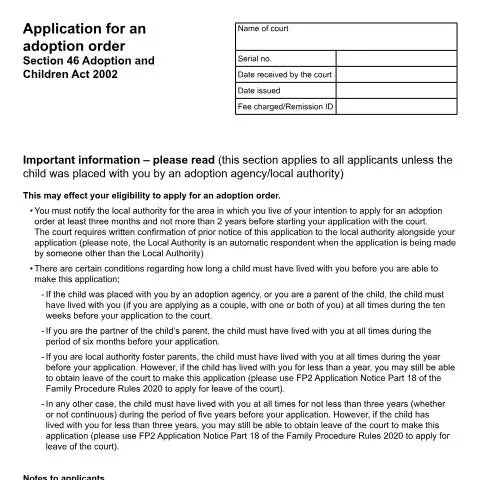
The A58 application operates within a carefully calibrated framework of eligibility criteria that reflects Parliament's intention to balance the welfare of the child with the rights of all parties involved. The form's opening section immediately confronts applicants with what may be their first substantial hurdle: the local authority notification requirement.
This notification must occur at least three months before making the court application, but not more than two years prior. This timing window serves multiple purposes: it allows local authorities to conduct necessary checks and assessments whilst preventing indefinite delays that might not serve the child's interests. The requirement applies to all applicants except those where the child was placed by an adoption agency or local authority—a distinction that often catches prospective adopters off guard.
The Residence Requirements: A Tiered System of Timescales
The form establishes different residence requirements depending on the applicant's relationship to the child, creating what essentially amounts to a tiered system of eligibility:
| Applicant Category | Required Residence Period | Special Considerations |
|---|---|---|
| Agency-placed child or birth parent | 10 weeks continuous residence | Must be immediately before application |
| Partner of child's parent | 6 months continuous residence | Step-parent adoption scenarios |
| Local authority foster parents | 1 year continuous residence | FP2 form may allow shorter periods |
| Other applicants | 3 years within 5-year period | Need not be continuous |
These varying timescales reflect different levels of existing relationship and oversight. Agency placements already involve professional assessment, hence the shorter requirement. Conversely, the three-year requirement for other applicants acknowledges that these situations may involve less formal oversight and therefore require demonstration of a more established caring relationship.
The Leave of Court Mechanism
For applicants who cannot meet the standard residence requirements, the form references the FP2 Application Notice under Part 18 of the Family Procedure Rules 2020. This represents a crucial safety valve in the system, allowing courts to consider applications where the welfare of the child might be served despite technical non-compliance with residence requirements. However, obtaining leave of court requires demonstrating exceptional circumstances and compelling reasons why the standard requirements should be waived.
Jurisdictional Boundaries and Form Selection Complexities
The A58 form operates within specific jurisdictional parameters that often perplex applicants navigating the adoption landscape for the first time. The form explicitly states its limitation to children who are habitually resident in the British Islands—a legal concept that extends beyond simple physical presence to encompass the centre of the child's life and interests.
This jurisdictional limitation creates a tripartite system of adoption applications:
- Form A58: For children habitually resident in the British Islands in standard domestic adoption scenarios
- Form A60: For children brought into the UK specifically for adoption purposes, typically involving international elements
- Form A59: For Convention adoption orders under international adoption treaties
The distinction between these forms often proves crucial, as using the incorrect form can result in applications being rejected or significantly delayed. The concept of habitual residence particularly challenges applicants in cases involving recent immigration or complex cross-border family arrangements.
The British Islands Definition
The form's reference to "British Islands" encompasses England, Wales, Scotland, Northern Ireland, the Channel Islands, and the Isle of Man. This broader definition than "United Kingdom" reflects the shared legal traditions and mutual recognition arrangements that exist across these jurisdictions for family law matters, though each maintains its own court system and procedural requirements.
Dissecting the Application Structure: Beyond Basic Information Gathering
The A58 form's architecture reveals the complexity underlying what might appear to be straightforward information gathering. Part 1 demonstrates this complexity through its graduated approach to applicant information, distinguishing between single and joint applications whilst accommodating various family structures and legal relationships.
The form's approach to domicile and habitual residence requirements reflects fundamental principles of English private international law. Applicants must establish either domicile in part of the British Islands or habitual residence for at least one year ending with the application date. This dual approach recognises that people's legal connections to a jurisdiction may be established through different mechanisms—domicile often being acquired at birth or through long-term intention, whilst habitual residence focuses on current life patterns and connections.
The Status Classification System
Perhaps the most intricate aspect of the A58 form lies in its status classification system for single applicants. The form creates distinct pathways depending on the applicant's relationship to the child and their personal circumstances:
Partner of the child's parent applications represent the most straightforward single applicant scenario, typically involving step-parent adoptions where one partner seeks to adopt their spouse's or partner's child. These applications often proceed more smoothly due to the existing family structure and reduced complexity regarding parental consent.
However, the form becomes significantly more complex for other single applicants, requiring detailed justification for why they are not applying jointly with a spouse or civil partner. The form anticipates various scenarios:
- Unmarried applicants without civil partners
- Divorced individuals or those whose civil partnerships have been dissolved
- Widows, widowers, or surviving civil partners
- Married individuals or civil partners applying alone due to specific circumstances
For married applicants or civil partners seeking to adopt alone, the form requires demonstration that their spouse or civil partner cannot be found, that they have separated permanently, or that their spouse or civil partner lacks capacity or is physically incapable of making an application.
The Local Authority Web: Notifications, Assessments, and Automatic Respondent Status
One of the most significant aspects of the A58 process involves the intricate relationship with local authorities, which extends far beyond simple notification requirements. When applicants submit their A58 form, they trigger a complex web of local authority involvement that fundamentally shapes the adoption process.
The three-month notification requirement serves as more than administrative housekeeping—it initiates the local authority's statutory duty to investigate and report on the suitability of the proposed adoption. This period allows local authorities to conduct home visits, interview applicants, review the child's circumstances, and prepare comprehensive reports for the court.
The Automatic Respondent Principle
A crucial aspect often overlooked by applicants is that local authorities automatically become respondents in adoption proceedings when the application is made by someone other than the local authority itself. This means the local authority becomes a party to the proceedings with rights to participate, object, and present evidence to the court. This respondent status reflects the state's parens patriae responsibility to protect children's welfare, even in private family arrangements.
The automatic respondent status creates a dynamic where local authorities must balance their role as independent assessors of the child's welfare against their position as potential objectors to the adoption. This dual role occasionally creates tension, particularly in cases where local authorities have concerns about the proposed adoption but applicants believe they are acting in the child's best interests.
Written Confirmation Requirements
The form specifically requires "written confirmation of prior notice of this application to the local authority alongside your application." This requirement ensures courts have evidence that proper notification procedures have been followed and that local authorities have had adequate time to prepare their response. The absence of such confirmation can lead to applications being rejected or adjourned, potentially adding months to the process.
Professional Representation and Court Procedures
The A58 form's inclusion of detailed solicitor information reflects the complex legal landscape surrounding adoption proceedings. Whilst legal representation is not mandatory for adoption applications, the form's structure suggests the expectation that most applicants will seek professional legal assistance.
The solicitor information section requires comprehensive contact details including DX numbers and fee account information, reflecting the court system's need for efficient communication and the reality that adoption proceedings often involve multiple hearings and extensive correspondence. The inclusion of fee account numbers particularly reflects the court's expectation that legal representation will be ongoing throughout the process.
The Role of Legal Professional Privilege
Adoption proceedings create unique challenges for legal professional privilege, as the court's paramount consideration—the child's welfare—may require disclosure of information that would normally be protected. Solicitors representing adoption applicants must navigate these complexities whilst ensuring their clients understand both their rights and obligations within the process.
The form's structure anticipates ongoing legal representation throughout the adoption process, from initial application through final order. This reflects the reality that adoption proceedings are rarely straightforward administrative processes but rather complex legal proceedings requiring careful navigation of statutory requirements, evidential standards, and procedural rules.
Temporal Dynamics and Process Evolution
The A58 application initiates a process with its own temporal rhythms and procedural milestones that extend far beyond the initial form submission. Understanding these temporal dynamics proves crucial for applicants seeking to manage expectations and plan for the journey ahead.
From the moment of submission, the A58 triggers a series of interconnected processes: court administration and case management, local authority investigation and reporting, potential birth parent notification and consent procedures, and judicial consideration and hearing scheduling. Each element operates according to its own timescales whilst remaining interdependent with others.
The Court's Case Management Role
Modern adoption proceedings operate under active case management principles, with courts taking responsibility for ensuring cases progress efficiently whilst maintaining proper procedural safeguards. The A58 application provides the foundation for this case management approach, with courts using the information provided to identify potential complications, schedule appropriate hearings, and ensure all necessary parties are properly involved.
The form's serial number and date tracking systems enable courts to monitor case progress and ensure compliance with statutory timescales. These administrative elements, whilst appearing mundane, play crucial roles in ensuring the adoption system operates effectively and that children's cases are resolved within reasonable timeframes.
Fee Structures and Remission Provisions
The A58 form incorporates fee charging and remission identification systems that reflect the court system's approach to balancing access to justice with resource management. Adoption applications attract substantial court fees, but comprehensive remission provisions ensure that financial circumstances do not prevent meritorious applications from proceeding.
The remission system operates through detailed means testing that considers not only current income but also capital assets and essential expenditure. This approach recognises that prospective adopters may have complex financial circumstances, particularly where they are already supporting children informally or where employment patterns have changed to accommodate caring responsibilities.
The Welfare Paramount Principle in Practice
Every aspect of the A58 form and the subsequent adoption process operates under the shadow of the welfare paramount principle established in the Adoption and Children Act 2002. This principle requires courts to treat the child's welfare throughout their life as the paramount consideration when making any decision relating to adoption.
The form's structure reflects this principle through its comprehensive approach to gathering information about applicants, their circumstances, and their relationship to the child. Each section serves not merely administrative purposes but contributes to the court's ultimate welfare assessment. The detailed personal information, residence requirements, and status classifications all provide evidence relevant to the fundamental question: will this adoption serve the child's welfare throughout their life?
This welfare-centric approach distinguishes adoption proceedings from other family court processes where competing adult interests might receive greater weight. In adoption cases, adult wishes and preferences remain secondary to children's welfare, creating a legal framework where even well-intentioned applicants may face refusal if courts conclude the proposed adoption would not serve the child's best interests.
The A58 form thus represents more than a mere application document—it serves as the foundation for one of the most profound legal transformations available in modern family law. Through its detailed requirements and complex procedural framework, it ensures that the creation of new family relationships through adoption receives the careful scrutiny and legal protection that such fundamental changes demand. The form's evolution and continued refinement reflect the legal system's ongoing commitment to balancing efficient administration with the paramount welfare of children whose futures depend on these crucial proceedings.