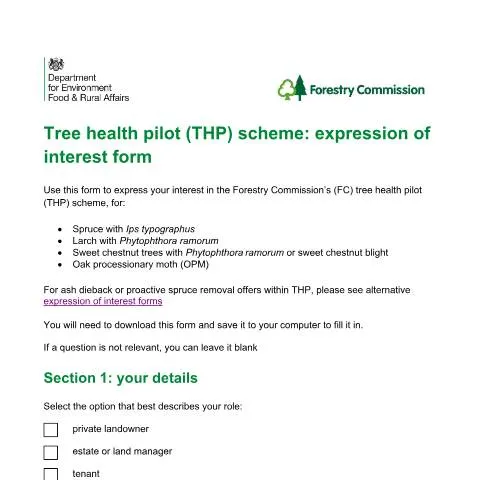
Navigating the Tree Health Pilot Scheme: Your Key to Tree Management
The Tree Health Pilot (THP) scheme, initiated by the Forestry Commission under the Department for Environment, Food & Rural Affairs, offers crucial support to landowners and managers dealing with tree health issues. Whether you manage private woodlands, are a tenant, or represent a business, the expression of interest form is your first step towards obtaining assistance in addressing various tree health challenges, notably from pests and diseases such as Ips typographus and Phytophthora ramorum.
Understanding Your Role in the Tree Health Scheme
Identifying your specific role within the THP scheme is essential as it dictates how you will fill out the expression of interest form. The options available include:
- Private landowner
- Estate or land manager
- Tenant
- Representative or employee of a business or organisation
- Representative from a local authority
- Agent acting on behalf of a client
Private Landowners and Tenants: If you are a private landowner or tenant, you will complete sections 1.0 to 1.4 of the form. This includes providing details such as your name, contact information, and a brief description of your land.
Agents: Agents filing on behalf of clients must enter the client’s details in section 1.0 and their own information in section 2.0.
Organisational Representatives: For those completing the form as part of an organisation, sections 1.0 to 1.7 must be filled out comprehensively to reflect both the organisation’s and your roles.
Document Preparation: Essential Steps Before Submission
Prior to completing the expression of interest form, ensure that you gather all necessary information and documents. This preparation is crucial for a seamless application process.
Documentation Checklist
- Personal Details: Full name, email address, and phone number.
- Business Information: If applicable, include the name of the business or organisation and your role within it.
- Site Details: Identify the specific sites you wish to include in your application, including their locations via Ordnance Survey (OS) National Grid references.
- Tree Health Issues: List any confirmed tree pests or diseases on your land.
- Statutory Notices: If you've received a Statutory Plant Health Notice (SPHN), its number and date should be noted.
This comprehensive document gathering will not only assist in filling out the form accurately but will also prepare you for any questions that may arise during the review process.
Tree Health Challenges Addressed by the Scheme
The THP scheme primarily focuses on several critical tree health issues. Understanding these challenges is vital for determining your eligibility and the assistance you can receive.
Targeted Pests and Diseases
- Spruce with Ips typographus: The eight-toothed spruce bark beetle has become a significant threat to spruce populations.
- Larch with Phytophthora ramorum: This pathogen affects larch trees, leading to significant health issues.
- Sweet Chestnut Trees: Both Phytophthora ramorum and sweet chestnut blight pose risks to these trees.
- Oak Processionary Moth (OPM): The OPM is a pest that can severely impact oak trees and their surrounding ecosystems.
Familiarising yourself with these pests and diseases will not only help you articulate your needs on the form but will also enhance your overall understanding of how to manage these challenges effectively.
Timelines: From Expression of Interest to Action
Once your expression of interest form is submitted, it's essential to be aware of the subsequent timeline and what happens next.
Key Milestones
| Milestone | Description | Time Frame |
|---|---|---|
| Submission of Form | Email the completed form to the Forestry Commission | Ongoing |
| Confirmation of Eligibility | Receive an email confirming if you meet the eligibility criteria | Within 2-4 weeks after submission |
| Site Visit | A tree health pilot woodland officer contacts you to arrange a visit | Scheduled post-eligibility confirmation |
| Full Application | If invited, submit a detailed application along with your Single Business Identifier (SBI) number | As per invitation |
Understanding these key milestones can help you prepare for each stage of the process, ensuring you’re ready for any necessary follow-up actions.
Eligibility Criteria and Group Applications
It’s not just individual applications that are considered; the THP also welcomes group applications. If you are considering applying as part of a group, it’s essential to understand the eligibility criteria.
Group Application Insights
When expressing interest on behalf of a group, whether it be local landowners or a collective estate management team, you will need to indicate this in Section 3.0 of the form. If you're unsure about joining a group, there’s an opportunity to indicate your interest in becoming part of an existing group in Section 3.2.
Eligibility Considerations:
- Groups must have a defined number of landowners. The form asks for this specific number in Section 3.1.
- Each member of the group must meet individual eligibility criteria related to land ownership and the presence of specific tree health issues.
Collaborating with other landowners can provide broader support and access to shared resources, enhancing the effectiveness of the management strategies you implement.
Consequences of Non-Compliance and Rights of Participants
Understanding the implications of your submission is paramount. Failing to comply with the requirements of the THP scheme can lead to various consequences.
Rights and Responsibilities
As a participant:
- You have the right to receive assistance if you meet the eligibility criteria.
- You are obliged to provide accurate information on the expression of interest form.
Consequences of Non-Compliance:
- Inaccurate submissions may result in denial of assistance or funding.
- Failure to respond to follow-up requests from Forestry Commission representatives can jeopardise your application.
It’s essential to maintain communication throughout the process, ensuring that all information provided is up-to-date and accurate.
Further Resources and Continuous Learning
Participating in the THP scheme also opens the door to continuous education regarding tree health management. Numerous resources are available to assist applicants in understanding tree health issues better and implementing effective management practices.
Useful Resources
- Guidelines from the Forestry Commission on tree health management
- Workshops and seminars hosted by local authorities or environmental groups
- Online resources from the Department for Environment, Food & Rural Affairs regarding tree pest identification and management strategies
By engaging with these resources, you’ll be better equipped to manage your tree health challenges proactively and effectively.
Final Notes on the Expression of Interest Process
The expression of interest form is not merely a bureaucratic hurdle but a gateway to managing tree health challenges effectively. Engagement with the THP scheme can bring significant benefits, not only for your land but also for the broader ecosystem.
As you complete your form, ensure that every detail is accurate, and take the time to consider how best you can present your situation to the Forestry Commission. Remember, this is the beginning of your journey toward achieving better tree health for your land and potentially contributing to wider environmental goals.
For any additional queries regarding the process, reaching out to your local forestry officer can provide tailored guidance specific to your circumstances, ensuring you’re well-supported throughout this initiative.
Understanding the Tree Health Pilot Scheme
The Tree Health Pilot Scheme is a pivotal initiative launched by the UK government aimed at tackling tree health issues across various regions. This scheme is part of a broader strategy to ensure the vitality of Britain's woodlands and mitigate the impacts of tree pests and diseases. The focus is on research and practical solutions that can be employed at local levels, engaging communities in the preservation of their natural surroundings.
Through the Tree Health Pilot Scheme, various stakeholders, including local authorities, woodland owners, and conservation groups, are encouraged to participate in projects that promote tree health. This includes activities such as monitoring tree health, developing disease-resistant species, and implementing management practices to enhance woodland resilience. The pilot seeks to trial innovative approaches that may be scaled up for wider application across the UK.
Eligibility to participate often varies by the nature of the project proposed, emphasizing the scheme's adaptive management approach. Interested parties should be well-acquainted with the local ecological landscape, including any existing tree health challenges specific to their area, which is crucial for developing a relevant and effective expression of interest form.
Completing the Expression of Interest Form
When applying to the Tree Health Pilot Scheme, completing the Expression of Interest (EoI) form is a critical step. This form is your opportunity to outline your proposed project, showcasing how it aligns with the objectives of the scheme. Here, clarity and detail are paramount.
The EoI form typically requires information on several key areas:
- Project Description: Provide a comprehensive overview of your project. Detail the specific tree health issues you aim to address, the methods you plan to implement, and the expected outcomes.
- Location: Specify the geographic area where the project will take place. Highlight any unique characteristics of the local environment that may influence your project's success.
- Partnerships: If collaborating with other organizations or experts, include their details and describe how these partnerships will enhance the project.
- Funding Requirements: Although the EoI form may not require a detailed budget, providing an outline of potential funding needs can strengthen your proposal.
Furthermore, while filling out the EoI form, ensure compliance with the Data Protection Act 2018 and UK GDPR. This includes being transparent about how any personal data collected will be used and protected, as well as ensuring that consent is obtained where necessary.
Post-Submission Processes and Next Steps
Once your Expression of Interest form is submitted, it enters a crucial evaluation phase. The assessment is typically conducted by relevant bodies within the Department for Environment, Food & Rural Affairs (DEFRA) and may involve several steps.
You can expect to receive feedback within a specified timeframe, which varies depending on the volume of submissions and the complexity of projects proposed. Feedback may include requests for additional information or clarification, as well as suggestions for enhancing your project proposal.
If your EoI is approved, you will be invited to develop a full application. This next stage could require a more detailed project plan, budget forecasts, and perhaps evidence of stakeholder engagement. It's crucial to remain engaged and responsive throughout this process, as successful communication can significantly influence the outcome.
Additionally, keep in mind that participating in the pilot scheme is not just about securing funding but also involves a commitment to data sharing and transparency. You may be required to report on the progress of your project and its impacts on tree health, contributing to a broader understanding and better management of tree health issues across the country.