Understanding the Climate Change Agreements Framework and Its Administrative Architecture
The Climate Change Agreements (CCA) scheme represents one of the UK's most sophisticated energy efficiency policy mechanisms, offering industrial sectors a pathway to secure reduced rates on the Climate Change Levy whilst committing to ambitious energy performance targets. At the heart of this framework lie two interconnected legal instruments: Umbrella Agreements and Underlying Agreements, whose templates serve as the foundation for negotiating sector-wide energy efficiency commitments across British industry.
Established under Schedule 6 of the Finance Act 2000, the scheme operates through a dual-tier structure where sector associations negotiate overarching terms through Umbrella Agreements, whilst individual facilities secure their participation through site-specific Underlying Agreements. The Environment Agency acts as the Administrator, wielding considerable authority in determining eligibility, setting targets, and issuing the crucial reduced-rate certificates that unlock levy discounts.
The current iteration of the scheme, spanning Certification Periods 8 through 10 (July 2027 to March 2033), reflects evolving government priorities around net-zero commitments and industrial decarbonisation. These templates provide the legal scaffolding for agreements that can deliver substantial cost savings—potentially millions of pounds annually for large energy-intensive operations—whilst driving measurable improvements in energy efficiency across participating sectors.
Sector Associations and the Umbrella Agreement Architecture
The Umbrella Agreement serves as the foundational document that establishes the relationship between the Environment Agency and recognised sector associations. These associations must demonstrate their representative status under paragraph 47(2)(b) of Schedule 6, meaning they possess legitimate authority to negotiate on behalf of facilities within their sector.
Qualifying sector associations typically include established trade bodies such as the Chemical Industries Association, UK Steel, or the Food and Drink Federation. However, the Administrator retains discretion in recognising representative status, considering factors including:
- Membership coverage across the sector's energy-intensive facilities
- Constitutional authority to enter binding commitments
- Technical expertise in energy management and efficiency measurement
- Financial standing to support ongoing administrative obligations
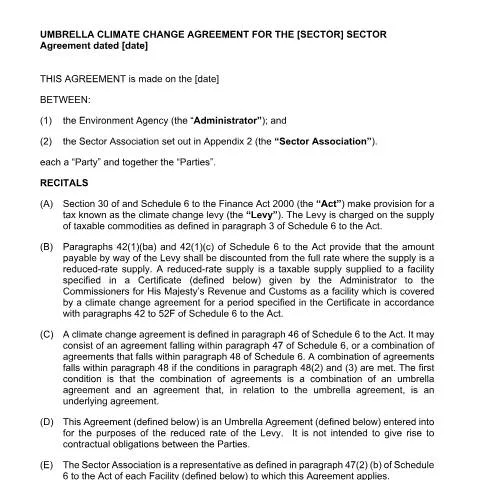
The Umbrella Agreement establishes sector-wide parameters including eligibility criteria, target-setting methodologies, and buy-out fee structures. Crucially, it operates as a non-contractual framework—the Agreement explicitly states it "is not intended to give rise to contractual obligations between the Parties"—yet creates binding administrative obligations under the statutory scheme.
Sectoral Variations and Technical Specifications
Each sector's Umbrella Agreement incorporates bespoke technical annexes reflecting industry-specific energy consumption patterns and efficiency opportunities. The steel sector, for instance, includes detailed provisions for blast furnace operations and electric arc furnace efficiency metrics, whilst the chemicals sector addresses complex multi-product facilities with varying energy intensities.
The Technical Annex typically addresses combined heat and power (CHP) plant considerations, recognising that many industrial facilities operate sophisticated energy generation systems that complicate straightforward energy efficiency calculations. These provisions ensure that efficiency improvements in CHP operations receive appropriate recognition within target calculations.
Facility-Level Participation Through Underlying Agreements
Individual facilities secure their participation through Underlying Agreements that translate sector-wide commitments into site-specific targets and obligations. The facility operator—typically the legal entity with operational control rather than necessarily the property owner—enters these agreements following successful completion of the eligibility assessment process.
Facility eligibility operates through a multi-layered assessment examining both technical criteria and administrative compliance. The technical assessment considers factors including annual energy consumption thresholds, industrial process classifications, and the facility's capacity to achieve meaningful efficiency improvements. Administrative requirements encompass corporate structure verification, financial standing assessment, and demonstration of appropriate energy management systems.
Greenfield Facilities and Base Year Determination
The scheme accommodates both established operations and new facilities through differentiated base year provisions. For existing facilities, the base year represents a historical 12-month period ending before the Underlying Agreement's execution, providing a performance benchmark against which future improvements are measured.
Greenfield facilities—new operations without historical performance data—receive special treatment with their base year commencing on the Underlying Agreement's activation date. This approach recognises that new facilities require time to optimise their operations and establish stable energy consumption patterns.
| Facility Type | Base Year Definition | Target Setting Approach |
|---|---|---|
| Established Operations | 12 months ending before agreement date | Historical performance baseline |
| Greenfield Facilities | 12 months from agreement activation | Projected efficiency trajectory |
| Substantially Modified Plants | Agreed period reflecting new configuration | Hybrid approach considering modifications |
Target Periods, Certification, and Performance Monitoring
The current scheme operates through defined Target Periods aligned with Certification Periods, creating a structured timeline for performance assessment and certificate renewal. Certification Period 8 (July 2027 to June 2029) represents the first full cycle under the updated framework, followed by Certification Period 9 (July 2029 to June 2031) and concluding with Certification Period 10 (July 2031 to March 2033).
The Environment Agency issues reduced-rate certificates following successful target achievement, enabling facilities to access discounted Climate Change Levy rates on their energy supplies. These certificates specify the exact facilities covered, the applicable certification period, and any conditions attached to the reduced-rate entitlement.
Performance monitoring operates through comprehensive energy consumption reporting, with facilities required to submit detailed data demonstrating their progress against agreed targets. The Administrator employs sophisticated verification procedures, including on-site audits and technical assessments, to ensure reported performance accurately reflects actual energy efficiency improvements.
Buy-Out Mechanisms and Financial Obligations
Facilities failing to achieve their agreed targets face buy-out fee obligations calculated according to formulae specified in the Umbrella Agreement's Rule 7 provisions. These fees reflect the economic value of the efficiency improvements not delivered, creating financial incentives for genuine performance improvement rather than reliance on penalty payments.
Buy-out fee calculations consider multiple factors including the shortfall magnitude, energy price indices, and sector-specific adjustment factors. The Administrator serves Buy-Out Fee Notices following target period assessments, with operators having defined appeal rights and payment timescales.
Administrative Procedures and Documentation Requirements
The scheme operates through rigorous administrative procedures designed to ensure transparency, consistency, and legal compliance across all participating sectors and facilities. The Environment Agency maintains comprehensive records of all agreements, certificates, and performance data, supporting both individual facility management and scheme-wide policy evaluation.
Operators must maintain detailed energy consumption records, including monthly meter readings, fuel consumption data, and production output statistics. These records support both routine performance monitoring and the detailed assessments required for certificate renewal or target variation applications.
Decision Notices and Administrative Appeals
The Administrator communicates formal decisions through Decision Notices covering certificate issuance, target variations, and facility eligibility determinations. These notices specify the reasoning behind administrative decisions, relevant legal provisions, and available appeal mechanisms.
Decision Notices address three primary categories of determinations:
- Certificate decisions relating to initial issuance, renewal, or variation requirements
- Target variation decisions following facility modifications or changed circumstances
- Facility variation decisions addressing changes in facility scope or operational arrangements
Operators dissatisfied with administrative decisions may pursue appeals through established procedures, including independent technical review and, ultimately, judicial review of administrative action where appropriate legal grounds exist.
Charging Structures and Financial Obligations
Participation in the Climate Change Agreements scheme involves various financial obligations beyond potential buy-out fees. The Climate Change Agreements Charges Scheme 2012 establishes fee structures covering application processing, certificate issuance, and ongoing administrative support.
These charges reflect the substantial administrative effort involved in operating the scheme, including technical assessments, site audits, data verification, and ongoing monitoring activities. The charging structure operates on a cost-recovery basis, ensuring that scheme participants bear the costs of administration rather than general taxpayers.
Charges vary according to facility size, sector complexity, and the level of administrative support required. Large, complex facilities with multiple processes and significant energy consumption face higher charges reflecting their greater administrative burden, whilst smaller, straightforward operations benefit from reduced fee structures.
Payment Obligations and Enforcement Mechanisms
The Finance Act 2000's paragraph 52C provisions establish the Administrator's authority to levy charges on scheme participants, creating legally enforceable payment obligations. Operators failing to meet their financial obligations face potential certificate suspension or withdrawal, effectively removing their access to reduced Climate Change Levy rates.
The Administrator employs graduated enforcement approaches, beginning with payment reminders and progressing through formal notices to certificate suspension where necessary. This approach recognises that many payment delays reflect administrative issues rather than deliberate non-compliance, whilst maintaining scheme integrity through firm action against persistent defaulters.
Combined Heat and Power Integration and Technical Complexities
Many industrial facilities operate sophisticated combined heat and power (CHP) systems that complicate straightforward energy efficiency assessments. The scheme's technical provisions address these complexities through detailed methodologies recognising the efficiency benefits of CHP operations whilst preventing double-counting of energy savings.
CHP integration requires careful consideration of heat and electricity generation efficiency, export arrangements, and the interaction between on-site generation and grid electricity consumption. The Technical Annex provides detailed calculation methodologies ensuring that CHP efficiency improvements receive appropriate recognition within target assessments.
Facilities with CHP installations may qualify for adjusted target calculations reflecting their reduced grid electricity consumption and improved overall energy efficiency. However, these adjustments require comprehensive technical documentation demonstrating actual performance improvements rather than theoretical efficiency gains.
Measurement and Verification Protocols
The scheme employs rigorous measurement and verification protocols ensuring that reported energy efficiency improvements reflect genuine performance enhancements. These protocols address common challenges including seasonal variations, production mix changes, and the impact of facility modifications on energy consumption patterns.
Verification procedures include regular data audits, on-site inspections, and independent technical assessments conducted by qualified energy professionals. The Administrator maintains panels of approved technical assessors with sector-specific expertise, ensuring that complex industrial processes receive appropriate specialist evaluation.
Facilities must implement appropriate metering and monitoring systems capable of providing accurate, timely data supporting their performance claims. The scheme's technical requirements specify minimum metering standards whilst recognising that different industrial processes may require bespoke monitoring approaches reflecting their specific operational characteristics.
Sector-Specific Considerations and Template Adaptations
The Climate Change Agreements scheme recognises that different industrial sectors face unique challenges in achieving energy efficiency targets. Template adaptations must reflect these sector-specific requirements whilst maintaining the core framework established by the Environment Agency.
For energy-intensive sectors such as steel, aluminium, and cement manufacturing, Umbrella agreements typically incorporate more complex baseline methodologies. These sectors often require bespoke energy efficiency metrics that account for production variations and process-specific factors. The steel sector, for instance, may need templates that accommodate different production routes – electric arc furnace versus blast furnace operations – each requiring distinct target-setting approaches.
Chemical and petrochemical sectors present particular template challenges due to their integrated processes and co-generation facilities. Underlying agreements for these sectors must carefully delineate energy consumption boundaries, particularly where steam, electricity, and process heat are interconnected. Templates should include provisions for energy allocation methodologies that comply with both CCA requirements and sector-specific accounting standards.
Food and drink manufacturing sectors benefit from templates that acknowledge seasonal production patterns and product diversification. Underlying agreements must incorporate flexibility mechanisms that account for production campaigns, seasonal processing of agricultural inputs, and varying product mix throughout the agreement period. These templates often include normalisation factors that adjust targets based on production volumes and product complexity.
The textiles sector requires templates that address the unique challenges of batch processing and the wide variety of production techniques employed across different fabric types. Energy consumption patterns in textiles can vary significantly between natural and synthetic fibre processing, dyeing operations, and finishing processes. Templates must provide sufficient granularity to capture these variations whilst maintaining practical monitoring requirements.
Paper and packaging sectors face specific template requirements related to recycled content usage and moisture control systems. These sectors often operate continuous processes where energy efficiency improvements must be balanced against product quality requirements. Templates should include provisions for energy consumption adjustments related to raw material quality variations and environmental conditions affecting drying processes.
Glass manufacturing presents unique template considerations due to the continuous nature of furnace operations and the energy-intensive melting process. Underlying agreements must account for furnace campaigns, colour changes, and product mix variations that significantly impact energy consumption patterns. Templates should incorporate provisions for major maintenance shutdowns and restart procedures that temporarily affect energy efficiency performance.
Compliance Monitoring and Reporting Framework Integration
Effective CCA templates must seamlessly integrate with the comprehensive monitoring and reporting framework established by the Environment Agency. This integration extends beyond basic energy consumption reporting to encompass detailed performance tracking, milestone monitoring, and corrective action protocols.
Annual reporting templates require specific data collection methodologies that align with both CCA requirements and existing corporate reporting systems. Companies must establish monitoring protocols that capture energy consumption data at appropriate intervals – typically monthly for larger sites and quarterly for smaller operations. The templates should specify data quality requirements, including meter accuracy standards, data validation procedures, and acceptable estimation methodologies for periods when direct measurement is unavailable.
Milestone reporting represents a critical component of CCA compliance, requiring templates that clearly define progress measurement criteria and reporting timelines. These templates must specify the evidence requirements for demonstrating progress towards targets, including documentation of energy efficiency measures implemented, investment levels achieved, and performance improvements realised. The reporting framework should accommodate both absolute energy consumption reductions and efficiency improvements normalised for production changes.
Third-party verification requirements add another layer of complexity to template design. Verification protocols must be embedded within the reporting templates, specifying the scope of verification activities, required qualifications for verifiers, and documentation standards that must be maintained. These requirements vary depending on sector size and agreement complexity, with larger sectors typically requiring more comprehensive verification procedures.
Non-compliance reporting procedures require carefully structured templates that facilitate transparent communication between participants and the Environment Agency. These templates must provide clear escalation pathways, specify remedial action timelines, and establish criteria for determining when additional measures may be required. The framework should distinguish between temporary performance shortfalls that can be addressed through operational adjustments and systemic issues requiring more fundamental interventions.
Data management protocols embedded within templates must ensure consistency across multiple reporting periods whilst accommodating evolving measurement technologies and methodologies. Templates should specify data retention requirements, backup procedures, and system compatibility standards that ensure long-term data integrity. These protocols become particularly important for agreements spanning multiple target periods, where consistent baseline comparisons are essential.
Performance benchmarking components within templates enable participants to assess their progress relative to sector averages and best practice examples. These benchmarking tools should incorporate statistical methodologies that account for site-specific factors whilst providing meaningful performance comparisons. The templates must balance transparency requirements with commercial confidentiality concerns, ensuring that benchmarking data provides value without compromising competitive positions.
Legal Framework Evolution and Template Adaptability
The legal framework surrounding Climate Change Agreements continues to evolve in response to changing policy priorities, technological developments, and international climate commitments. Template design must incorporate sufficient flexibility to accommodate these changes whilst maintaining legal certainty for agreement participants.
Brexit implications have introduced new considerations for CCA templates, particularly regarding alignment with evolving UK climate policy independent of EU frameworks. Templates must now accommodate potential divergence from EU energy efficiency standards whilst maintaining robust environmental objectives. This includes provisions for incorporating new UK-specific methodologies, performance standards, and reporting requirements that may differ from previous EU-aligned approaches.
The Net Zero commitment by 2050 has created additional template requirements that extend beyond traditional energy efficiency metrics. Modern templates increasingly incorporate carbon intensity measures, renewable energy integration provisions, and pathways for achieving deeper decarbonisation. These elements require careful integration with existing CCA frameworks to avoid conflicting objectives or duplicative requirements.
Emerging technologies present both opportunities and challenges for template development. Digital monitoring systems, artificial intelligence applications, and advanced process control technologies offer enhanced precision in energy management but require updated template provisions to accommodate new data types and monitoring methodologies. Templates must balance innovation encouragement with proven measurement reliability.
Carbon pricing mechanisms and their interaction with CCA benefits require sophisticated template provisions that account for changing economic incentives. As carbon prices evolve, templates must ensure that CCA participation remains economically attractive whilst delivering genuine environmental benefits. This may require periodic adjustment mechanisms that maintain appropriate incentive structures throughout agreement periods.
International competitiveness considerations increasingly influence template design, particularly for trade-exposed sectors facing carbon leakage risks. Templates must incorporate provisions that maintain sector competitiveness whilst delivering environmental improvements, potentially including benchmarking against international best practices and adjustment mechanisms for global market conditions.
Regulatory convergence with other UK environmental schemes requires template coordination to minimise administrative burden whilst maximising environmental outcomes. This includes alignment with emissions trading schemes, renewable energy support mechanisms, and industrial strategy initiatives that may overlap with CCA objectives. Templates should facilitate integrated compliance approaches where multiple schemes apply to the same facilities.
Future-proofing provisions within templates must anticipate potential regulatory changes whilst maintaining current compliance certainty. This includes flexibility clauses that allow for methodology updates, target adjustments based on technological developments, and transition mechanisms for evolving policy frameworks. These provisions must balance adaptability with the long-term certainty required for business investment planning.