When Property Restrictions Become Obsolete: Understanding Withdrawal Scenarios
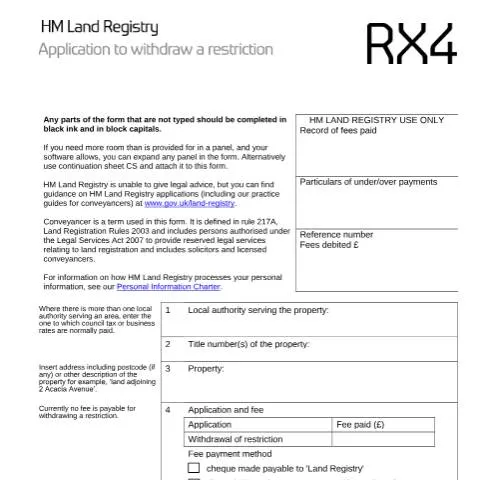
Property restrictions registered at HM Land Registry serve as protective mechanisms, safeguarding interests ranging from mortgage lender rights to covenant enforcement and matrimonial home protections. Yet circumstances evolve: mortgages are repaid, matrimonial proceedings conclude, or commercial arrangements terminate. When these changes render existing restrictions unnecessary or counterproductive, Form RX4 provides the statutory mechanism for their formal removal.
The withdrawal process involves more than simply requesting deletion. It requires demonstrating legitimate authority to remove the restriction, whether through personal entitlement as the sole interested party or by securing comprehensive consents from all affected parties. The form accommodates various scenarios, from straightforward single-party withdrawals to complex multi-stakeholder arrangements requiring careful coordination of legal interests.
Understanding the distinction between restriction types proves crucial. Standard Form restrictions, such as those protecting matrimonial homes under the Family Law Act 1996, follow established withdrawal protocols. However, bespoke restrictions crafted for specific commercial arrangements may contain unique consent requirements that demand careful interpretation of their registered wording.
Establishing Your Authority to Withdraw: The Two-Track Approach
Form RX4 presents applicants with two distinct pathways for establishing withdrawal authority, each reflecting different legal circumstances and evidential requirements.
Single-Party Entitlement Route
The first pathway applies when the applicant represents the sole interested party in the restriction. This scenario commonly arises when:
- A mortgage lender seeks to remove their own restriction following loan redemption
- An individual withdraws a matrimonial home rights restriction after divorce proceedings conclude
- A company removes restrictions protecting their own commercial interests
- The original restriction beneficiary no longer requires protection
Panel 10 requires applicants to specify whether they believe themselves to be the only interested party or whether they are specifically named in the restriction as the person authorised to consent, certify, or receive notices. This distinction matters because restriction wording often designates specific individuals or entities with particular roles in the withdrawal process.
Multi-Party Consent Route
The alternative pathway acknowledges that many restrictions protect multiple interests or specify particular parties whose agreement is mandatory. This route demands either:
- Physical submission of signed consent documents from all required parties
- Conveyancer certification that all necessary consents have been obtained and are held on file
The conveyancer certification option provides practical efficiency for professional transactions whilst maintaining legal safeguards. However, it places professional responsibility on the certifying conveyancer to ensure comprehensive consent collection before making the declaration.
| Restriction Type | Typical Consent Requirements | Common Scenarios |
|---|---|---|
| Matrimonial Home Rights | Spouse/civil partner consent | Divorce finalisation, property transfer |
| Mortgage Protection | Lender consent or redemption evidence | Loan repayment, refinancing |
| Covenant Enforcement | Beneficiary landowner consent | Development agreement changes |
| Trust Protections | All trustee/beneficiary consents | Trust termination, asset distribution |
Navigating the Application Form: Technical Requirements and Documentation
Form RX4 demands precision in completion, with specific formatting requirements that reflect HM Land Registry's digital processing capabilities and legal record-keeping standards.
Property Identification and Restriction Details
Panel 2 requires accurate title number specification, accommodating both single-title applications and complex scenarios involving multiple registered titles. When restrictions affect several properties within a development or estate, all relevant title numbers must be listed to ensure comprehensive coverage.
Panel 8 demands precise restriction identification, requiring the registration date and beneficiary details as they appear on the official register. This information must match exactly, as discrepancies can trigger requisitions or application rejection. Where restrictions were registered years earlier, applicants may need to obtain official copies of the register to verify exact wording and dates.
Supporting Documentation Strategy
Panel 7 serves as the documentary inventory, listing all supporting materials submitted with the application. The strategic selection of supporting documents can significantly influence processing efficiency:
- Death certificates when restriction beneficiaries have deceased
- Divorce decrees absolute for matrimonial home restrictions
- Redemption statements evidencing mortgage discharge
- Corporate dissolution certificates when company beneficiaries no longer exist
- Deed releases from covenant beneficiaries
HM Land Registry's document handling policy involves scanning followed by destruction, applying to both original documents and certified copies. This process eliminates return obligations whilst maintaining digital records for future reference.
Partial Withdrawal Complications
Panel 8 accommodates scenarios where restrictions require partial withdrawal, affecting only designated portions of the registered estate. This frequently occurs in development contexts where restrictions protecting undeveloped land become inappropriate following construction completion, or where covenant modifications affect specific plot areas within larger developments.
Partial withdrawals demand careful plan preparation, typically requiring professionally prepared plans showing affected areas "edged red" in accordance with HM Land Registry conventions. These plans must demonstrate sufficient clarity to enable precise register amendment without ambiguity.
Professional vs Personal Applications: Choosing Your Submission Route
The application pathway choice significantly impacts processing experience, communication protocols, and professional responsibility distribution.
Conveyancer-Led Applications
Professional submission through qualified conveyancers offers several advantages beyond mere convenience. Panel 6 recognises key number holders - typically solicitors and licensed conveyancers with established HM Land Registry accounts - enabling streamlined processing and direct electronic communication.
Conveyancer involvement provides particular value in complex consent scenarios. The certification option in Panel 10(B) allows conveyancers to confirm consent collection without requiring physical document submission, reducing processing delays whilst maintaining legal safeguards through professional indemnity arrangements.
Professional applications benefit from warning of cancellation notifications sent via email, providing advance notice if applications face potential rejection due to outstanding requisitions or technical deficiencies.
Personal Application Considerations
Individual applicants submitting Form RX4 directly assume greater responsibility for documentation completeness and legal compliance. Without conveyancer certification options, all required consents must be physically submitted, potentially extending processing timelines.
Personal applicants should anticipate more detailed HM Land Registry scrutiny of their withdrawal authority, particularly in complex scenarios involving multiple interested parties or unusual restriction wording. The absence of professional oversight may trigger additional requisitions seeking clarification of legal entitlements or consent adequacy.
Documentation Standards for Personal Applications
Individual applicants must ensure supporting documents meet HM Land Registry's evidential standards:
- Consent documents must bear original signatures from all required parties
- Identity verification may be requested for consent providers
- Corporate consents require proper execution under company seals or board resolutions
- Attorney consents demand evidence of valid powers of attorney
Processing Timeline and Registry Response Protocols
Form RX4 applications follow HM Land Registry's standard processing procedures, though timelines vary considerably based on application complexity and supporting documentation quality.
Initial Processing Phase
Upon receipt, applications undergo preliminary assessment covering basic completeness, fee payment verification, and title number validation. This initial stage typically concludes within five working days, resulting in either acceptance for detailed examination or immediate rejection for fundamental deficiencies.
Common rejection triggers include:
- Incomplete form panels or missing signatures
- Incorrect or non-existent title numbers
- Mismatched restriction details or beneficiary names
- Insufficient fee payment (though currently no fees apply to restriction withdrawals)
Substantive Assessment Procedures
Accepted applications proceed to substantive legal assessment, examining withdrawal authority and consent adequacy. This phase involves detailed register analysis, restriction wording interpretation, and supporting document evaluation.
Registry caseworkers may issue requisitions requesting additional information or documentation. Common requisition subjects include:
- Clarification of applicant's interest in the restriction
- Additional consents from previously unidentified interested parties
- Evidence of corporate authority for company applications
- Plan clarifications for partial withdrawal applications
Requisition responses typically require submission within 15 working days, though extensions may be granted for complex scenarios requiring extensive documentation collection.
Completion and Register Amendment
Successful applications result in formal restriction removal and register amendment. HM Land Registry issues completion notices confirming the withdrawal registration date and providing updated register references.
For electronically submitted applications with email communication preferences, completion notices arrive digitally, often within hours of final processing. Postal applications receive traditional completion documentation, extending overall timelines by several additional days.
Complex Scenarios: When Standard Procedures Require Adaptation
Certain restriction withdrawal scenarios demand approaches beyond Form RX4's standard framework, requiring additional legal considerations and alternative procedural routes.
Deceased Beneficiary Complications
When restriction beneficiaries have died, withdrawal authority typically transfers to personal representatives or surviving joint beneficiaries. However, establishing this authority may require:
- Grant of probate or letters of administration evidencing personal representative appointment
- Death certificates confirming beneficiary decease
- Survivorship evidence for joint beneficial interests
Complex estate scenarios may require court applications under the Trustee Act 1925 seeking directions on restriction withdrawal authority, particularly where beneficiary identity remains uncertain or disputed.
Corporate Dissolution Scenarios
Restrictions protecting dissolved companies present particular challenges. While company dissolution typically extinguishes corporate interests, restrictions may persist on the register indefinitely without active withdrawal.
Resolution pathways include:
- Crown disclaimer applications for bona vacantia property interests
- Court declarations confirming restriction obsolescence
- Statutory declarations evidencing corporate dissolution and interest extinction
Matrimonial Proceedings Interactions
Restrictions registered during matrimonial proceedings require careful coordination with family court orders and consent orders. Premature withdrawal may breach court directions or prejudice ongoing financial remedy applications.
Safe withdrawal typically requires:
- Decree absolute evidencing divorce finalisation
- Financial remedy consent orders confirming property arrangements
- Court permission where proceedings remain active
Strategic Timing and Coordination with Related Transactions
Restriction withdrawal timing often requires careful coordination with broader property transactions, ensuring procedural sequences support rather than hinder overall objectives.
Sale Transaction Coordination
Property sales frequently necessitate restriction removal to enable clean title transfer. However, premature withdrawal may eliminate important protections before alternative safeguards are established. Strategic approaches include:
- Conditional withdrawal arrangements triggered by completion
- Simultaneous processing of withdrawal and transfer applications
- Escrow arrangements securing consent documents pending transaction completion
Professional conveyancers typically coordinate these processes through established HM Land Registry procedures, ensuring restriction removal coincides precisely with ownership transfer to avoid protection gaps.
Refinancing and Mortgage Arrangements
Mortgage refinancing commonly requires existing lender restriction withdrawal whilst simultaneously registering new lender protections. This process demands careful timing to prevent periods where properties lack adequate security protection.
Standard practice involves Form RX4 submission alongside new mortgage registration applications, enabling HM Land Registry to process both transactions simultaneously and maintain continuous security coverage throughout the refinancing process.
The elimination of fees for restriction withdrawals removes previous cost barriers that sometimes delayed necessary restriction removal, enabling more responsive alignment with commercial transaction timelines and reducing unnecessary register encumbrances.
Complex Scenarios and Multiple Restriction Types
When dealing with property transactions, you may encounter situations where multiple restrictions affect the same title, requiring careful coordination in your withdrawal approach. The Land Registry maintains several categories of restrictions, each with distinct withdrawal procedures that can overlap in complex ways.
Matrimonial home rights restrictions often coincide with charging order restrictions, particularly in divorce proceedings. If your property has both a Form A restriction (protecting matrimonial home rights) and a charging order restriction, you'll need to address each separately. The matrimonial restriction typically requires either a court order dissolving the marriage settlement or consent from both spouses, whilst the charging order restriction needs satisfaction of the underlying debt or court discharge.
Properties held in trust frequently display multiple restriction types simultaneously. A standard Form A restriction protecting beneficiary interests might coexist with restrictions relating to specific trust provisions, overseas beneficiaries, or court-imposed restrictions following trust disputes. Each restriction demands its own evidence package, though the Land Registry may accept a single comprehensive application covering multiple restrictions if the underlying legal basis connects them.
Bankruptcy restrictions present particular complexity when combined with other restriction types. If a property owner becomes bankrupt whilst other restrictions remain active, the trustee in bankruptcy must coordinate with existing restriction holders. The bankruptcy restriction typically takes precedence, but withdrawal procedures must account for all parties' interests. You'll need clearance from the Official Receiver or appointed trustee, plus evidence that other restriction holders consent to the withdrawal sequence.
Fill in your form directly online
No printing: type your details into the boxes of the official form, tick, then download the PDF ready to send.
- 1Type into the form boxes
- 2Tick in one click
- 3Save and download the PDF
Sequential withdrawal becomes crucial when restrictions depend on each other. For instance, a restriction protecting a second charge might need to remain until a primary mortgage restriction is withdrawn, ensuring the charge holder's security isn't compromised. The Land Registry requires clear evidence of the intended withdrawal order and confirmation that all parties understand the implications.
Time-limited restrictions add another layer of complexity. Some restrictions automatically expire after specified periods, whilst others require active renewal. If you're withdrawing restrictions approaching their expiry date, consider whether withdrawal is necessary or whether allowing natural expiry might be simpler. However, expired restrictions don't automatically disappear from the register – they require formal removal, which follows similar procedures to voluntary withdrawal.
Cross-border elements significantly complicate restriction withdrawal, particularly for properties with overseas owners or beneficiaries. Additional documentation requirements include apostilled certificates, translated documents, and evidence of foreign legal proceedings. Processing times extend considerably, often requiring 20-30 working days rather than the standard timeframes.
Professional Representation and Legal Considerations
The complexity of restriction withdrawal often necessitates professional assistance, though the Land Registry accepts applications from various representative types. Understanding who can act on your behalf and the associated requirements prevents delays and ensures compliance with professional standards.
Solicitors and licensed conveyancers represent the most common professional choice for restriction withdrawal. They can submit applications using their professional accounts, often receiving priority processing and direct communication channels with Land Registry caseworkers. Professional representatives must provide their registration numbers and confirm they hold appropriate professional indemnity insurance covering the transaction value.
When engaging professional representation, ensure they understand the specific restriction type affecting your property. General property lawyers might lack experience with unusual restrictions like those protecting agricultural tenancies or ecclesiastical properties. Specialist expertise becomes essential for complex trust restrictions, overseas ownership situations, or restrictions arising from commercial disputes.
Power of attorney arrangements enable third parties to handle restriction withdrawal on your behalf, but the Land Registry imposes strict verification requirements. Lasting powers of attorney must be registered with the Office of the Public Guardian, whilst general powers of attorney require witnessing and often additional identity verification. If the restriction involves multiple parties, each principal might need separate attorney appointments.
Companies and corporate entities face additional representation requirements. Directors can act for their companies, but must provide evidence of their appointment and authority to deal with the specific property. Corporate resolutions might be necessary for significant property transactions, particularly if the restriction withdrawal affects company charges or security interests.
Unrepresented applicants can submit RX4 applications directly, but must meet higher evidence standards. The Land Registry scrutinises self-represented applications more thoroughly, often requesting additional documentation or clarification. Consider professional representation if your situation involves complex legal issues, multiple parties, or significant financial implications.
Professional negligence considerations become relevant if your representative makes errors during the withdrawal process. Solicitors and licensed conveyancers carry professional indemnity insurance, providing protection if their mistakes cause financial loss. However, this protection doesn't extend to delays caused by your failure to provide accurate information or necessary documentation.
Costs and fee structures vary significantly between professional representatives. Solicitors typically charge higher hourly rates but might complete the process more efficiently. Licensed conveyancers often offer competitive fixed fees for straightforward withdrawal applications. Always obtain written fee estimates and clarify what services are included, particularly regarding additional costs if complications arise.
Legal aid availability for restriction withdrawal is extremely limited, generally restricted to cases involving domestic violence or exceptional hardship. Most applicants must fund their own professional representation, making cost comparison essential for budget planning.
Post-Withdrawal Implications and Property Rights
Successfully withdrawing a restriction doesn't simply return your property to an unrestricted state – it creates new legal relationships and potential obligations that require careful consideration. Understanding these implications helps you plan effectively and avoid unintended consequences.
Title insurance considerations often change following restriction withdrawal. If the restriction protected against specific risks – such as undisclosed interests or defective titles – its removal might affect your insurance coverage. Contact your title insurance provider before submitting the withdrawal application to understand coverage implications and whether additional premiums apply.
Mortgage lender requirements frequently intensify after restriction withdrawal, particularly if the restriction protected the lender's security interest. Even with lender consent to withdrawal, they might impose new conditions on your mortgage terms or require additional security. Some lenders insist on updated property valuations or legal reviews following significant restriction changes.
Tax implications can arise unexpectedly from restriction withdrawal. If the restriction prevented property disposals, its removal might trigger capital gains tax considerations or affect your principal residence relief eligibility. Stamp duty land tax clawback provisions might apply if the original restriction related to tax relief conditions. Consult HMRC guidance or seek professional tax advice for complex situations.
Planning permission and building regulation compliance might require review after restriction withdrawal. Some restrictions specifically protect against development that breaches planning conditions or building standards. Removing these restrictions doesn't grant planning permission, but might remove obstacles to future development applications.
Neighbour notification requirements don't typically apply to restriction withdrawal, but consider courtesy communications if the restriction affected neighbouring properties. Agricultural restrictions, access rights, or environmental protections might have provided benefits to adjacent landowners. While you're not legally obligated to notify neighbours, doing so can prevent future disputes.
Future sale implications require forward planning. Potential purchasers might question why restrictions were previously necessary and whether underlying issues remain unresolved. Maintain comprehensive records of the withdrawal process, including all supporting evidence and Land Registry correspondence. These documents become valuable for demonstrating clear title to future buyers.
Registration priority affects subsequent dealings with your property. The Land Registry processes applications in strict chronological order, so timing your restriction withdrawal strategically can prevent complications with planned transactions. If you're simultaneously applying for other register changes – such as name changes or address updates – coordinate the applications to avoid processing conflicts.
Liability considerations persist after restriction withdrawal, particularly if the restriction protected third-party interests. While withdrawal removes the restriction's legal effect, it doesn't necessarily discharge underlying obligations. For example, withdrawing a restriction protecting a debt doesn't cancel the debt itself – it simply removes the Land Registry protection.
Record-keeping obligations continue indefinitely after restriction withdrawal. The Land Registry maintains permanent records of all register entries, including withdrawn restrictions. These historical entries might become relevant for future legal proceedings, insurance claims, or property disputes. Maintain your own comprehensive records as the Land Registry's search services might not capture all relevant details from complex withdrawal processes.