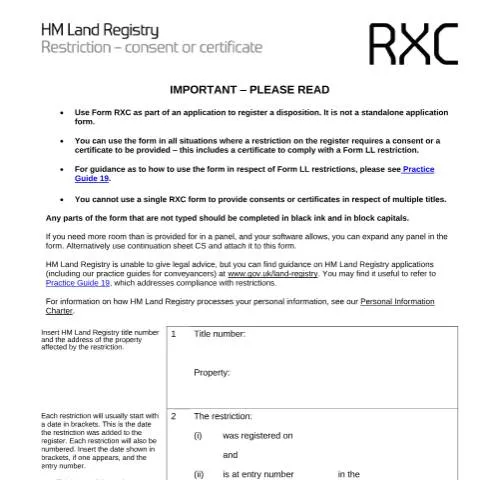
When Property Restrictions Meet Real-World Transactions: Understanding the RXC Certificate
Property transactions in England and Wales often hit an unexpected hurdle when solicitors discover that a restriction on the title register prevents completion without specific consents or certificates. The Restriction: consent or certificate (RXC) form becomes the key that unlocks these blocked transactions, serving as the formal mechanism to satisfy HM Land Registry that the necessary permissions have been obtained.
Unlike standalone application forms, the RXC operates as a supporting document that accompanies disposition applications. This distinction matters significantly: you cannot submit an RXC in isolation, and each form covers only a single title number. For conveyancers managing portfolio transactions, this means preparing separate RXC forms for each affected property, adding layers of complexity to what might initially appear as straightforward sales or transfers.
The form's versatility extends across the full spectrum of property restrictions, from standard consent requirements to the increasingly common Form LL restrictions that protect leaseholder interests. This breadth of application makes the RXC an essential tool for anyone navigating England and Wales' sophisticated property registration system.
Decoding Restriction Types and Their Certificate Requirements
Property restrictions come in numerous forms, each triggering different requirements for the RXC certificate. Understanding these variations proves crucial for determining who can provide the necessary consent and what evidence supports their authority.
Standard consent restrictions typically arise from charging orders, matrimonial proceedings, or commercial lending arrangements. These restrictions name specific parties whose consent enables the transaction to proceed. The restriction's wording determines precisely who can complete the RXC form – sometimes naming individuals explicitly, other times referring to roles like "the charging party" or "the mortgagee".
Form LL restrictions represent a more specialised category, protecting leaseholders' rights under leasehold reform legislation. These restrictions require certificates rather than simple consents, with strict rules governing who can provide the necessary certification. Only individually regulated conveyancers can certify compliance with Form LL restrictions, excluding paralegals and unregulated staff members who might otherwise handle standard consent procedures.
| Restriction Type | Required Response | Authorised Signatories | Additional Evidence |
|---|---|---|---|
| Named party consent | Consent | Person named in restriction | Identity verification |
| Role-based consent | Consent | Person holding specified role | Evidence of role/authority |
| Form LL restriction | Certificate | Individually regulated conveyancer only | Professional indemnity insurance details |
| Corporate consent | Consent | Authorised officers under rule 91B | Board resolution or authority evidence |
Navigating Corporate and Trust Restrictions
Corporate entities face particular complexities when restrictions affect their properties. Rule 91B of the Land Registration Rules 2003 strictly defines which individuals can provide consents on behalf of companies, typically limiting this authority to directors, company secretaries, or other officers with specific delegated powers.
Trust arrangements add further layers of complexity, especially where trustees have changed since the restriction's registration. The RXC form must clearly identify current trustees and provide evidence of their authority, which may require production of trust deeds, retirement documents, or appointment records.
Completing Panel 3: Authority and Identity Verification
Panel 3 of the RXC form requires careful navigation between two primary pathways: direct authority and representative authority. This section determines the entire approach to completing the remainder of the form and significantly impacts the supporting evidence requirements.
Direct authority applies when the person completing the form is explicitly named in the restriction or holds a position described within it. For example, if the restriction requires consent from "the registered proprietor of title AB123456", and the signatory owns that title, they would tick the first box in Part A and complete Part B with their details.
Representative authority covers situations where conveyancers, employees, agents, or attorneys act on behalf of the person or entity with the actual power to consent. This pathway requires additional evidence to establish the representative's authority, with different standards applying to different types of representatives.
Professional Status and Regulatory Requirements
Individually regulated conveyancers enjoy broader authority under the RXC system, particularly for Form LL restrictions where their professional status provides the necessary credibility. These professionals must provide their roll number and approved regulator details, creating an audit trail that HM Land Registry can verify if questions arise.
Employee conveyancers face more restrictions, particularly when their employers rather than they personally hold the professional qualification. Such employees can still complete RXC forms for standard consents but cannot certify Form LL compliance unless they hold individual regulation.
Evidence Requirements and Supporting Documentation
The RXC form's effectiveness depends heavily on the quality and appropriateness of supporting evidence. HM Land Registry's assessment focuses on establishing clear chains of authority from the restriction's requirements to the person actually signing the form.
Powers of attorney represent one of the most common forms of supporting evidence, particularly in family transactions or where property owners live abroad. The power must be valid, registered where required, and sufficiently broad to cover the specific consent being given. Enduring powers of attorney require additional evidence that the donor lacks mental capacity, while lasting powers of attorney need registration with the Office of the Public Guardian.
Corporate evidence varies significantly depending on the company's structure and the signatory's role. Standard evidence includes board resolutions authorising specific individuals to give consents, company searches confirming current officers, and evidence of any delegated authorities. For larger organisations, this might extend to detailed policy documents or management structure charts.
Probate and Estate Situations
Estate transactions present particular challenges when restrictions affect deceased owners' properties. Personal representatives must provide grants of probate or letters of administration, along with evidence that all executors or administrators consent to the transaction. Where restrictions name the deceased owner specifically, the RXC form must clearly establish the chain of authority from the original restrictionee to the current signatories.
Intestacy situations require additional care, particularly where multiple family members hold administration rights. The RXC form may need signatures from all administrators, or clear evidence that one administrator has authority to act alone in the specific circumstances.
Timing and Integration with Property Transactions
The RXC form's role as a supporting document rather than a standalone application creates specific timing requirements that affect transaction planning. Conveyancers must coordinate RXC submission with the main disposition application, ensuring both documents arrive at HM Land Registry simultaneously and reference each other correctly.
Pre-completion preparation proves essential, particularly for complex restrictions requiring evidence from multiple parties. Gathering corporate resolutions, powers of attorney, or professional certificates can take weeks, making early identification of restriction requirements crucial for maintaining transaction timetables.
Register edition dates create additional timing pressures. The RXC form must reference the correct register edition date, which can change if new entries are registered between form preparation and submission. Practice Guide 19 provides specific guidance on handling these situations, particularly for Form LL restrictions where timing precision matters most.
Multiple Title Complications
Portfolio transactions involving multiple properties each subject to restrictions require separate RXC forms for each title number. This requirement significantly increases documentation volumes and creates coordination challenges, particularly where different restrictions require consents from different parties or evidence of varying types.
Conveyancers often establish systematic approaches for managing multiple RXC submissions, including standardised evidence gathering procedures and coordination protocols with all relevant parties. The inability to use single RXC forms for multiple titles means that even minor variations between properties can multiply administrative requirements substantially.
Technical Completion and Common Complications
Form completion requires meticulous attention to HM Land Registry's technical requirements, starting with the fundamental rule that all handwritten entries must use black ink and block capitals. Modern practice increasingly favours electronic completion where possible, reducing transcription errors and improving legibility.
Panel expansion capabilities allow for detailed responses where standard form fields prove insufficient. Most conveyancing software supports panel expansion, but where this functionality is unavailable, continuation sheet CS provides the necessary additional space. The key requirement is maintaining clear connections between expanded panels and the original form structure.
Document referencing becomes crucial where restrictions are not yet registered but are contained in pending applications. The RXC form must reference the specific document and date containing the restriction, creating dependencies on the timing and success of the underlying registration application.
Quality Control and Error Prevention
Common errors in RXC completion often stem from misunderstanding the restriction's specific requirements or incorrectly identifying who has authority to provide consents. Careful reading of the restriction's exact wording proves essential, as seemingly minor differences in language can significantly affect completion requirements.
Cross-referencing between the RXC form and supporting evidence helps prevent inconsistencies that could delay registration. Names, dates, and reference numbers must align precisely across all documentation, with particular attention to corporate names and individual identity details.
Professional Practice and Risk Management
Conveyancers handling RXC forms face significant professional responsibilities, particularly when certifying Form LL compliance. Professional indemnity insurance considerations become paramount, as incorrect certificates can expose practitioners to substantial liability for any resulting losses.
Risk assessment procedures should evaluate each restriction's complexity and the clarity of authority chains before accepting instructions. Complex corporate structures, overseas entities, or unusual trust arrangements may warrant specialist advice or additional insurance considerations.
Documentation retention becomes crucial for professional protection, particularly given the potential for future challenges to completed transactions. Comprehensive file records should include all evidence considered, decision-making rationales, and any specialist advice obtained during the RXC completion process.
The integration of RXC procedures into broader transaction management systems helps ensure consistency and reduces the risk of overlooked requirements. Many practices develop standardised checklists and procedures specifically for restriction handling, creating systematic approaches that reduce both errors and professional liability exposure.
Common Scenarios Triggering RXC Restrictions
Understanding when an RXC restriction might be applied helps property owners and legal practitioners anticipate potential complications in transactions. The Land Registry applies these restrictions in various circumstances, each with distinct implications for how consent must be obtained or certificates provided.
Divorce and Separation Proceedings
Family breakdown represents one of the most frequent triggers for RXC restrictions. When divorce proceedings commence, either spouse may apply to register a restriction to prevent the other from disposing of matrimonial property without court approval. The restriction typically references the specific court case number and requires either a court order or consent from the applicant spouse before any disposition can proceed.
In contested divorces, solicitors often register multiple restrictions across various properties to preserve assets pending financial settlement discussions. The wording might specify that no disposition may be registered without an order from the Family Court or written consent from both parties' legal representatives. This mechanism proves particularly valuable when one spouse attempts to transfer property to third parties to defeat potential financial claims.
Separated couples who own property jointly but haven't yet commenced formal proceedings may also benefit from voluntary RXC restrictions. By mutual agreement, they can prevent either party from acting unilaterally whilst they negotiate separation terms privately or through mediation services.
Bankruptcy and Insolvency Situations
When bankruptcy proceedings are imminent or underway, trustees in bankruptcy frequently register RXC restrictions to protect creditors' interests. These restrictions prevent the bankrupt individual from disposing of property that forms part of their estate without the trustee's express consent or a court order from the bankruptcy court.
The restriction wording in bankruptcy cases often references the relevant sections of the Insolvency Act 1986 and may specify that dispositions require either trustee consent or court approval under specific statutory provisions. This creates a comprehensive barrier against asset stripping whilst ensuring legitimate transactions can still proceed with proper authorisation.
Individual Voluntary Arrangements (IVAs) may also trigger similar restrictions, though these typically allow more flexibility for the debtor to continue managing their affairs subject to supervisor oversight. The restriction might permit dispositions with the IVA supervisor's written consent, providing a more streamlined process than full bankruptcy restrictions.
Trust and Estate Administration
Complex trust structures often necessitate RXC restrictions to ensure proper governance and beneficiary protection. When trusts hold significant property portfolios, restrictions may require consent from multiple trustees, protectors, or beneficiaries before dispositions can proceed. This prevents any single trustee from acting beyond their authority or contrary to the trust's best interests.
Estate administration frequently involves RXC restrictions, particularly in contested probate situations. Personal representatives may register restrictions requiring court approval for property disposals when beneficiaries dispute the will's validity or the executor's actions. These restrictions remain in place until probate disputes are resolved or the court grants specific disposal authority.
Charitable trusts face additional complexity, as restrictions may reference requirements for Charity Commission consent alongside trustee approval. This dual-consent mechanism ensures compliance with both trust law and charity regulation, protecting the organisation's assets and maintaining public confidence in charitable governance.
Procedural Requirements and Documentation Standards
Successfully navigating RXC restrictions demands meticulous attention to procedural requirements and documentation standards. The Land Registry maintains strict criteria for both applying restrictions and subsequently obtaining the necessary consents or certificates for dispositions to proceed.
Application Process and Supporting Evidence
Applying for an RXC restriction requires Form RX1 accompanied by appropriate supporting documentation that demonstrates the applicant's legitimate interest in preventing unauthorised dispositions. The application must clearly specify the exact wording of the proposed restriction, referencing relevant legal proceedings, trust documents, or other circumstances justifying the restriction.
Supporting evidence varies significantly depending on the underlying circumstances. Divorce proceedings require copies of the petition and any interim court orders, whilst bankruptcy situations demand official documentation from the trustee or court. Trust-related restrictions need relevant excerpts from trust deeds or court orders appointing trustees, ensuring the Land Registry can verify the restriction's legal foundation.
The applicant must also provide evidence of their standing to apply for the restriction. Spouses in divorce proceedings can rely on their matrimonial interest, whilst trustees must demonstrate their appointment through appropriate documentation. Third parties, such as creditors or beneficiaries, face higher evidential burdens and may need court orders supporting their applications.
Fill in your form directly online
No printing: type your details into the boxes of the official form, tick, then download the PDF ready to send.
- 1Type into the form boxes
- 2Tick in one click
- 3Save and download the PDF
Priority protection through official search certificates becomes crucial when applying for restrictions, particularly in volatile situations where the registered proprietor might attempt to dispose of property quickly. The search certificate provides a priority period during which the restriction application takes precedence over competing registrations, preventing last-minute disposals that could defeat the restriction's purpose.
Consent Documentation and Certification Requirements
When seeking to dispose of property subject to an RXC restriction, obtaining proper consent documentation requires careful attention to the restriction's specific wording and requirements. The consent must come from the exact person or body specified in the restriction, using language that clearly authorises the proposed disposition.
Consent letters should identify the property by its title number and address, specify the nature of the proposed disposition, and confirm that the consent-giver has authority to provide such consent. Legal practitioners typically draft these letters on firm letterhead, including practising certificate numbers and Law Society regulation details to enhance credibility with the Land Registry.
Court orders satisfying RXC restrictions must specifically address the property in question and grant clear authority for the proposed disposition. Generic orders dealing with broader issues may not satisfy the restriction's requirements, necessitating applications for specific property disposal orders. The court order should be sealed and include the case number referenced in the original restriction.
Certificate evidence, where permitted by the restriction's wording, requires careful consideration of what constitutes acceptable certification. Some restrictions accept solicitor certificates confirming specific facts or compliance with particular requirements, whilst others demand certificates from court officials, trustees, or other specified parties. The certificate must address each element specified in the restriction's wording to ensure the Land Registry accepts it as sufficient evidence.
Land Registry Assessment and Registration Process
The Land Registry's assessment of consent documentation or certificates follows established protocols designed to ensure compliance with the restriction's requirements whilst maintaining efficient registration processes. Land Registry caseworkers examine submissions against the specific restriction wording, checking that all requirements are met before allowing dispositions to proceed.
Complex restrictions may require senior caseworker review or legal department consultation, particularly when the consent documentation raises novel issues or the restriction wording creates ambiguity about requirements. This internal review process can extend registration timescales, making early engagement with the Land Registry advisable for urgent transactions.
The Land Registry maintains discretion to reject consent documentation that doesn't clearly satisfy the restriction's requirements, even if the underlying transaction appears legitimate. This emphasises the importance of precise drafting in both restriction applications and subsequent consent documentation, ensuring all requirements are explicitly addressed rather than left to implication or interpretation.
Strategic Considerations and Risk Management
Effective management of RXC restrictions requires sophisticated strategic thinking, balancing protection objectives against practical transaction needs. Legal practitioners and property professionals must navigate complex competing interests whilst maintaining compliance with procedural requirements and managing client expectations about timescales and costs.
Timing and Priority Considerations
Strategic timing of restriction applications can significantly impact their effectiveness and the broader legal or commercial context. In matrimonial situations, early restriction registration may prevent asset dissipation but could also escalate conflict and complicate settlement negotiations. Conversely, delayed applications risk the other party completing dispositions before protective measures take effect.
Priority periods created by official searches become critical in competitive situations where multiple parties may seek to register competing interests. Understanding the interaction between search priorities, restriction applications, and substantive transaction registrations requires careful coordination between legal teams and land registry agents to ensure optimal outcomes.
The relationship between RXC restrictions and other forms of protection, such as cautions against dealings or charging orders, demands strategic consideration. Multiple protective mechanisms may provide enhanced security but can also create procedural complexity and increase costs, requiring careful assessment of proportionality and effectiveness.
Commercial transactions involving restricted properties require sophisticated project management to coordinate consent processes with completion timescales. Early identification of restrictions through property searches allows transaction teams to build appropriate contingencies into contract terms and completion arrangements, preventing last-minute delays or failures.
Cost-Benefit Analysis and Alternative Approaches
RXC restrictions involve both direct costs and indirect commercial implications that require careful evaluation against alternative protective mechanisms. Direct costs include Land Registry fees, legal fees for application preparation, and ongoing costs for consent processes in future transactions. Indirect costs encompass reduced property marketability, delayed transaction timescales, and potential impacts on property values.
Alternative protective mechanisms may offer more cost-effective or targeted solutions depending on specific circumstances. Contractual restrictions between parties might provide adequate protection without Land Registry involvement, whilst charging orders or other security interests could better serve creditor protection objectives. Trust structures might eliminate the need for restrictions through appropriate governance mechanisms.
The duration and scope of protection required influences the cost-benefit calculation significantly. Short-term protection during specific legal proceedings might justify higher costs per unit time, whilst long-term restrictions require careful consideration of cumulative impacts and ongoing administrative burdens.
Regular review of restriction necessity helps manage costs and avoid unnecessary impediments to legitimate transactions. As circumstances change, restrictions that once served important protective functions may become obsolete or counterproductive, requiring active management rather than passive maintenance.
Dispute Resolution and Enforcement Mechanisms
Disputes over RXC restrictions and their application create complex procedural and substantive legal issues requiring specialist expertise. Disagreements may arise over the restriction's validity, the interpretation of consent requirements, or the adequacy of evidence provided to satisfy the restriction's terms.
The Land Registry's internal review and appeals processes provide initial dispute resolution mechanisms, allowing parties to challenge caseworker decisions about restriction applications or consent documentation. These processes require careful preparation of legal arguments and supporting evidence, often necessitating specialist land law expertise to navigate successfully.
Court proceedings may become necessary when Land Registry processes cannot resolve disputes or when underlying legal issues require judicial determination. Applications to remove restrictions, declarations about consent requirements, or injunctive relief to prevent inappropriate restriction applications each require different procedural approaches and legal strategies.
Enforcement of restriction terms against non-complying parties involves complex interactions between land law, contract law, and procedural rules. Breach of restriction terms might constitute contempt of court where court orders are involved, or breach of contract in consensual arrangements, each requiring different enforcement approaches and remedies.
The international dimension of modern property ownership creates additional complexity when restrictions involve overseas parties or assets. Cross-border enforcement of restriction terms, obtaining consent from foreign entities, and coordinating with international legal proceedings require specialist expertise in conflict of laws and international legal cooperation mechanisms.