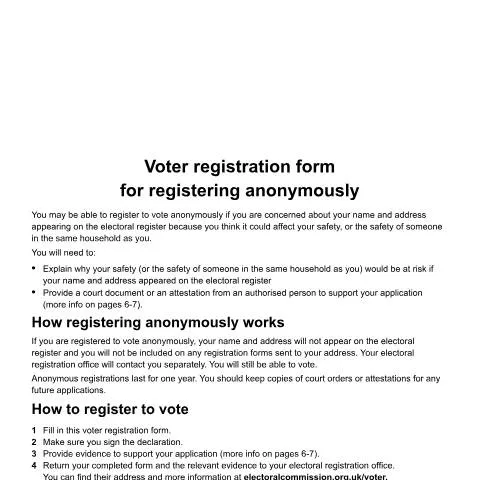
When Your Address Becomes a Security Risk: Understanding Anonymous Voter Registration
For some citizens, the simple act of appearing on the electoral register can pose a genuine threat to their personal safety. Whether you're fleeing domestic violence, working in a profession that attracts unwanted attention, or facing harassment that could escalate if your address becomes public knowledge, anonymous voter registration offers a vital protection whilst preserving your democratic rights.
The anonymous voter registration process, managed through your local Electoral Registration Office, allows eligible individuals to participate in elections without their name and address appearing on publicly accessible versions of the electoral register. This protection extends beyond just hiding your details – it ensures you won't receive standard registration forms at your address, and all communication about your electoral status happens through separate, secure channels.
The Narrow Gateway: Who Qualifies for Anonymous Registration
Anonymous registration isn't available simply because you prefer privacy. The system is specifically designed for individuals whose safety would be genuinely at risk if their details appeared on the electoral register. The Electoral Commission and local registration offices apply strict criteria when assessing applications.
Personal Safety Scenarios
The most common qualifying circumstances include victims of domestic violence who have relocated to escape an abusive partner, individuals who have received credible threats of violence, or those whose work puts them at particular risk. Police officers, social workers dealing with dangerous cases, and court staff handling serious criminal matters often qualify, as do journalists covering sensitive topics or individuals involved in high-profile legal proceedings.
Household Safety Considerations
Significantly, the protection extends beyond just your own safety to cover anyone living in the same household. If your partner, children, or other household members would be at risk because of your electoral registration details becoming public, this strengthens your application. This provision recognises that threats often extend to family members and that perpetrators may target anyone associated with their intended victim.
Nationality and Immigration Status Requirements
Before considering anonymous registration, you must first be eligible to vote. This means being a British or Irish citizen, a Commonwealth citizen with appropriate immigration status, or an EU citizen from specific countries who maintained continuous permission to remain in the UK after Brexit. For EU citizens from Austria, Belgium, Bulgaria, Croatia, Czech Republic, Estonia, Finland, France, Germany, Greece, Hungary, Italy, Latvia, Lithuania, Netherlands, Romania, Slovakia, Slovenia, or Sweden, you'll need to demonstrate continuous lawful residence since 31 December 2020.
Navigating the ITR-A-E Form: Section-by-Section Completion
The ITR-A-E form spans eight pages and requires careful attention to detail. Unlike standard voter registration, every section carries additional weight because you're asking for exceptional treatment that requires justification.
Personal Details and Address Complications
Section 1 presents an immediate complexity: you must provide your actual residential address, even though this address won't appear on the public register. This address is where you genuinely live and where the Electoral Registration Office needs to know you reside for voting purposes. However, you can also specify a different correspondence address if receiving mail at your residential address would compromise your safety.
Many applicants worry about providing their real address, but remember that Electoral Registration Offices are bound by strict confidentiality requirements. Your address details are held securely and separately from the public register. Staff handling anonymous registrations receive specific training on data protection and the sensitive nature of these applications.
Multiple Residences and Timing Considerations
If you live at more than one address – perhaps splitting time between a safe house and another location, or maintaining separate addresses for security reasons – you must declare this. The form asks specifically about other addresses because this affects which constituency you vote in and ensures you're only registered once.
Section 5 about previous addresses becomes particularly important for anonymous applicants. If you've moved recently to escape a dangerous situation, providing your previous address helps the Electoral Registration Office understand your circumstances and may support your application for anonymous registration.
The Evidence Challenge: Court Documents and Attestations
The most critical aspect of anonymous registration is providing appropriate evidence. The Electoral Registration Office cannot simply take your word that you face a safety risk – they need formal documentation that demonstrates the credible nature of the threat.
Court Documents as Primary Evidence
Court orders provide the strongest evidence for anonymous registration applications. Restraining orders, non-molestation orders, occupation orders, or injunctions specifically mentioning threats to your safety carry significant weight. Family court orders in domestic violence cases, criminal court orders relating to harassment or stalking, and civil court injunctions all qualify as appropriate documentation.
The court document doesn't need to be recent – a restraining order from several years ago can still support your application if the threat remains credible. However, you should explain in your application how the historical court order relates to your current safety concerns.
Professional Attestations: Who Can Support Your Application
When court documents aren't available, attestations from authorised professionals can support your application. These attestations must come from individuals in specific roles who can professionally assess the risk to your safety.
| Professional Role | What They Can Attest | Typical Scenarios |
|---|---|---|
| Police Officer (Inspector level or above) | Credible threats, ongoing investigations, risk assessments | Harassment cases, stalking, domestic violence without court orders |
| Social Worker (qualified and registered) | Professional assessment of risk to vulnerable adults or families | Child protection cases, vulnerable adult safeguarding |
| Medical Practitioner | Evidence of injuries or psychological impact from threats | Domestic violence, harassment causing health impacts |
| Solicitor or Barrister | Legal assessment of threat level, pending legal proceedings | Civil harassment cases, employment-related threats |
Timing, Duration, and the Annual Renewal Reality
Anonymous registrations operate on a strict annual cycle, which differs significantly from standard voter registration that continues indefinitely until you move or become ineligible. This annual requirement reflects the exceptional nature of anonymous registration and ensures that the protection remains necessary.
The Registration Timeline
Electoral Registration Offices process anonymous registration applications throughout the year, but timing affects which elections you can participate in. Applications must be received and approved before electoral register publication deadlines for specific elections. For parliamentary elections, this typically means your application needs approval several weeks before polling day.
If you're applying close to an election, contact your Electoral Registration Office immediately to understand whether your application can be processed in time. Some offices expedite anonymous registration applications when elections are imminent, particularly if your safety concerns are well-documented.
Preparing for Annual Renewals
The annual renewal requirement means you should maintain copies of all supporting evidence. Court orders don't expire in terms of their evidential value for electoral purposes, and professional attestations may remain valid if the underlying circumstances haven't changed. However, some Electoral Registration Offices prefer updated attestations for renewals, particularly if your circumstances have evolved.
Start your renewal process at least two months before your current anonymous registration expires. This provides time for any additional evidence gathering and ensures continuous protection without gaps that could expose your details.
When Applications Face Challenges: Appeals and Alternative Approaches
Not every anonymous registration application succeeds on first submission. Electoral Registration Offices must balance individual safety concerns against the principle that electoral registers should be as complete and accessible as possible for democratic purposes.
Common Reasons for Initial Rejection
Applications often face challenges when the evidence doesn't clearly demonstrate a current safety risk. Historical threats that have clearly resolved, vague concerns about privacy without specific safety implications, or professional situations that involve general public exposure rather than targeted personal threats may not meet the threshold for anonymous registration.
The Electoral Registration Office may also reject applications where the supporting evidence comes from inappropriate sources. Character references from friends or family members, general statements about feeling unsafe without specific incidents, or attestations from professionals who haven't directly assessed your situation typically don't provide sufficient support.
Strengthening Resubmitted Applications
If your initial application is unsuccessful, you can reapply with additional evidence. Consider obtaining a more detailed professional attestation that specifically addresses the Electoral Registration Office's concerns, or seek legal advice about whether your situation might warrant court proceedings that would generate appropriate documentation.
Some applicants benefit from contacting specialist support organisations. Women's refuges, domestic violence charities, and victim support services often have experience helping clients navigate anonymous registration applications and may be able to provide additional supporting documentation or connect you with appropriate professionals for attestations.
Beyond Registration: How Anonymous Status Affects Your Electoral Experience
Successfully obtaining anonymous registration changes how you interact with the electoral system in several practical ways that extend beyond simply hiding your details from public view.
Polling Day Procedures
When you vote, polling station staff will have your name on a separate, confidential list rather than the main electoral register. You'll still need to provide your name and address to receive your ballot paper, but this information won't be visible to other voters or party representatives monitoring the polling station. Some polling stations may direct anonymous voters to a separate desk or provide additional privacy during the identification process.
Postal and Proxy Voting Considerations
Anonymous voters can apply for postal votes or proxy votes using the same processes as other registered voters, but additional security measures apply. Postal vote applications from anonymous voters receive enhanced scrutiny to prevent fraud, and the Electoral Registration Office may request additional identity verification.
If you're voting by proxy, ensure your chosen proxy understands they're acting for an anonymous voter and may face additional questions at the polling station. The proxy voting process works normally, but polling station staff may need to verify the arrangement more carefully.
Contact and Communication Protocols
Your Electoral Registration Office will contact you separately about electoral matters rather than including you in general mailings to your address. This means you might receive election information later than other households, and you should ensure your contact details remain current to avoid missing important communications about upcoming elections or changes to polling arrangements.
Political parties cannot access your details for campaigning purposes, which means you won't receive candidate literature or campaign communications at your address related to your voter registration. However, parties may still contact your address through other means if they obtain your details from different sources.
Maintaining Protection: Long-term Considerations and Exit Strategies
Anonymous voter registration provides essential protection, but it's not necessarily a permanent solution. Your circumstances may change, making the protection unnecessary, or you might need to transition to different safety measures while maintaining electoral participation.
Assessing Ongoing Need
Each annual renewal provides an opportunity to assess whether anonymous registration remains necessary. If court proceedings have concluded with protective measures, if threatening individuals have been prosecuted or moved away, or if your professional circumstances have changed, you might consider returning to standard voter registration.
However, don't underestimate the value of continued protection. Some threats remain credible for years, and the effort of maintaining anonymous registration is minimal compared to the potential consequences of exposure. Discuss your ongoing risk assessment with the same professionals who supported your initial application.
Transitioning Back to Standard Registration
If you decide anonymous registration is no longer necessary, you can simply allow your annual registration to expire and register normally. Alternatively, contact your Electoral Registration Office to discuss transitioning mid-year if your circumstances change dramatically. The office can advise whether immediate transition is possible or whether you should complete the current annual period before changing your registration status.
Remember that once you return to standard registration, your details will appear on the next published electoral register. Consider the timing of this transition carefully, particularly if electoral register updates coincide with periods when you might face increased risk or attention.