When British Citizenship Isn't Automatic: Understanding Form T Registration
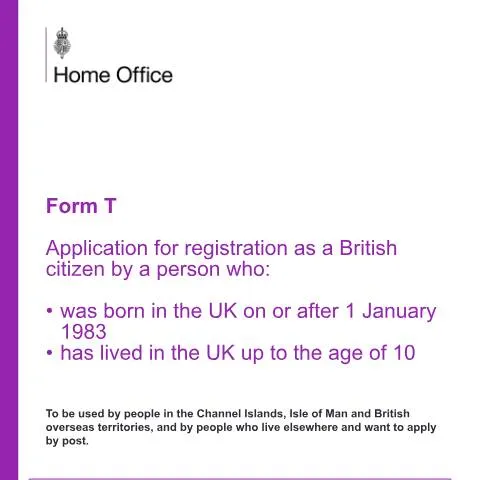
Thousands of people born in the UK after 1 January 1983 discover a surprising reality: birth on British soil doesn't automatically confer citizenship. This fundamental shift in nationality law created a generation who, despite their deep roots in the UK, must actively register as British citizens through Form T. The application becomes particularly relevant for those who have lived continuously in the UK up to age 10, creating a pathway to citizenship that recognises genuine connection to the country.
Form T serves a specific cohort within the complex landscape of British nationality law. Unlike the automatic jus soli (right of the soil) that applied before 1983, modern citizenship rules depend heavily on parental status at birth. A child born in England, Scotland, Wales or Northern Ireland to parents who weren't British citizens or settled residents finds themselves in legal limbo—British by culture and upbringing, yet lacking formal citizenship status.
This registration process differs fundamentally from naturalisation applications. Form T applicants aren't seeking to become British; they're claiming a right that circumstances prevented them from obtaining at birth. The distinction matters significantly for processing times, requirements, and the applicant's legal standing throughout the process.
The Legislative Framework Behind Form T Applications
The British Nationality Act 1981 revolutionised UK citizenship law, introducing the principle that birth in the UK alone wasn't sufficient for citizenship. Section 1(4) of the Act established the registration right for children who had lived in the UK for their first ten years, creating what would become the Form T pathway.
This legislative change reflected broader immigration policy shifts in the early 1980s. The previous jus soli system, inherited from imperial law, had become incompatible with modern immigration controls. The new framework aimed to ensure citizenship reflected genuine connection to the UK rather than mere geographical accident of birth.
The registration right under section 1(4) recognises that a child who has spent their formative years in the UK has developed the strongest possible connection to British society, regardless of their parents' immigration status at the time of birth.
Subsequent amendments have refined but not fundamentally altered this framework. The Immigration Act 2014 introduced new requirements for some registration routes, but Form T applications remain largely governed by the original 1981 provisions. UK Visas and Immigration (UKVI) processes these applications under well-established precedents, making outcomes relatively predictable for qualifying applicants.
Territorial Scope and Jurisdictional Considerations
Form T applications extend beyond mainland UK births. The application covers births in the Channel Islands, Isle of Man, and British overseas territories, reflecting the complex constitutional arrangements within the British Isles and overseas territories. Each jurisdiction maintains its own birth registration system, but citizenship matters remain reserved to the UK government.
This territorial complexity often surprises applicants born in places like Gibraltar, the Falkland Islands, or even Jersey and Guernsey. Despite their distinct legal systems, births in these territories fall under the same post-1983 citizenship rules, making Form T the appropriate registration route for qualifying individuals.
Decoding Eligibility: The Ten-Year Residence Requirement
The cornerstone of Form T eligibility lies in demonstrating continuous UK residence from birth until age 10. However, 'residence' carries specific legal meaning that differs from mere physical presence. UKVI interprets residence as lawful presence with a genuine home in the UK, not temporary visits or irregular stays.
| Age Period | Residence Requirement | Documentation Needed |
|---|---|---|
| Birth to Age 5 | Continuous UK residence | Birth certificate, GP records, nursery attendance |
| Age 5 to 10 | Continuous UK residence | School records, council tax records, NHS registrations |
| After Age 10 | No specific requirement | Current address verification |
The residence requirement allows for brief absences—family holidays, visiting relatives abroad, or temporary trips don't disqualify applicants. However, prolonged absences exceeding 90 days in any 12-month period may require detailed explanation and supporting evidence to demonstrate maintained UK residence.
Calculating Residence Periods
UKVI calculates the ten-year period from the applicant's date of birth, not from any immigration entry date. This distinction proves crucial for children whose parents' immigration status changed during their early years. A child born to visitors who later obtained settlement can still qualify for Form T registration, provided they maintained continuous residence throughout the qualifying period.
The assessment considers the family unit's circumstances holistically. Where parents faced immigration difficulties or periods of uncertain status, UKVI examines whether the child genuinely resided in the UK throughout their first decade, regardless of their parents' formal immigration position.
Navigating Parental Status Complexities
Form T applications often involve intricate questions about parental nationality and immigration history. The application requires detailed information about both parents' birth details, nationalities, and citizenship status—information that directly impacts the child's citizenship entitlement at birth.
Children born to parents who later acquired British citizenship present particularly nuanced cases. If either parent became a British citizen or obtained settled status before the child's 18th birthday, this might affect their citizenship entitlement through alternative routes. UKVI caseworkers must determine whether Form T remains the appropriate application route or whether the applicant already possesses British citizenship through other provisions.
Mixed-Status Families and Documentation Challenges
Families with complex immigration histories often struggle to provide complete parental documentation. Missing birth certificates, unclear nationality records, or parents who themselves lack clear immigration status can complicate Form T applications. UKVI guidance acknowledges these difficulties and accepts alternative evidence where official documents aren't available.
The application process requires particular sensitivity where family circumstances involve:
- Stateless parents or those with unclear nationality status
- Refugee families who may lack complete documentation from their country of origin
- Adoption cases where birth parent information isn't available
- Single-parent families where one parent's details are unknown or unavailable
Document Assembly: Building Your Evidence Portfolio
Successful Form T applications depend heavily on comprehensive documentation that establishes both identity and continuous UK residence. Unlike passport applications that rely primarily on official identity documents, Form T requires evidence spanning the applicant's entire first decade of life.
The documentation strategy should demonstrate unbroken residence through overlapping evidence periods. A gap in documentation doesn't automatically doom an application, but applicants must provide reasonable explanations and alternative evidence where possible.
Primary Identity and Birth Documentation
Form T requires original or certified copies of birth certificates, with specific requirements varying by issuing authority. UK birth certificates must be full certificates showing parental details, not short-form extracts. For births in British overseas territories, applicants need certificates from the local registration authority plus evidence of the territory's connection to the UK at the time of birth.
Parental documentation proves equally crucial. Both parents' birth certificates and nationality evidence help UKVI determine whether the child acquired citizenship automatically at birth. Where parents naturalised as British citizens after the child's birth, the dates become critical for assessing alternative citizenship entitlements.
Residence Evidence by Life Stage
Early childhood residence evidence typically includes:
- NHS medical records showing continuous GP registration and childhood vaccinations
- Nursery or childcare records demonstrating attendance and parental contact details
- Local authority records including housing benefit documentation or council correspondence
- Utility bills in parents' names showing family address history
School-age evidence becomes more substantial and easier to obtain. Primary school admission records, annual school reports, and attendance certificates provide strong evidence of continuous UK residence. Educational records carry particular weight because they demonstrate not just physical presence but integration into British society and institutions.
Processing Realities: Timelines and UKVI Decision-Making
Current Form T processing times reflect UKVI's broader capacity constraints, with standard applications typically taking 6-8 months from submission to decision. However, complex cases involving missing documentation or unclear residence periods can extend significantly longer. The version 02/26 form reflects recent updates to streamline processing, but applicants should plan for extended waiting periods.
UKVI's approach to Form T applications has evolved toward more thorough scrutiny of residence evidence. Caseworkers increasingly request additional documentation where initial submissions don't clearly establish continuous residence. This trend reflects broader policy emphasis on preventing citizenship fraud, though it can frustrate genuine applicants with straightforward cases.
The Role of Biometric Enrolment
Form T applicants must attend biometric enrolment appointments at designated service centres. The process captures fingerprints and photographs for security databases, with appointments typically available within 2-3 weeks of application submission. Biometric data links the citizenship registration to the individual's broader immigration and identity records, enabling UKVI to verify residence claims against existing databases.
For applicants living outside the UK, postal applications remain possible, but biometric requirements may necessitate travel to the nearest British diplomatic post offering such services. This requirement can significantly complicate applications for families who have relocated abroad after the applicant's childhood in the UK.
Beyond Approval: Citizenship Ceremonies and Practical Implications
Successful Form T applicants over 18 must attend citizenship ceremonies before receiving their certificates. These ceremonies, conducted by local authorities, represent the formal moment of citizenship acquisition. The process typically takes 2-4 weeks to arrange after UKVI approval, with applicants able to request ceremonies in specific local authority areas if they have moved since application.
The citizenship ceremony requirement reflects policy emphasis on civic integration and shared British values. Unlike naturalisation ceremonies that include oath-taking by adult immigrants, Form T ceremonies acknowledge that the applicant was already integrated into British society from childhood. The ceremony serves more as recognition than initiation into citizenship.
Rights and Responsibilities Post-Registration
Form T registration confers full British citizenship with identical rights to those who acquired citizenship at birth. This includes unrestricted right of abode, eligibility for British passports, and protection of British diplomatic services worldwide. Crucially, registered citizens can pass British citizenship to their children born anywhere in the world, breaking any cycle of uncertainty for future generations.
The registration also resolves practical difficulties that may have persisted throughout the applicant's life. Many Form T applicants discover their citizenship ambiguity only when applying for passports, seeking employment requiring security clearance, or attempting to sponsor family members for UK visas. Registration eliminates these uncertainties definitively.
However, registration carries responsibilities including potential liability for UK tax on worldwide income for UK residents, eligibility for jury service, and obligation to assist with national emergencies if called upon. These responsibilities mirror those of all British citizens and reflect the fundamental nature of citizenship as a reciprocal relationship with the state.
Documenting Your Journey: Evidence Requirements and Record-Keeping
The T application demands meticulous documentation spanning your entire qualifying period. Unlike straightforward visa applications, citizenship claims require evidence of continuous residence, good character, and legal status throughout potentially decades of UK presence.
For residence evidence, UKVI expects a comprehensive timeline. Bank statements remain the gold standard—monthly statements covering the full qualifying period demonstrate both presence and integration into UK financial systems. However, gaps in banking history aren't fatal if you provide alternative evidence. Council tax bills, utility statements, NHS medical records, and employment documentation can fill chronological holes. P60 certificates from HMRC prove not only presence but also tax compliance, strengthening your good character case.
Travel documentation presents particular challenges for long-term residents. Your current passport may not cover the entire qualifying period, especially if you've renewed it multiple times. UKVI accepts expired passports as evidence, but obtaining copies of old travel documents from embassies can take months. Consider this when planning your application timeline. Some applicants maintain detailed personal travel logs, though these carry less weight than official stamps.
Educational certificates require careful handling. UK qualifications need no translation, but overseas credentials must be officially translated and, in some cases, authenticated by the relevant embassy or through the UK's ENIC service. If you've studied in the UK, your university can provide confirmation letters detailing course duration and completion dates, which help establish continuous residence.
Employment evidence extends beyond simple confirmation letters. UKVI may scrutinise employment gaps, career changes, or periods of self-employment. If you've been self-employed, SA100 tax returns and business registration documents become crucial. For employees, a combination of contracts, payslips, and P45/P60 forms creates a robust employment narrative.
Digital record-keeping proves invaluable for T applications. Scan all documents in high resolution, maintaining both chronological and categorical filing systems. Consider that UKVI may request additional evidence during processing, so accessible digital archives save considerable time and stress.
Navigating Complex Family Circumstances and Dependency Claims
Form T accommodates various family structures, but complex circumstances require careful navigation. Blended families, adoption scenarios, and situations involving estranged parents or guardians present unique challenges that standard guidance doesn't fully address.
Children's applications often hinge on their parents' status, but timing becomes crucial. If one parent naturalises before the child turns 18, the child may automatically acquire citizenship under Section 1(3) of the British Nationality Act 1981, potentially eliminating the need for a T application. However, this automatic acquisition isn't always straightforward—the child must be in the UK when the parent naturalises, and complex residence requirements may still apply.
Adoption cases require additional documentation. UK adoption orders automatically confer certain rights, but overseas adoptions need recognition under UK law first. The Adoption and Children Act 2002 sets out recognition criteria, but processing times can be lengthy. Some families find themselves in limbo, where a child has lived in the UK for years following overseas adoption but cannot naturalise until the adoption gains UK recognition.
Divorced or separated parents face particular complications. If one parent has sole parental responsibility, they can usually make citizenship applications independently. However, where parental responsibility is shared, both parents typically must consent to the child's naturalisation. UKVI may accept alternative arrangements where one parent cannot be contacted, but you'll need legal evidence of attempts to reach them and potentially court orders establishing your right to make unilateral decisions.
Guardianship situations require careful documentation. Local authority care orders, private guardianship arrangements, and informal care by relatives all have different implications for citizenship applications. Foster children in long-term placements may qualify for naturalisation, but the local authority typically must support the application and provide detailed care history.
Military families stationed overseas present another complexity. Crown service provisions may maintain UK residence continuity for naturalisation purposes, but documentation requirements differ. Military personnel need service records confirming overseas postings, and family members must prove their dependency relationship throughout the qualifying period.
Same-sex couples and civil partnerships have equal rights to marriage for citizenship purposes, but historical complications may arise. Relationships formed before civil partnerships became legal in 2005 might require additional evidence to establish genuine and subsisting relationships for the full qualifying period.
Post-Application Process: What Happens After Submission
Submitting your T application marks the beginning, not the end, of the naturalisation process. Understanding UKVI's internal procedures helps set realistic expectations and prepare for potential requests or complications.
Initial processing involves document verification and database checks. UKVI cross-references your details against immigration records, criminal databases, and tax information held by HMRC. This explains why discrepancies between your application and official records can cause significant delays. Even minor inconsistencies—different name spellings or address variations—may trigger manual reviews requiring several additional weeks.
The good character assessment represents the most unpredictable element of T processing. While serious criminal convictions clearly pose problems, UKVI's interpretation of "good character" extends far beyond criminal records. Outstanding tax obligations, benefit fraud investigations, immigration violations, and even civil judgments may influence decisions. The assessment considers the full qualifying period, so minor issues from years past might resurface during processing.
Biometric enrollment typically occurs 6-8 weeks after submission, though appointment availability varies by location. London and major cities often have longer waiting times than regional centres. The biometric appointment isn't merely administrative—UKVI uses this opportunity to conduct identity verification and may ask additional questions about your application. Arriving with supporting documents can help address any queries immediately.
Request for additional evidence arrives unpredictably during processing. UKVI may seek clarification on residence periods, request updated documents if your originals are aging, or ask for specific evidence addressing perceived weaknesses in your application. Response deadlines are typically tight—usually 28 days—and extensions are rarely granted. Maintaining your document archive throughout processing proves essential for swift responses.
Decision notification comes via post to your registered address. Successful applicants receive invitation letters to citizenship ceremonies, which must be attended within three months. The ceremony itself is brief but significant—you'll make the citizenship oath and receive your naturalisation certificate, which serves as proof of British citizenship for all future purposes.
Unsuccessful applications include detailed refusal letters explaining UKVI's reasoning. Many refusals stem from insufficient evidence rather than fundamental ineligibility, making reapplication viable once you address the identified shortcomings. However, each application requires fresh fees, so understanding refusal reasons thoroughly before resubmitting prevents costly repeat rejections.
Processing times fluctuate based on application volumes and complexity. Standard cases average 6-8 months, but complex applications involving detailed residence calculations or extensive travel histories may take significantly longer. UKVI provides limited updates during processing, so patience becomes essential for navigating this final phase of your citizenship journey.