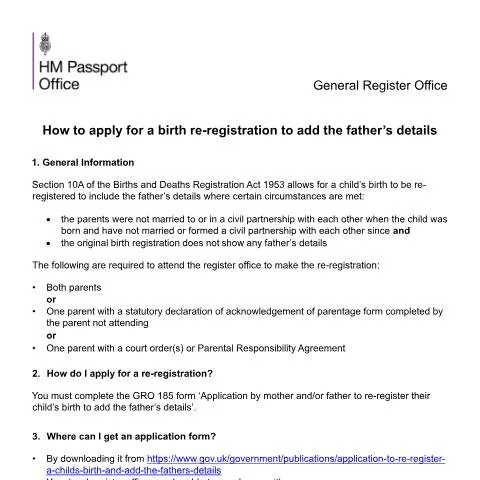
Understanding Section 10A Birth Re-registration: When Fathers Weren't Originally Recorded
When unmarried parents welcome a child and only the mother initially registers the birth, the father's details remain absent from the original certificate. Years later, circumstances may change—perhaps the relationship has evolved, custody arrangements need clarification, or passport applications require complete parental information. The Application to re-register a child's birth and add the father's details addresses this specific scenario under Section 10A of the Births and Deaths Registration Act 1953.
This re-registration process differs fundamentally from corrections or amendments. Rather than fixing an error, it creates an entirely new birth entry that includes both parents' information. The original registration remains in the records, but a fresh certificate emerges with the father's details properly documented. This distinction proves crucial for understanding both the legal implications and the practical requirements.
The General Register Office maintains strict eligibility criteria. Both parents must have been unmarried when the child was born and must remain unmarried to each other at the time of application. If they subsequently married or entered a civil partnership, a different re-registration pathway applies entirely. The original birth certificate must show no father's details whatsoever—even partial information disqualifies this particular procedure.
Navigating the GRO 185 Form: Section-by-Section Requirements
The GRO 185 form structures itself around establishing parental identity, child details, and the specific circumstances justifying re-registration. Section 1 captures basic information about both parents, requiring full names, addresses, and occupations exactly as they should appear on the new certificate. Accuracy here proves essential—any discrepancies between the form and supporting documentation can delay processing significantly.
Section 2 focuses on the child's existing birth registration details. Applicants must provide the original registration district, sub-district, and entry number from the current certificate. The register office location and date of original registration help officials locate the correct entry within their records. Common oversight: parents sometimes confuse the registration date with the birth date, particularly when registration occurred weeks after the actual birth.
Sections 5 and 6 contain crucial eligibility questions that determine the application pathway. Section 5 specifically asks whether parents ever married or formed a civil partnership with each other. A single "yes" answer redirects applicants to an entirely different form and process. Section 6 addresses court orders, parental responsibility agreements, or other legal documentation that might substitute for joint attendance at the register office.
The form's design intentionally creates multiple branching pathways based on responses. This complexity reflects the varied circumstances surrounding unmarried parents and their evolving relationships over time.
Four Distinct Application Routes: Matching Your Circumstances
The General Register Office's flowchart system divides applications into four distinct options, each with specific requirements and processing locations. Understanding which route applies prevents delays and ensures proper handling.
| Option | Circumstances | Requirements | Processing Location |
|---|---|---|---|
| Option 1 | Both parents can attend together; no court orders or complications | Completed GRO 185 form | Local register office |
| Option 2 | Only one parent can attend; other parent cooperative | GRO 185 form + Form 16 statutory declaration | GRO or via local office |
| Option 3 | Both can attend; court orders or PRA involved | GRO 185 form + certified court documents | GRO or via local office |
| Option 4 | One parent unwilling; court orders required | GRO 185 form + certified court orders/PRA | GRO or via local office |
Option 1 represents the most straightforward scenario. Both parents simply contact their preferred register office, arrange an appointment, and complete the process locally. The register office staff guide them through the final steps and can issue new certificates immediately upon completion.
Option 2 introduces the Form 16 statutory declaration, a separate document where the absent parent formally acknowledges paternity. This sworn statement must be completed at any register office in England or Wales, requiring the absent parent's physical presence before a registrar. The declaration then accompanies the main application, providing legal verification of paternal acknowledgment.
Options 3 and 4 involve court orders or Parental Responsibility Agreements, requiring certified photocopies rather than original documents. The certification process must occur through official channels—solicitors, register offices, or other authorized bodies can provide this service for a fee.
Court Orders and Legal Documentation: Acceptable Evidence Standards
The General Register Office maintains specific criteria for court orders, accepting only those issued by UK courts under particular legislative provisions. Section 4 or 4ZA of the Children Act 1989 covers Parental Responsibility Agreements where fathers gain formal parental rights through agreement with the mother. These agreements require specific formatting and witnessing procedures.
Financial provision orders under Paragraph 1 of Schedule 1 of the Children Act 1989 establish paternity through maintenance obligations. Courts issue these orders when fathers accept financial responsibility for children, creating legal recognition of the parental relationship. Similarly, Section 4 of the Family Law Reform Act 1987 grants comprehensive parental rights and duties.
Older legislation remains valid for historical cases. The Guardianship of Minors Act 1971 covers custody, care and control, or financial provision orders from earlier periods. The Affiliation Proceedings Act 1957 specifically names putative fathers, though this terminology reflects historical legal language rather than current practice.
Critical limitation: DNA tests, child maintenance agreements, or court orders from outside the UK hold no validity for this process. Only UK court orders under the specified legislative provisions qualify, regardless of their apparent relevance or strength as evidence.
The Statutory Declaration Process: Form 16 Requirements and Procedures
When one parent cannot attend the register office, Form 16 provides the statutory declaration mechanism for acknowledging paternity. This process requires the absent parent's physical presence at any register office in England or Wales, where they must swear or affirm the declaration before a qualified registrar.
The declaration form captures detailed information about the parent making the statement, the child in question, and the specific acknowledgment of paternity. Registrars verify identity through official documentation—driving licences, passports, or other government-issued identification suffice. The parent must understand the legal implications of making a false declaration, which constitutes a criminal offense.
Timing considerations affect the statutory declaration process. Some register offices operate appointment systems for declarations, potentially causing delays if not arranged in advance. The declaration remains valid indefinitely once properly completed, allowing flexibility in coordinating the main application submission.
Geographic flexibility benefits parents living far apart. The absent parent can complete Form 16 at any register office nationwide, not necessarily the same office handling the main application. This arrangement accommodates separated parents or those living in different regions.
Documentation and Identity Verification
Registrars conducting statutory declarations follow strict identity verification protocols. Primary identification documents include current UK or EU passports, UK driving licences with photographic identification, or national identity cards from EU member states. Secondary documentation might include birth certificates, marriage certificates, or official correspondence from government departments.
The registrar records the declaration process in official registers, creating a permanent record of the acknowledgment. Parents receive copies of the completed Form 16, which they must include with their GRO 185 application. Lost or damaged copies can be replaced through the original register office, though fees may apply.
Processing Locations and Administrative Pathways
Application routing depends entirely on the specific circumstances and option classification. Local register offices handle Option 1 cases directly, scheduling appointments and completing the entire process on-site. Parents can walk away with new certificates the same day, making this the most efficient pathway when both parents can attend together.
The General Register Office in Southport processes Options 2, 3, and 4, either directly through postal applications or via local register offices acting as intermediaries. Local offices can accept applications and forward them to GRO, though this adds processing time compared to direct submission.
Postal applications to GRO require careful packaging and tracking. Certified photocopies of court orders or completed Form 16 declarations must accompany the main application. Using recorded delivery or special delivery services provides proof of submission and tracking capabilities, though standard post remains acceptable for non-urgent applications.
Processing timeframes vary significantly between pathways. Local register office appointments typically complete within one to two weeks of initial contact. GRO processing generally requires four to six weeks from receipt of complete applications, though complex cases involving court order verification may extend longer.
Quality Control and Document Verification
The General Register Office implements thorough verification procedures for all re-registration applications. Staff check original birth registration details against current records, ensuring accuracy and preventing duplicate entries. Court orders undergo legal review to confirm validity and scope of authority.
Applications with missing or inadequate documentation return to applicants with detailed explanations of required corrections. This quality control process, while potentially frustrating, ensures legal compliance and prevents future complications with the new birth certificate.
Certificate Issuance and Associated Costs
The re-registration process itself carries no charge—a significant benefit compared to many administrative procedures. However, obtaining new birth certificates following re-registration incurs standard certificate fees. Full birth certificates cost £11 each, while short certificates cost £11 each as of current fee structures.
Parents typically require multiple certificates for various purposes—passport applications, school enrollments, or other official procedures. Planning certificate quantities in advance proves economical, as subsequent orders require separate applications and additional fees. The General Register Office accepts payment through various methods, including cheques, postal orders, or online payments for qualifying applications.
New certificates reflect the complete family information, showing both parents' details as they appear on the GRO 185 form. The certificate format follows standard layouts, with no indication that re-registration occurred. For all practical purposes, these certificates function identically to original registrations completed at birth.
Certificate delivery typically occurs through standard post unless expedited services are specifically requested and paid for. Parents requiring urgent certificates for time-sensitive applications should factor delivery timeframes into their planning, particularly during peak periods when processing volumes increase.
Legal Implications and Long-term Considerations
Birth re-registration creates permanent legal records with lasting implications for both parents and children. The father gains official recognition in government records, potentially affecting inheritance rights, parental responsibility, and custody considerations. Children benefit from complete documentation for passport applications, educational enrollment, and other official procedures requiring parental information.
The process cannot be reversed once completed. While the original birth registration remains in historical records, the new registration becomes the primary reference for all future purposes. Parents should carefully consider the long-term implications, particularly in complex family situations involving multiple relationships or disputed paternity.
Re-registration affects various government departments and their records. HM Passport Office, DVLA, and other agencies may require updated documentation for their procedures. Parents should proactively update relevant records to maintain consistency across government systems.
International considerations may arise for families with overseas connections. Some countries recognize UK re-registered birth certificates without question, while others may require additional documentation or apostille certification for official use abroad. Parents planning international moves or dual nationality applications should research specific requirements in advance.
Common Scenarios Requiring Re-registration and Father Addition
The circumstances leading to a re-registration application vary considerably, each presenting unique documentation requirements and procedural considerations. Understanding these scenarios helps determine the most appropriate approach for your specific situation.
Unmarried Parents at Time of Birth
When parents are unmarried at the time of birth, the father's details cannot be automatically included on the birth certificate unless both parents attend the registration together. If the mother registered the birth alone, re-registration becomes necessary to add paternal information. This scenario requires either a statutory declaration of parentage from both parents or a court order establishing paternity.
The statutory declaration (Form 16) must be completed jointly, with both parents' signatures witnessed by a solicitor, magistrate, or other authorised person. This declaration confirms the father's identity and both parents' acknowledgement of paternity. The original birth certificate will be cancelled, and a new certificate issued showing both parents' details.
Subsequent Marriage of Parents
Parents who marry after their child's birth can apply for re-registration to reflect their changed marital status. This legitimisation process requires the original birth certificate, the parents' marriage certificate, and Form 17 (Application for re-registration). The marriage certificate must be an official copy issued by the relevant registration authority.
The re-registered birth certificate will show the parents as married at the time of the child's birth, even though the marriage occurred subsequently. This legal fiction ensures the child's legitimacy for inheritance and other legal purposes, though modern law largely eliminates distinctions between children born within or outside marriage.
Adoption and Subsequent Biological Father Recognition
Complex situations arise when adopted children seek to add their biological father's details to official records. This typically requires court intervention, as adoption creates new legal parentage. The biological father cannot simply be added to the adopted child's birth certificate without legal proceedings to establish or restore parental rights.
Such cases often involve family court applications under the Children Act 1989, requiring legal representation and careful consideration of all parties' interests, including the adoptive parents and the child's welfare.
Regional Variations and Devolved Administration Requirements
Birth registration operates differently across the UK's constituent countries, with each maintaining separate registration systems and specific requirements for re-registration applications.
England and Wales Procedures
The General Register Office for England and Wales processes re-registration applications through local register offices. Applications must be submitted to the register office for the district where the birth was originally registered, not necessarily where the family currently resides.
Fill in your form directly online
No printing: type your details into the boxes of the official form, tick, then download the PDF ready to send.
- 1Type into the form boxes
- 2Tick in one click
- 3Save and download the PDF
Processing times typically range from 10 to 15 working days, though complex cases requiring additional verification may take longer. The register office will contact applicants if additional documentation is needed or if there are discrepancies requiring clarification.
Fees for re-registration in England and Wales include the statutory re-registration fee plus the cost of certified copies. Multiple certified copies can be ordered simultaneously, which proves more economical than requesting additional copies later.
Scotland's Distinct System
National Records of Scotland (NRS) administers birth registration in Scotland, with different forms and procedures from England and Wales. Scottish applications use Form 18 for re-registration with father addition, and the process includes additional safeguards for data verification.
Scottish law permits certain variations not available elsewhere in the UK, including specific provisions for same-sex couples and recognition of traditional Scottish naming customs. The NRS website provides detailed guidance on acceptable documentation, which may differ from requirements in other UK jurisdictions.
Processing in Scotland often proves faster than other UK regions, with most straightforward applications completed within seven working days. However, applications requiring legal verification or involving disputed parentage may take several weeks.
Northern Ireland Specifications
The General Register Office for Northern Ireland (GRONI) handles birth re-registration with its own forms and procedures. Northern Ireland maintains particularly strict documentation requirements, often requesting additional proof of identity and residence.
GRONI requires all foreign documents to be apostilled or legalised, even for EU citizens, following Brexit-related procedural changes. This affects families with international connections who may have obtained documents from other countries.
The fee structure in Northern Ireland includes additional charges for expedited processing, available in urgent circumstances such as passport applications or legal proceedings requiring updated birth certificates.
Legal Implications and Long-term Considerations
Re-registering a birth certificate with father addition creates lasting legal consequences extending far beyond the immediate administrative change. Understanding these implications helps families make informed decisions about proceeding with the application.
Inheritance and Succession Rights
Adding the father's details to a birth certificate establishes legal parentage for inheritance purposes under the Administration of Estates Act 1925 and subsequent legislation. This grants the child automatic inheritance rights from the father's estate, even if no will exists.
Conversely, the father gains potential inheritance rights from the child, though this rarely becomes relevant in practice. More significantly, the change affects intestacy rules, determining how property passes between family members in cases of unexpected death.
The re-registration may also impact existing wills and trusts. Legal instruments referring to "children" or "issue" will now include the child with updated parentage, potentially altering inheritance distributions. Families with significant assets should consider reviewing estate planning documents following re-registration.
Parental Responsibility and Legal Obligations
Re-registration does not automatically grant parental responsibility to unmarried fathers. A separate application under Section 4 of the Children Act 1989 may be necessary to obtain parental responsibility, which governs decision-making about the child's upbringing, education, and medical care.
However, the updated birth certificate provides strong evidence supporting parental responsibility applications and simplifies future legal proceedings involving the child. It also establishes the father's obligation to provide financial support, potentially affecting Child Maintenance Service calculations.
The father becomes liable for child maintenance from the date of re-registration, regardless of previous informal arrangements. This obligation continues until the child reaches 18 or completes full-time education, whichever occurs later.
Nationality and Citizenship Implications
Re-registration can significantly impact the child's nationality status, particularly for children with one British and one foreign parent. British nationality law considers parentage at birth, so establishing British father parentage through re-registration may qualify the child for British citizenship by descent.
However, nationality implications vary depending on the father's citizenship status, the child's place of birth, and relevant international treaties. Children born before specific dates may face different rules under transitional provisions in nationality legislation.
Families considering re-registration for nationality purposes should obtain specialist immigration advice before proceeding. The Home Office's UK Visas and Immigration department provides guidance on nationality applications following birth re-registration, but individual cases often require detailed analysis.
Impact on Social Security Benefits
The Department for Work and Pensions (DWP) considers updated birth certificates when assessing benefit entitlements, particularly for Universal Credit, Child Benefit, and housing support. Adding the father's details may affect household composition calculations and income assessments.
Single parents receiving benefits based on their status as sole carers may face reassessment following re-registration. The DWP examines whether the father contributes to the child's care and maintenance, potentially affecting benefit amounts.
However, re-registration alone does not automatically trigger benefit changes. The actual living arrangements and financial support provided determine benefit calculations, not simply the names appearing on official documents.