Corporate Director Changes: When Your Business Entity Needs a Formal Update
When a corporate director undergoes significant changes—whether it's a name alteration, registered address modification, or legal status transformation—Companies House requires formal notification through form CH02. This process becomes particularly crucial when your company's board includes corporate entities rather than individual persons, creating a complex web of administrative requirements that must be navigated with precision.
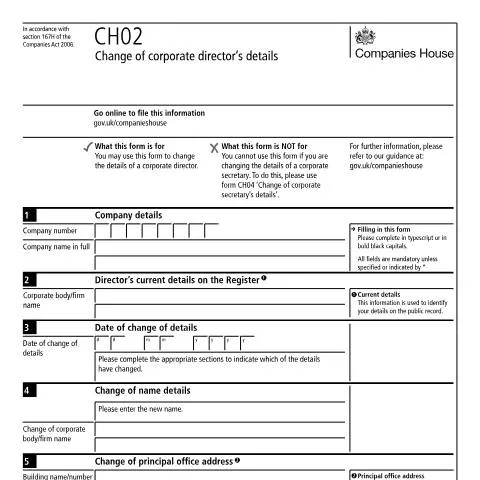
The CH02 form serves as the official mechanism for updating corporate director information on the public register, ensuring transparency and compliance with the Companies Act 2006. Unlike changes affecting individual directors or corporate secretaries, this form specifically addresses the unique circumstances surrounding corporate board members, where entire business entities hold directorial positions.
Distinguishing Corporate Directors from Other Company Officers
Corporate directors represent a distinct category within company governance structures. These are business entities—not individuals—that hold directorial positions within your company. This arrangement commonly occurs in complex corporate structures, holding companies, or when subsidiary relationships require formal board representation.
The CH02 form exclusively handles changes for these corporate directors. It's essential to understand that this form cannot be used for:
- Individual director changes (which require different forms)
- Corporate secretary modifications (handled through form CH04)
- General company information updates
- Share capital or constitutional changes
This specificity reflects the complex legal framework governing corporate governance, where different types of officers require distinct procedural approaches for record maintenance.
Legal Framework and Section 167H Compliance
Form CH02 operates under section 167H of the Companies Act 2006, which mandates specific notification procedures for corporate director changes. This statutory requirement ensures that the public register maintains accurate, up-to-date information about corporate governance structures, supporting transparency in business operations.
The legal obligation extends beyond mere administrative convenience—failure to properly notify changes can result in compliance issues and potential penalties. Companies House maintains these records as part of the public register, making accurate information crucial for stakeholder confidence and regulatory compliance.
Preparing Your Corporate Director Information Before Filing
Successful completion of form CH02 requires meticulous preparation of corporate director information. The form demands precise details across multiple categories, each serving specific legal and administrative purposes.
Current Details Verification
Before initiating any changes, you must accurately identify the corporate director's current details as they appear on the public register. This includes the exact corporate name, current registered address, and any existing legal form designations. These details serve as the baseline for identifying which records require modification.
The verification process involves cross-referencing your internal records with the official Companies House register. Any discrepancies between your records and the official register must be resolved before proceeding with the CH02 form submission.
Documentation Requirements for Different Change Types
| Change Type | Required Information | Additional Considerations |
|---|---|---|
| Name Change | New corporate name in full | Must reflect legal entity changes |
| Address Change | New principal office address | Physical location required, no PO boxes |
| Legal Form | New legal structure details | Includes governing law changes |
| Registration Details | New registration numbers | State/jurisdiction specifications |
Navigating the Form Sections: A Detailed Walkthrough
The CH02 form comprises several interconnected sections, each addressing specific aspects of corporate director information. Understanding the purpose and requirements of each section ensures accurate completion and reduces the likelihood of rejection or delays.
Section 1: Company Identification
This foundational section establishes which company is filing the change notification. You must provide the complete company name exactly as it appears on the Companies House register, along with the company number. Any variation in company name spelling or formatting can cause processing delays or rejection.
The company number serves as the primary identifier for your filing, linking the CH02 form to your specific company record. This eight-character alphanumeric code must be entered precisely, including any leading zeros.
Section 2: Current Corporate Director Details
This section requires the corporate director's current information as it appears on the public register. The principal office address must be recorded exactly as registered, including building numbers, street names, post towns, counties, and postcodes. This information serves as the reference point for identifying which director record requires modification.
Accuracy in this section is critical—if the current details don't match the register exactly, Companies House cannot process the change request effectively.
Section 3: Date of Change Specification
The date of change represents when the modification actually occurred, not when you're filing the form. This distinction is important for legal and compliance purposes, as it establishes the timeline for when new information became effective.
The date must be entered in DD/MM/YYYY format, following UK conventions. The change date cannot be in the future, and significant delays between the change date and filing date may prompt enquiries from Companies House.
Address Changes: Physical Location Requirements and Restrictions
Address modifications for corporate directors involve specific requirements that differ from standard postal addresses. Companies House mandates that the principal office address must be a physical location capable of receiving documents, reflecting the legal requirement for proper service of notices and communications.
Acceptable Address Formats
The new address must include sufficient detail for document delivery, incorporating building names or numbers, street addresses, post towns, and valid postcodes. While PO box numbers are generally prohibited as standalone addresses, they may be acceptable when included as part of a complete physical address.
DX numbers and LP (Legal Post in Scotland) numbers are explicitly prohibited, as these represent delivery services rather than physical locations. This restriction ensures that legal documents can be served effectively at the registered address.
International Address Considerations
When corporate directors maintain principal offices outside the UK, additional information becomes necessary. The address must include country designation and may require state or regional specifications depending on the jurisdiction. These international addresses must still represent genuine business locations rather than accommodation addresses or mail forwarding services.
Legal Form Changes and Governing Law Modifications
Section 6 of the CH02 form addresses complex legal transformations that corporate directors may undergo. These changes often result from corporate restructuring, mergers, acquisitions, or jurisdictional relocations that alter the fundamental legal character of the directing entity.
Legal Form Transformations
When a corporate director changes its legal form—such as converting from a limited company to a limited liability partnership, or transforming from a UK entity to a European company structure—the CH02 form captures these modifications. The form requires detailed specification of both the previous and new legal forms, ensuring accurate public record maintenance.
These changes often accompany broader corporate reorganisations and may require coordination with other regulatory bodies beyond Companies House. The timing of CH02 filing should align with the completion of the underlying legal transformation.
Governing Law Modifications
Changes in governing law typically occur when corporate directors relocate their legal domicile or undergo cross-border mergers. The form requires specification of the new governing jurisdiction and may necessitate additional registration details in the new jurisdiction.
For corporate directors maintaining registrations in multiple jurisdictions, the form accommodates new registration numbers and registry details. This information helps establish the corporate director's legal status and facilitates cross-border regulatory cooperation.
Authentication Requirements and Authorised Signatories
Form CH02 authentication involves specific requirements regarding who may sign and submit the form on behalf of the company. The authentication section reflects the legal authority structure within companies and ensures that only authorised individuals can modify corporate director information.
Authorised Signatory Categories
The form may be authenticated by various categories of authorised individuals, including directors, secretaries, persons authorised under sections 270 or 274 of the Companies Act 2006, administrators, receivers, and other specified office holders. Each category represents different circumstances under which form submission may be necessary.
For standard operations, directors or company secretaries typically authenticate CH02 forms. However, during insolvency proceedings or special administrative circumstances, other authorised individuals may need to handle the submission process.
UK Societas Considerations
UK Societas entities require special attention during authentication, with specific provisions for identifying which organ of the UKS the signatory represents. This reflects the unique governance structure of Societas entities and ensures proper legal authority for form submission.
The authentication process requires entering the signatory's printed name but does not require physical signatures, reflecting Companies House's modernised approach to form processing and digital submission capabilities.
Submission Timing and Processing Expectations
Understanding the timing requirements and processing expectations for CH02 forms helps ensure compliance and avoid potential delays or complications. Companies House operates specific timeframes for various aspects of the submission and processing cycle.
Filing Deadlines and Legal Obligations
While the CH02 form doesn't specify absolute filing deadlines, companies have ongoing obligations to maintain accurate public records. Significant delays between actual changes and form submission may prompt enquiries or compliance concerns, particularly if the changes affect the company's ability to receive legal documents or communications.
Best practice suggests filing CH02 forms promptly after changes occur, typically within a few weeks of the actual modification date. This approach ensures public record accuracy and demonstrates proactive compliance with regulatory requirements.
Processing Timeline and Public Record Updates
Companies House processing times for CH02 forms typically range from several days to a few weeks, depending on the complexity of changes and current processing volumes. Simple address changes generally process more quickly than complex legal form modifications requiring additional verification.
Once processed, the changes appear on the public register immediately, making the updated information available to searchers and stakeholders. This rapid publication emphasises the importance of accuracy in form completion, as errors become publicly visible quickly.
Post-Submission Monitoring and Follow-Up Procedures
After submitting form CH02, monitoring the processing status and being prepared for potential follow-up communications ensures successful completion of the corporate director change process. Companies House may require additional information or clarification during processing, making responsive communication essential.
Processing Status Verification
Companies House provides various mechanisms for tracking form submission status, including online services that allow verification of processing progress. Regular monitoring helps identify any processing delays or issues requiring attention.
The presenter information section of the form becomes particularly valuable during this phase, as Companies House uses these contact details for any processing enquiries or clarification requests. Providing accurate contact information facilitates smooth communication throughout the processing period.
Error Resolution and Resubmission
If Companies House identifies errors or missing information during processing, they typically return the form with specific guidance on required corrections. The checklist provided with the form helps prevent common errors, but complex changes may still require clarification or additional documentation.
Resubmission following error correction should address all identified issues comprehensively to avoid further delays. Maintaining records of all communications and corrections helps track the progression toward successful completion.
The CH02 process reflects the broader regulatory framework governing corporate transparency and accountability in the UK. By ensuring accurate and timely notification of corporate director changes, companies contribute to the integrity of the public register while fulfilling their ongoing compliance obligations under the Companies Act 2006.
Common Scenarios Requiring Director Detail Changes
Understanding when you need to file Form CH02 helps ensure compliance with Companies House requirements. The most frequent scenario involves a director's change of residential address, which must be reported within 14 days of the change occurring. This includes moves within the UK, relocations abroad, or changes from temporary to permanent addresses.
Marriage or civil partnership often triggers the need for CH02 filing when a director adopts their partner's surname or double-barrels their name. The company must update records to reflect the legal name change, requiring supporting documentation such as a marriage certificate or deed poll. Directors who undergo gender transition may also need to update their details, including changes to title, forename, or gender marker on official records.
Professional changes can necessitate CH02 submissions too. When a director qualifies for new professional designations (such as becoming a chartered accountant or solicitor), companies may choose to update the director's occupation field to reflect their enhanced credentials. Similarly, directors retiring from active practice might update their occupation from "Solicitor" to "Retired Solicitor" or simply "Retired".
Nationality changes present another common scenario. Directors who obtain British citizenship, acquire dual nationality, or renounce a previous nationality must update their records accordingly. This is particularly relevant for directors from EU countries following Brexit, as their nationality status may have implications for their directorship eligibility in certain regulated sectors.
Date of birth corrections, while less common, do occur. These typically arise when initial appointment forms contained errors or when directors discover discrepancies between their Companies House records and other official documents like passports or driving licences. Such corrections require careful documentation to demonstrate the authentic date of birth.
Electronic Filing vs Paper Submissions: Practical Considerations
Companies House strongly encourages electronic filing through their WebFiling service, which offers significant advantages over paper submissions. Electronic CH02 forms are processed faster, typically updating the public record within 24 hours of successful submission. The system provides immediate confirmation of receipt and flags common errors before submission, reducing the likelihood of rejection.
The electronic system validates postcodes automatically and checks National Insurance numbers against HMRC databases where provided. This real-time validation catches formatting errors that might delay paper submissions. Electronic filers also benefit from saved templates, making it easier to submit multiple director changes or repeat similar changes across different companies.
Paper submissions remain available for companies without internet access or those preferring traditional methods. However, paper forms take considerably longer to process—typically 8 to 10 working days—and lack the immediate error-checking benefits of electronic submission. Paper forms must be printed clearly, preferably typed, as handwritten submissions with unclear text may be rejected.
For companies managing multiple directorships or frequent changes, establishing a Companies House account provides additional benefits. Account holders can track submission status, download confirmation certificates, and maintain a history of all filings. The account dashboard also provides reminders for upcoming filing deadlines and alerts for rejected submissions.
Authentication codes, required for electronic submissions, must be obtained from Companies House if not already held. These codes are company-specific and serve as a security measure to prevent unauthorised filings. Companies should store authentication codes securely and consider designating multiple individuals within the organisation who can access them when needed.
Post-Filing Procedures and Record Management
Once Companies House processes your CH02 submission, the updated director information becomes publicly available through the company's filing history. The public record shows both the change made and the date it was registered, creating a permanent audit trail of director detail modifications. Companies should download and retain confirmation certificates as proof of timely filing.
Internal record-keeping requires updating various company documents beyond the statutory register. Board meeting minutes should record the decision to update director details, particularly when changes affect the director's capacity to fulfil their role. Employment contracts, service agreements, and insurance policies may need amendments to reflect updated director information.
Banking relationships often require notification of director changes, especially when the director is a signatory on company accounts or has personal guarantees in place. Banks typically request updated director information to maintain their customer due diligence records and may require new signature specimens following name changes.
Professional service providers—including accountants, solicitors, and insurance brokers—should be notified of director changes to ensure their records remain current. This is particularly important for regulated companies where professional advisors must maintain accurate records of company officers for their own compliance purposes.
HMRC notification may be necessary depending on the nature of the change. While HMRC doesn't automatically receive Companies House updates, directors with significant tax obligations or those involved in PAYE administration should consider whether their changed details affect their tax affairs. Nationality changes, in particular, may have implications for tax residence status.
Companies operating in regulated sectors must consider additional notification requirements. Financial services companies may need to inform the Financial Conduct Authority, while companies in other regulated industries should check whether director detail changes trigger specific reporting obligations to their sectoral regulators.
Regular reconciliation between Companies House records and internal company registers helps identify discrepancies before they become compliance issues. Many companies incorporate this check into their annual compliance reviews, comparing public records against internal documentation to ensure consistency across all company records.