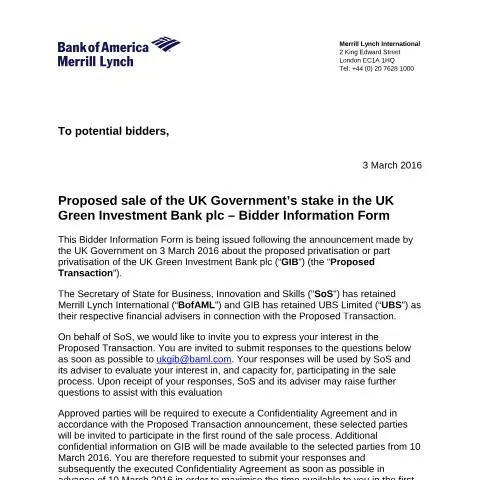
Understanding the Landscape of the Bidder Information Form
The Bidder Information Form is a pivotal document in the context of the proposed sale of shares within the UK Green Investment Bank plc. This form serves as a gateway for potential bidders, allowing them to express their interest and demonstrate their capability to participate in this significant governmental action. Understanding the nuances of this form is essential for bidders aiming for involvement in the privatisation process initiated by the UK Government.
Timeline of Engagement: From Interest to Formal Bidding
The journey begins with the issuance of the Bidder Information Form, which was announced on 3 March 2016. As a potential bidder, recognising key dates in this process is crucial:
- 03 March 2016: Announcement of the proposed sale.
- 10 March 2016: Deadline for submitting responses along with the executed Confidentiality Agreement.
By adhering to these dates, bidders can ensure that they maximise their participation in the bidding process. The timeline is strict, and delays may result in disqualification from consideration. Once responses are received, further evaluations and queries may arise, leading to the first round of the sale process.
Who Initiates the Bidding Process?
The initiation of the bidding process does not lie solely with the bidders; it is equally dependent on the role of the Secretary of State for Business, Innovation and Skills (SoS) and their advisors, including Merrill Lynch International and UBS Limited. These bodies guide the overall transaction and evaluate the submissions from potential bidders. It is vital for bidders to understand that the SoS is looking for entities that meet specific criteria to participate effectively in this process.
Decoding the Bidder Information Form Structure
When approaching the completion of the Bidder Information Form, bidders should focus on several critical sections outlined in the document:
- Bidder Identity: Providing the name of the bidding entity, identification of the ultimate parent company, and clarifying whether the bid is individual or through a consortium.
- Confirmation of Bidder Criteria: A declaration stating that the bidder does not fall under any exclusion grounds, as detailed in the accompanying annexes.
- Conflict of Interests: Disclosing any potential conflicts, including ownership in competing businesses or related fields.
- Approvals: Confirmation that necessary approvals are in place and that all information provided has been reviewed by decision-makers.
- Other Relevant Information: Any additional context or information that might bolster the bidder's position in the evaluation.
Each of these sections must be completed meticulously, as inaccuracies or omissions could jeopardise the bidder’s potential to proceed further in the sales process.
Submission Channels: Navigating the Formalities
The submission of the Bidder Information Form must be done via email, directed to [email protected], as stated in the announcement. This process is designed for efficiency, yet it also demands a precise approach:
- Email Submission: Ensure the form is filled out completely and attachments, such as the Confidentiality Agreement, are included.
- No Direct Contact: It is critical for bidders to refrain from contacting any management or employees of GIB directly concerning the transaction without prior written consent from SoS.
Following the submission, it is advisable for bidders to maintain communication through the specified channels to stay informed about the evaluation process.
Processing and Evaluation: What Happens After Submission?
Once the Bidder Information Form is submitted, it undergoes a meticulous evaluation process. The SoS and their advisors will assess the submitted responses against a set of criteria:
- Experience of the bidder in relevant investments.
- Compliance with the Fit and Proper Person Test, ensuring no criminal convictions or sanctions hinder participation.
- Analysis of disclosed conflicts of interest and how they are managed.
This evaluation phase is critical because it determines which bidders advance to the next stages of the sale process. Bidders may be contacted for further information or clarification, emphasising the importance of transparency and accuracy in the initial submission.
Discerning the Differences: Bidder Information Form vs. Related Documents
Potential bidders must understand what sets the Bidder Information Form apart from other documentation that may be required in similar contexts:
| Document | Purpose | Requirement |
|---|---|---|
| Bidder Information Form | Express interest in the sale and demonstrate capability. | Required for all potential bidders. |
| Confidentiality Agreement | Protects sensitive information during the evaluation. | Must be executed by approved bidders. |
| Financial Bid | Final proposal detailing financial terms of the bid. | Submitted in subsequent stages. |
Each document serves a distinct purpose, and bidders must track their progress through these stages to maintain eligibility and a strong competitive stance.
Documenting Supporting Evidence: What to Prepare
Before tackling the Bidder Information Form, having supporting documents ready can bolster a bid’s credibility. Here’s a checklist of potential documents to gather:
- Proof of Financial Capability: Statements or records demonstrating the financial health of the bidding entity.
- Relevant Experience Documentation: Past project summaries or engagement descriptions to showcase experience.
- Conflict of Interest Statements: Prepared declarations of any potential conflicts, along with resolution strategies.
Having these documents prepared in advance can streamline the application process and instil confidence in the evaluators regarding the bidder’s preparedness.
Navigating the Pitfalls: Common Misunderstandings and Best Practices
As bidders engage with the Bidder Information Form, they should be aware of common pitfalls that may lead to disqualification:
- Inaccurate Information: Ensure all details, especially regarding identity and approvals, are correct to avoid complications.
- Ignoring the Exclusion Grounds: Familiarise yourself with Annex 2 of the form, which outlines grounds for exclusion clearly.
- Delayed Submission: Meeting the deadline is non-negotiable; a late submission risks elimination from the process.
By adhering to these best practices and focusing on the details outlined in the Bidder Information Form, bidders can improve their chances of successfully participating in the sale process.
Understanding the Green Investment Bank's Role in Sustainable Investment
The Green Investment Bank (GIB), now operating under the Green Investment Group (GIG), was established in 2012 with a distinct mandate: to accelerate the UK’s transition to a sustainable, low-carbon economy. The bank was set up with the objective of mobilising private sector investment into green infrastructure projects, focusing on areas such as renewable energy, energy efficiency, and waste management. Initially funded by the UK government, the GIB aimed to catalyse investment in green projects that might otherwise struggle to attract capital due to perceived risk factors.
Understanding the GIB’s operational framework is essential for potential bidders in the sale of shares. The bank functions not just as a funder but also as a facilitator. It complements public sector investment by sharing risks with private investors, thereby enabling larger-scale projects that can have a significant positive impact on the environment. Furthermore, the GIB has placed great emphasis on transparency and accountability, which are critical for building trust with stakeholders and the public. This ethos is reflected in its financial reporting and project disclosures, which are readily available for potential bidders to review.
Bidder Eligibility and Requirements for the Green Investment Bank Share Sale
When considering participation in the Green Investment Bank share sale, prospective bidders must navigate a series of eligibility criteria and documentation requirements. The process is designed to ensure that only qualified entities partake in the bidding, maintaining the integrity and purpose of the bank. Typically, bidders must demonstrate a strong financial standing, proven experience in investment or financial services, and a commitment to sustainable investments.
One of the core requirements is the completion of the Bidder Information Form. This form is not simply an administrative step; it serves to provide the GIB with a detailed understanding of the bidder's background, investment philosophy, and strategic intentions regarding the shares. The form typically requests information such as:
- Company structure and ownership: A clear outline of the organizational structure, including any parent or subsidiary companies.
- Financial statements: Recent audited financial statements that demonstrate the bidder's ability to undertake significant investments.
- Investment strategy: A detailed narrative on how the bidder intends to leverage the shares and contribute to the GIB’s mission of promoting green investment.
- Previous experience: Information on past investment projects, particularly those related to renewable energy or sustainable development.
Prospective bidders should also be prepared for potential interviews or follow-up discussions with GIB representatives. It’s advisable to approach these interactions with clarity regarding the bidder’s long-term vision for the shares and how this aligns with the GIB’s objectives. This proactive engagement can significantly enhance a bidder's prospects during the selection process.
Strategic Considerations for Bidders in the Green Investment Bank Share Sale
Entering the bidding process for shares in the Green Investment Bank is not merely a financial transaction; it is a strategic decision that requires careful consideration of various factors. Bidders should assess the current market landscape for green investment, as well as anticipated regulatory changes that could influence the bank's operations and profitability.
One critical factor is the evolving landscape of environmental legislation and policies, both at the UK level and internationally. For instance, the UK government has announced ambitious targets for carbon neutrality by 2050. This creates a supportive environment for green investments, but it also means that bidders must stay abreast of potential policy shifts that could impact market dynamics.
Additionally, bidders should contemplate the competitive landscape. With an increasing number of financial institutions and investors focusing on sustainable investment, understanding the positioning of the GIB within this market is vital. This involves not only evaluating other potential bidders but also grasping how the GIB differentiates itself from other entities in the green financing sphere.
Another strategic consideration is the ongoing assessment of investment opportunities post-acquisition. Bidders should have a clear plan for how they will leverage their shares to further enhance the GIB’s mission. This could involve identifying specific projects that align with their investment strategy or collaborating with other stakeholders to amplify impact.
Finally, bidders are encouraged to evaluate their own sustainability credentials. The GIB is committed to promoting best practices in environmental stewardship. Bidders that can demonstrate a track record in sustainable investment practices may find themselves at an advantage, as their values would resonate more closely with those of the GIB.