When Companies Issue New Shares: The SH01 Return and Your Statutory Obligations
Once your company has been incorporated and begins trading, the likelihood of needing additional capital becomes a practical reality. Whether you're bringing in new investors, rewarding employees with equity, or issuing bonus shares to existing shareholders, any allocation of shares beyond those taken by subscribers at formation triggers a specific reporting requirement to Companies House. The SH01 return serves as the formal notification mechanism, ensuring the public register accurately reflects your company's evolving share capital structure.
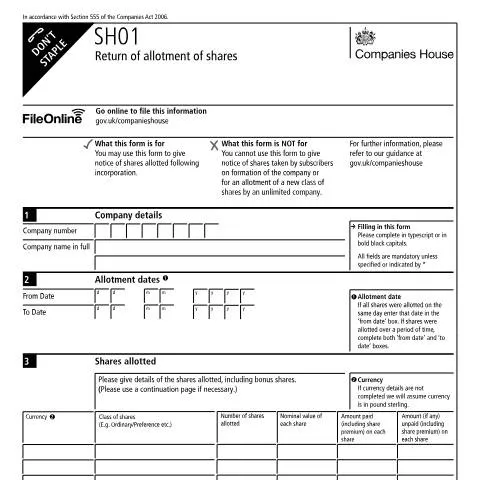
This statutory return operates under Section 555 of the Companies Act 2006, which mandates that companies must notify Companies House within one month of any share allotment. The form captures not merely the basic details of new shares issued, but provides a comprehensive snapshot of your entire issued share capital position following the allotment event.
Distinguishing SH01 from Other Share-Related Company Filings
The SH01 return occupies a specific niche within the broader landscape of Companies House filings related to share capital. Understanding when to use SH01 rather than alternative forms prevents costly filing errors and potential regulatory complications.
What Falls Within SH01 Scope
The form explicitly covers shares allotted following incorporation. This encompasses various scenarios including equity fundraising rounds, employee share option exercises, conversion of convertible securities into ordinary shares, and bonus share distributions to existing shareholders. Crucially, the return captures both cash and non-cash consideration arrangements, with special provisions for public limited companies regarding valuation reports.
Exclusions and Alternative Procedures
Two significant exclusions apply to SH01 usage. Subscriber shares taken on formation fall outside this form's remit, as these are captured during the initial incorporation process via Form IN01. Additionally, unlimited companies issuing new share classes cannot use SH01, requiring different notification procedures entirely.
Where companies undertake more complex capital restructuring involving reductions, conversions, or subdivisions of existing share capital, alternative forms such as SH06 (return of purchase of own shares) or court-approved reduction schemes may be required instead.
Decoding the SH01 Structure: Section-by-Section Analysis
The current Version 8.0 of SH01, updated in March 2026, comprises six distinct sections, each serving specific regulatory and record-keeping functions.
Section 1: Company Identification Framework
Beyond basic company name and registration number verification, this section establishes the legal foundation for the return. The company name must match exactly with Companies House records—variations in spacing, punctuation, or abbreviations can trigger rejection. The company number serves as the primary identifier linking this return to existing corporate records.
Section 2: Allotment Dating Precision
Allotment dates carry significant legal implications, determining when shareholders acquire legal rights and when the one-month filing deadline commences. Where shares are allotted on a single date, only the 'from date' requires completion. However, phased allotments over multiple dates necessitate both 'from' and 'to' date entries, capturing the entire allotment period.
This dating mechanism becomes particularly relevant for employee share schemes where options vest incrementally, or staged investment rounds where tranches release against milestone achievements.
Section 3: Share Allotment Details Matrix
This section demands comprehensive disclosure of each share class allotted, structured around five key data points:
| Information Required | Purpose | Common Issues |
|---|---|---|
| Class of shares | Distinguishes ordinary, preference, deferred shares | Vague descriptions like "Class A" without rights specification |
| Number of shares allotted | Quantifies the exact allocation | Fractional shares in employee schemes |
| Nominal value per share | Establishes par value for capital calculations | Currency mismatches in international structures |
| Amount paid per share | Records consideration received including premiums | Separating nominal value from share premium |
| Amount unpaid per share | Captures partly-paid arrangements | Nil entries versus blank fields |
Non-Cash Consideration Complexities
Where shares are issued for non-monetary consideration—such as intellectual property transfers, debt conversions, or asset acquisitions—detailed description becomes mandatory. Public limited companies face enhanced requirements, potentially needing independent valuation reports attached to the return, particularly where non-cash consideration exceeds one-tenth of nominal value.
Currency Handling and Multi-Jurisdictional Considerations
Companies House operates a sterling-default assumption, but SH01 accommodates multi-currency share structures increasingly common in international businesses. Each currency requires separate tabulation within Section 4, with pound sterling typically occupying Currency Table A.
Currency Declaration Strategy
Failing to specify currency triggers automatic sterling classification, potentially creating discrepancies where shares carry euro, dollar, or other denominations. This becomes particularly problematic for holding companies with overseas subsidiaries or international joint ventures where local currency share issues occur.
The total issued share capital table aggregates all currency positions, requiring careful arithmetic to ensure consistency between individual currency tables and the grand total summary.
Statement of Capital: Your Company's Complete Share Picture
Section 4 extends beyond the immediate allotment to present your company's entire issued share capital position post-allotment. This comprehensive snapshot serves multiple regulatory functions, updating the public record and providing stakeholders with current capital structure information.
Aggregate Calculations and Common Pitfalls
The statement of capital demands precision across several calculation streams. Aggregate nominal value results from multiplying share numbers by individual nominal values, while total aggregate unpaid amounts capture outstanding calls on partly-paid shares.
Companies frequently err by conflating share premium with nominal value, or failing to account for shares issued at different times with varying payment terms. Where continuation pages become necessary due to multiple share classes, maintaining calculation accuracy across pages requires methodical cross-referencing.
Multi-Class Share Structures
Complex capital structures with preference shares, deferred shares, and multiple ordinary share classes each require separate tabulation. The aggregation process must maintain distinction between classes while providing consolidated totals for regulatory reporting purposes.
Prescribed Particulars: Defining Shareholder Rights Architecture
Section 5 addresses the detailed rights attaching to each share class, moving beyond basic numerical data to establish the legal framework governing shareholder relationships.
Four Pillars of Share Rights
The prescribed particulars framework encompasses four fundamental rights categories:
- Voting rights specification: Including conditional voting triggers, weighted voting arrangements, and situations where voting rights vary by circumstance
- Dividend participation rights: Covering preference dividend rates, cumulative provisions, and profit-sharing mechanisms
- Capital distribution rights: Establishing priorities on winding-up, liquidation preferences, and return of capital scenarios
- Redemption provisions: Detailing company or shareholder redemption options, mandatory redemption triggers, and redemption pricing mechanisms
Drafting Precision for Rights Descriptions
Rights descriptions require legal precision while maintaining accessibility for public record searchers. Vague formulations like "standard preference rights" lack sufficient detail, while overly technical language may obscure practical implications for potential investors or creditors.
Each share class demands separate rights specification, even where classes share similar characteristics. This granular approach prevents future disputes over shareholder entitlements and ensures regulatory compliance.
Filing Mechanics and Timeline Management
The one-month deadline from allotment date creates practical challenges, particularly for companies with complex approval processes or international coordination requirements. Companies House accepts SH01 returns via multiple channels, with online filing increasingly preferred for speed and processing efficiency.
Signature Authority and Corporate Governance
Section 6 signature requirements reflect corporate governance principles, permitting directors, company secretaries, or persons authorised under Companies Act provisions to execute the return. For Societas Europaea structures, specific adaptations acknowledge different governance frameworks.
The signature represents a formal declaration of accuracy, carrying potential personal liability implications for false or misleading statements. Directors should ensure thorough review before execution, particularly regarding complex share arrangements or non-cash consideration valuations.
Processing Timeline and Follow-Up Procedures
Companies House typically processes correctly completed SH01 returns within 8-10 working days of receipt. The updated information appears on the public register, triggering automatic updates to the company's filing history and current appointments records.
Where returns contain errors or missing information, Companies House issues rejection notices detailing specific deficiencies. Resubmission must occur within the original one-month deadline to avoid late filing penalties, making prompt attention to rejection notices crucial.
Post-Filing Implications and Ongoing Compliance Obligations
SH01 filing represents more than administrative compliance—it establishes legal facts affecting future corporate transactions, regulatory filings, and stakeholder relationships. The updated share capital information influences annual return preparation, dividend distribution calculations, and potential future fundraising activities.
Integration with Broader Corporate Compliance
Share allotment returns interconnect with various ongoing compliance obligations. Annual confirmation statements must reflect current share capital positions established through SH01 filings, while dividend distributions require verification against distributable reserves calculations incorporating new share capital.
Companies with employee share schemes face particular complexity, as individual option exercises may trigger multiple SH01 filings throughout the year. Establishing systematic procedures for tracking allotment dates and preparing returns becomes essential for maintaining compliance without overwhelming administrative burden.
The public nature of SH01 information also affects commercial relationships, with suppliers, lenders, and potential partners often reviewing recent share capital activity as part of their due diligence processes. Ensuring accuracy and completeness protects corporate reputation while facilitating future business development opportunities.
Common Mistakes and How to Avoid Them When Completing Form SH01
Filing an SH01 return incorrectly can lead to rejection by Companies House, potential penalties, and delays in updating your company's official records. Understanding the most frequent errors helps ensure your submission goes through smoothly first time.
Incorrect Share Classification Details
One of the most common pitfalls involves misclassifying share types or providing inconsistent information about share classes. If your company has multiple share classes—such as ordinary shares, preference shares, or shares with different voting rights—each must be clearly distinguished on the form. The prescribed particulars must match exactly what's stated in your articles of association.
For instance, if you're issuing "A" ordinary shares with enhanced voting rights, you cannot simply list them as "ordinary shares" without the class designation. Similarly, if preference shares carry a fixed dividend rate of 5%, this must be specified in the rights attached to the shares section. Companies House will cross-reference this information against your articles, so any discrepancy will likely result in queries or rejection.
Mathematical Errors in Share Calculations
Share allotment calculations frequently contain arithmetic mistakes, particularly when dealing with partly paid shares or premium payments. The total consideration received must equal the sum of nominal value plus any premium. If you're issuing 1,000 shares at £1 nominal value each with a £2 premium, the total consideration should be £3,000, not £1,000 or £2,000.
When shares are issued for non-cash consideration, such as property or services, the valuation becomes more complex. You must provide a realistic market value assessment, and if the consideration exceeds £100,000, you'll need an independent valuation report. Undervaluing or overvaluing non-cash consideration can trigger Companies House scrutiny and potential legal issues under the Companies Act 2006.
Timing and Dating Inconsistencies
The allotment date, resolution date, and filing deadline must align correctly. The allotment date cannot precede the date of the directors' resolution authorising the allotment (unless shareholder approval was obtained). If your board resolution is dated 15th March but you've recorded the allotment date as 10th March, this creates a legal impossibility that Companies House will flag.
Remember the one-month filing deadline runs from the allotment date, not the resolution date. If shares were allotted on 20th April, your SH01 must reach Companies House by 20th May, regardless of when you actually complete the paperwork. Bank holidays don't extend this deadline—if the due date falls on a weekend or public holiday, you must file by the preceding working day.
Electronic Filing vs Paper Submissions: Practical Considerations
Companies House strongly encourages electronic filing through WebFiling, but both digital and postal submissions remain valid options for SH01 returns. Each method has distinct advantages and potential drawbacks that may influence your choice depending on your company's circumstances and internal processes.
WebFiling Process and Requirements
Electronic submission through the Companies House WebFiling service requires an active authentication code, which takes 5-7 working days to arrive by post if you haven't registered previously. The online SH01 form includes built-in validation checks that can catch basic errors before submission, such as invalid postcodes, incorrect company numbers, or mathematical inconsistencies in share calculations.
The electronic system accepts PDF attachments for supporting documents, such as board resolutions or independent valuations for non-cash consideration. However, file size limits apply—each attachment cannot exceed 4MB, and the total submission must stay within 10MB. If your documentation exceeds these limits, you'll need to compress files or consider postal submission.
One significant advantage of WebFiling is immediate confirmation of receipt. You'll receive an electronic acknowledgement within minutes, showing exactly when Companies House received your submission. This timestamp can be crucial for proving compliance with the one-month deadline, particularly if you're filing close to the due date.
Paper Filing Considerations
Postal submissions offer certain advantages, particularly for complex allotments involving extensive documentation. There are no file size restrictions, so you can include comprehensive board minutes, detailed share agreements, or lengthy independent valuation reports without compression concerns.
However, paper filing carries inherent risks around delivery confirmation and processing delays. While recorded delivery provides proof of posting, it doesn't guarantee Companies House received your documents in readable condition. Processing times are typically longer—usually 8-10 working days compared to 24-48 hours for electronic submissions.
If you choose paper filing, ensure all pages are clearly legible, properly signed where required, and include the correct fee payment. Cheques should be made payable to "Companies House" and include your company number on the reverse. Any illegible sections or missing signatures will delay processing and may require resubmission.
Hybrid Approaches and Special Circumstances
Some companies adopt a hybrid approach, filing the basic SH01 electronically while posting supplementary documentation separately. This strategy combines the speed and confirmation benefits of electronic filing with the flexibility to include extensive paper documentation. If you use this method, clearly reference the electronic submission in your covering letter and ensure both arrive within the filing deadline.
Certain circumstances may dictate your filing method. For instance, if your allotment involves shares issued to bearer (though rare in modern practice), or includes complex conditional arrangements, Companies House may request additional paper documentation regardless of your initial filing method.
Post-Filing Procedures and Maintaining Accurate Company Records
Successfully submitting your SH01 form marks the beginning, not the end, of your post-allotment administrative responsibilities. Companies House acceptance triggers several ongoing obligations that directors must manage carefully to maintain statutory compliance and avoid future complications.
Updating Internal Company Records
Once Companies House processes your SH01, you must update your company's statutory registers to reflect the new shareholding structure. The register of members requires detailed entries for each new shareholder, including full names, addresses, share numbers held, class of shares, and the date of entry as a member.
If your allotment created new share classes, the register of members must clearly distinguish between different types of shares. For example, if you previously had only ordinary shares but issued preference shares, each shareholder's entry must specify which class they hold. This distinction becomes crucial for dividend distributions, voting rights, and potential future corporate actions.
The register of allotments and transfers also needs updating with details of the allotment, including the number and class of shares issued, the names of allottees, and the amount paid or due on each share. This register provides an audit trail of all share movements and must be kept at the company's registered office or single alternative inspection location (SAIL).
Share Certificate Issuance and Management
Following successful SH01 filing, companies must issue share certificates to new shareholders within two months of allotment, unless the articles of association specify otherwise. Share certificates serve as prima facie evidence of share ownership and must include specific information: the company name and number, shareholder's name and address, number and class of shares, amount paid up, and any distinguishing numbers.
Digital share certificates are becoming more common, but they must meet the same legal requirements as paper versions. Whether physical or electronic, certificates should be stored securely and tracked through a certificate register showing issue dates, certificate numbers, and replacement details if certificates are lost or damaged.
For partly paid shares, certificates must clearly show the amount paid and unpaid on each share. This information affects the shareholder's liability for future calls and must be accurate to avoid disputes. If you later make calls on partly paid shares, replacement certificates showing updated payment status may be necessary.
Ongoing Compliance and Future Considerations
Post-allotment compliance extends beyond immediate record-keeping. If your share allotment increased the company's issued share capital significantly, you may need to review and potentially update your articles of association, particularly provisions relating to pre-emption rights, transfer restrictions, or dividend policies.
Companies approaching the private company share capital threshold (currently £50,000 for re-registration as a public company) should monitor their position carefully. While most private companies never approach this limit, those that do may need to consider whether public company status aligns with their business objectives and compliance capabilities.
Tax implications also continue beyond the initial allotment. If shares were issued at a premium, this may affect future distributions and could create corporation tax considerations. Similarly, if employees received shares under employment-related schemes, ongoing PAYE and National Insurance obligations may apply depending on the specific arrangement terms.
Regular reconciliation between your internal registers and the information held at Companies House helps identify and correct discrepancies before they become problematic. Annual confirmation statements provide an opportunity to verify that all share allotments have been properly recorded and that your statutory information remains accurate and up-to-date.