Understanding the Notice to Cease to Act as an Administrative Receiver, Receiver, or Manager (RM02) in the UK
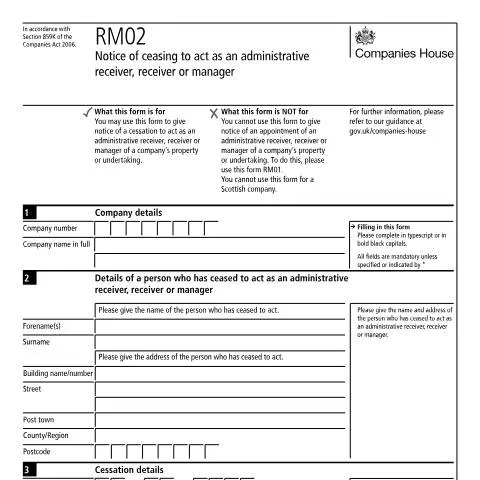
This official guidance provides an overview of the Companies House RM02 form, which serves as a formal notice that a person or entity has ceased to act as an administrative receiver, receiver, or manager of a company's property or undertaking. It is an important procedural step within UK company law, specifically under the Companies Act 2006.
The Purpose and Scope of the RM02 Notice
The RM02 form is used by individuals or entities to notify Companies House that they have stopped acting in the capacity of an administrative receiver, receiver, or manager. These roles are typically appointed to manage or realise a company's assets, often in the context of security enforcement or insolvency procedures.
It is important to note that the RM02 form is strictly for reporting a cessation of activity. It is not used to initiate or record the appointment of such roles. For appointments, the appropriate form is RM01. Additionally, this form is only applicable to companies registered in England, Wales, or England/Wales, and not for Scottish companies.
Legal Framework and Registration Requirements
The submission of the RM02 notice is governed by Section 859K of the Companies Act 2006. This legal requirement ensures that the public register accurately reflects the current status of individuals acting in these roles, maintaining transparency and accountability.
Once submitted, the information provided in the RM02 form will be publicly accessible, contributing to the transparency of company management and security interests.
Filling Out the RM02 Form: Key Details
Company and Person Details
- Company name in full and company number as registered with Companies House.
- The name and address of the individual or entity who has ceased to act.
- Specific details such as forename(s), surname, and full address including postcode.
Cessation Details
- Indicate whether the individual has ceased to act as an administrative receiver, receiver, or manager.
- Provide the date of cessation, using the format day/month/year.
Charge Creation Details (if applicable)
If the role was associated with a charge over property or undertaking, additional sections must be completed:
- For charges created before 6 April 2013, complete Part A and Part C.
- For charges created on or after 6 April 2013, complete Part B and Part C.
- Include details such as the charge creation date, description of the instrument, and property particulars.
Signatures and Submission Process
The form must be signed by the person who has ceased to act. This signature confirms the accuracy of the information provided. Once completed, the form can be submitted either online via the Companies House web filing service or by post to the designated address.
It is advisable to review the form carefully, ensuring all mandatory fields are completed and that the information matches the public register. An incomplete or incorrect submission may be returned, delaying the update of the public record.
Implications for the User and Public Record
Submitting the RM02 form ensures that the public record accurately reflects the current management structure of the company. It enhances transparency by publicly recording the cessation of roles related to the management or security enforcement of the company's assets.
For the individual or entity, this notice formally concludes their responsibilities associated with the role. It also helps prevent any future liabilities or misunderstandings regarding their involvement in the company's management.
Additional Considerations and Guidance
Further guidance on completing the RM02 form and related procedures can be found on the official Companies House website. It is recommended to consult the guidance notes to ensure compliance with legal requirements and to understand the process thoroughly.
For any questions or assistance, contact details are available on the official website, and submissions can be made electronically or by post, depending on the preference and circumstances of the filer.