Understanding the Memorandum of Association for Companies with Share Capital
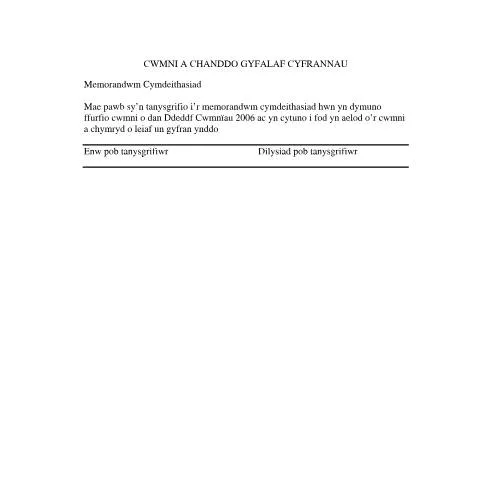
When establishing a company with share capital in the UK, the Memorandum of Association serves as the foundational constitutional document that formally records the initial commitment of the company's subscribers. This Welsh-language template, recognised by Companies House, demonstrates the bilingual nature of UK corporate law and provides the essential framework for documenting the founding members' agreement to form a company under the Companies Act 2006.
The document's significance extends beyond mere formality—it represents the legal moment of birth for a company with share capital. Each subscriber's signature on this memorandum constitutes their binding commitment to become a member of the company and to take at least one share. This commitment forms the bedrock of the company's initial share structure and establishes the founding shareholders' legal relationship with the entity they are creating.
Constitutional Role Within Company Formation Architecture
The Memorandum of Association operates alongside the Articles of Association to form the complete constitutional framework of a company with share capital. While the Articles govern the ongoing management and operation of the company, the Memorandum serves a more specific historical purpose—capturing the founding moment and the initial subscribers' commitments.
Under the Companies Act 2006, the Memorandum has been significantly streamlined compared to its predecessor under the Companies Act 1985. The modern version focuses exclusively on recording the subscribers' details and their commitment to form the company, rather than containing extensive constitutional provisions that have now migrated to the Articles of Association.
Statutory Requirements for Valid Execution
The template structure requires specific elements to meet Companies House registration requirements:
- Subscriber identification: Each founding member must be clearly named
- Authentication: Proper signature or other form of legal authentication from each subscriber
- Dating: The document must be dated to establish the chronological sequence of company formation
- Share commitment: Implicit agreement by each subscriber to take at least one share
The Welsh language version demonstrates compliance with Welsh Language Act requirements for companies being formed in Wales, though English versions are equally acceptable for companies registered anywhere in the UK.
Subscriber Categories and Their Distinct Legal Positions
Not all subscribers to a Memorandum of Association hold identical legal positions, and understanding these distinctions proves crucial for proper company formation planning.
| Subscriber Type | Minimum Share Commitment | Legal Status | Ongoing Obligations |
|---|---|---|---|
| Individual subscribers | One share minimum | Personal liability for shares | Member duties under Companies Act |
| Corporate subscribers | One share minimum | Entity-level commitment | Authorised representative system |
| Nominee subscribers | One share minimum | Nominee arrangement disclosure | Beneficial ownership reporting |
Authentication Methods Across Different Subscriber Types
The authentication column in the template accommodates various forms of legal validation depending on the subscriber's nature. Individual subscribers typically provide handwritten signatures, though electronic signatures may be acceptable under specific circumstances governed by the Electronic Communications Act 2000.
Corporate subscribers require more complex authentication procedures. The signature must come from an authorised representative of the corporate entity, typically a director or company secretary acting within their delegated authority. The authentication should reference the corporate capacity in which the signatory acts.
For nominee arrangements, additional complexity arises regarding beneficial ownership disclosure requirements under the People with Significant Control (PSC) regime, even though such disclosure occurs after incorporation rather than within the Memorandum itself.
Integration with Share Capital Structure Planning
While the Memorandum of Association commits each subscriber to taking "at least one share," the actual allocation of shares occurs through subsequent processes detailed in the Articles of Association and initial share allotment procedures. This creates a critical planning junction for company founders.
The minimum one share commitment represents a floor rather than a ceiling. Subscribers may agree to take substantially more shares, but such arrangements typically appear in separate subscription agreements or allotment letters rather than within the Memorandum itself. This separation allows for more detailed commercial terms while keeping the constitutional document focused on its core legal function.
Share Capital Considerations for Different Business Structures
Companies with nominal share capital often utilise the minimum commitment structure, where each subscriber takes exactly one share of minimal nominal value. This approach suits professional service companies, family businesses, or entities where ownership percentages will be determined through subsequent share issues rather than initial subscription.
Conversely, investment-backed companies may have subscribers committing to different share quantities from incorporation, though the Memorandum itself typically maintains the "at least one share" formulation while detailed arrangements appear in accompanying investment documentation.
The timing distinction proves important: the Memorandum creates the legal commitment to membership and minimum share-taking, but actual share allocation, payment, and issuance occur through post-incorporation procedures governed by the Articles of Association and directors' allotment powers.
Practical Execution Procedures and Common Variations
Executing the Memorandum of Association requires coordination among all intended subscribers, particularly when the founding group includes members in different locations or time zones. The document's structure accommodates this reality through its tabular format allowing each subscriber to complete their section independently.
Sequential signing represents the most common approach, where the document circulates among subscribers in turn. Each subscriber completes their name and authentication before passing the document to the next founding member. The final subscriber typically adds the execution date, though some practitioners prefer having the first subscriber add the date to establish a clear chronological starting point.
Remote Execution Challenges and Solutions
Modern company formation often involves subscribers located across different jurisdictions or unable to meet in person. While the Memorandum traditionally required original signatures on a single document, practical adaptations have evolved to accommodate contemporary business realities.
Counterpart execution allows each subscriber to sign identical copies of the Memorandum, with all counterparts together forming the complete executed document. This approach requires careful coordination to ensure all copies contain identical content and that Companies House receives a complete set showing all subscriber commitments.
Electronic signature platforms have gained acceptance for Memorandum execution, particularly following regulatory clarifications during the COVID-19 pandemic. However, the authentication method must provide sufficient legal certainty and audit trail to satisfy Companies House requirements and potential future legal challenges.
Relationship with Companies House Registration Process
The completed Memorandum of Association forms part of the incorporation application submitted to Companies House, typically alongside Form IN01 (Application to register a company) and the proposed Articles of Association. The timing and coordination of these documents affects the incorporation process flow and potential delays.
Companies House examination of the Memorandum focuses on formal compliance rather than commercial reasonableness. The registrar verifies that all subscriber names are clearly legible, that appropriate authentication appears for each subscriber, and that the document bears a valid execution date. Substantive review of subscriber suitability or financial capacity occurs through separate processes, particularly the fit and proper person assessments for directors.
Post-Incorporation Legal Effect and Limitations
Once Companies House issues the Certificate of Incorporation, the Memorandum of Association becomes a historical document rather than an active constitutional instrument. Its primary ongoing legal significance lies in establishing the founding membership and the original share commitment obligations.
The subscriber commitments created by the Memorandum survive incorporation and create enforceable obligations regarding initial share-taking. If a company calls upon subscribers to fulfil their share commitments and they fail to respond, the company may pursue legal remedies for breach of the subscription commitment, though practical enforcement depends on the specific circumstances and the company's financial position.
| Post-Incorporation Scenario | Memorandum Relevance | Practical Implications |
|---|---|---|
| Share allotment to subscribers | Establishes minimum entitlement | Cannot allot less than committed amount |
| Subscriber withdrawal pre-allotment | Potential breach of commitment | Legal remedies available to company |
| Third-party share transfers | No direct relevance | Articles of Association govern transfers |
| Company dissolution | Historical record maintained | Part of permanent company record |
Strategic Considerations for Different Company Types
The apparently simple structure of the Memorandum of Association masks significant strategic considerations that vary depending on the intended company structure and business model. Technology startups anticipating multiple funding rounds may prefer minimal initial subscriber commitments to preserve flexibility for complex future share structures, while established business incorporations may involve substantial initial commitments reflecting existing commercial relationships.
Family companies often utilise the Memorandum to establish initial family member participation while planning for subsequent share redistributions through family trusts or succession arrangements. The one-share minimum commitment provides a foundation for family membership without prejudicing future wealth planning strategies.
Professional Service Firms and Regulatory Constraints
Solicitors' practices, accounting firms, and other regulated professional services face additional complexity when completing the Memorandum of Association. Professional regulatory bodies may impose restrictions on share ownership that affect both subscriber selection and ongoing share transfer arrangements.
For solicitors' practices, the Solicitors Regulation Authority requires that share ownership comply with specific rules about qualified persons and authorised bodies. While these restrictions do not directly affect Memorandum completion, they influence subscriber selection and the practical enforceability of share commitments.
Medical companies face similar constraints under Care Quality Commission regulations, where share ownership may be restricted to qualified medical professionals or approved entities. The Memorandum subscriber list must reflect these regulatory requirements to avoid post-incorporation compliance issues.
Documentation Management and Record-Keeping Obligations
Companies House maintains the Memorandum of Association as part of the public company record, accessible through company searches and forming part of the company's constitutional documentation available to creditors, investors, and other stakeholders. This public accessibility requires careful consideration of the information disclosed within the subscriber details.
The company itself must maintain copies of the Memorandum as part of its statutory books, alongside other constitutional documents and statutory registers. These records support various ongoing compliance obligations, including audit requirements and potential investigations by regulatory authorities.
Data protection considerations arise regarding subscriber personal information, particularly where individual subscribers' details appear in the public record. The Data Protection Act 2018 and UK GDPR provide limited exemption for statutory filing requirements, but companies should consider privacy implications when selecting subscriber disclosure approaches.
Long-term record retention extends beyond the company's active life. Even after dissolution, Companies House maintains historical company records including the original Memorandum of Association, creating permanent public accessibility to subscriber information and founding arrangements. This permanence requires careful consideration of the long-term implications of subscriber participation and the information disclosed within the founding documentation.
Common Challenges and How to Navigate Them
Filing Form SH01 might appear straightforward, but several complications frequently arise that can delay processing or trigger queries from Companies House. Understanding these potential pitfalls beforehand can save considerable time and administrative burden.
One of the most frequent issues occurs when companies attempt to register subscribers who hold different classes of shares. If your company has ordinary shares and preference shares, for instance, each subscriber's shareholding must be clearly distinguished by class. The form requires separate entries for each share class, and mixing these details or presenting them ambiguously will result in rejection. Always specify whether shares are ordinary, preference, redeemable, or carry special voting rights.
Address formatting presents another common stumbling block. Companies House follows strict conventions for UK addresses, and international addresses for overseas subscribers require particular attention. For UK addresses, include the full postcode and ensure street numbers appear before street names. Overseas addresses must include the country name in English, and you should research whether Companies House has specific formatting requirements for particular jurisdictions. Some countries' address formats don't translate directly into the standard UK format, potentially requiring clarification notes.
Date inconsistencies cause frequent delays. The date of becoming a subscriber must align with your company's incorporation date or the date when share capital was increased. If these dates don't match your other Companies House filings, you'll need to provide explanatory documentation. Remember that the UK's date format follows DD/MM/YYYY conventions, and using alternative formats like MM/DD/YYYY will cause confusion.
National Insurance numbers for UK subscribers require careful verification. Companies House may cross-reference these details, and incorrect numbers will delay processing. For subscribers without National Insurance numbers—typically overseas individuals or those who've never worked in the UK—leave this field blank rather than inventing placeholder numbers. However, ensure you've provided sufficient alternative identification details to prevent queries about the subscriber's identity.
Share premium complications arise when shares are issued at above nominal value. If your £1 ordinary shares were issued for £5 each, the £4 difference represents share premium, which affects both your Form SH01 submission and your company's accounting obligations. Ensure your filing reflects the actual consideration paid, not just the nominal value, and be prepared to explain any significant premiums if Companies House queries them.
Corporate subscribers—where companies rather than individuals hold shares—require additional documentation. You'll need to provide the corporate subscriber's company registration number, registered office address, and potentially proof of their authority to hold shares in your company. Some corporate structures, particularly involving overseas companies, may require legal opinions about the corporate subscriber's capacity to hold UK company shares.
Integration with Broader Corporate Governance Framework
Form SH01 doesn't exist in isolation but forms part of your company's broader corporate governance obligations. Understanding how this filing connects to other regulatory requirements helps ensure comprehensive compliance and avoids inadvertent breaches of your duties as company officers.
Your company's Articles of Association directly impact SH01 submissions. Standard model articles typically don't restrict share transfers between existing shareholders, but bespoke articles might include pre-emption rights, transfer restrictions, or approval requirements. Before filing SH01, verify that your subscribers' shareholdings comply with any restrictions in your articles. If your articles require board approval for certain shareholdings, ensure this approval was obtained before the relevant dates you're reporting on Form SH01.
The relationship between SH01 filings and your annual Confirmation Statement (Form CS01) requires careful coordination. Your Confirmation Statement must reflect the same shareholder information you've submitted via SH01 forms throughout the year. Discrepancies between these filings will trigger Companies House queries and potentially delay processing of future submissions. Maintain detailed records of all share transactions and ensure your Confirmation Statement preparation takes account of all SH01 filings during the relevant period.
HMRC obligations intersect significantly with Companies House filings. Share transactions often have tax implications for both the company and individual shareholders. Stamp duty may apply to share transfers, and you might need to file returns with HMRC's Stamp Office. Additionally, if your subscribers receive shares as consideration for services or at below market value, this could constitute a benefit in kind with income tax and National Insurance implications. While Companies House doesn't enforce tax compliance, maintaining consistency between your Companies House filings and HMRC submissions prevents regulatory complications.
Data protection considerations under UK GDPR affect how you handle subscriber information. Personal details submitted on Form SH01 become part of the public record, but you must still comply with data protection principles when collecting and processing this information. Ensure subscribers understand that their details will become publicly available through Companies House records. For sensitive situations—such as domestic violence concerns—investigate whether Companies House's protected disclosure procedures might apply.
Anti-money laundering obligations require companies to maintain adequate records about their shareholders' identities and the source of funds used to acquire shares. While Form SH01 doesn't explicitly require this information, your underlying records should demonstrate compliance with the Money Laundering, Terrorist Financing and Transfer of Funds Regulations 2017. This becomes particularly important if your company later falls within the scope of the Register of People with Significant Control requirements.
Corporate finance implications extend beyond immediate compliance obligations. Accurate SH01 filings establish the foundation for future fundraising activities, employee share schemes, or potential acquisitions. Investors conducting due diligence will scrutinise your Companies House filings for accuracy and consistency. Any historical errors or omissions in SH01 submissions could complicate future corporate transactions and potentially affect your company's valuation or the terms of investment agreements.
Strategic Timing and Tactical Considerations
The timing of SH01 submissions can significantly impact your company's operations, regulatory compliance, and commercial relationships. Understanding the strategic implications of when and how you file these notices helps optimise your corporate administration while avoiding unintended consequences.
Batch processing versus individual submissions presents a tactical choice with practical implications. If your company experiences multiple subscriber changes within a short period—perhaps during a fundraising round or employee share scheme implementation—you might process several SH01 forms simultaneously. This approach ensures consistency across filings and reduces the risk of errors from piecemeal submissions. However, individual processing allows greater flexibility if circumstances change between transactions, and some complex shareholding structures benefit from sequential rather than simultaneous processing.
The interaction between SH01 timing and your company's financial year-end requires careful consideration. Share transactions near your accounting reference date can affect your annual accounts preparation, particularly regarding share capital disclosures and earnings per share calculations. If possible, complete SH01 filings well before your accountants begin preparing annual accounts to ensure accurate financial reporting. Last-minute share transactions often complicate statutory accounts preparation and may require amendments to previously filed documents.
Commercial sensitivity around subscriber information affects timing decisions. Once filed, SH01 details become publicly accessible through Companies House records, potentially revealing sensitive commercial information about your funding sources, strategic partnerships, or business relationships. Consider whether delaying certain filings until after commercial negotiations conclude might protect confidential information, but never compromise legal compliance for commercial convenience.
Coordination with professional advisers becomes crucial for complex transactions. Solicitors handling share purchase agreements, accountants managing tax implications, and corporate finance advisers structuring fundraising rounds all require accurate, timely information about subscriber changes. Establish clear communication protocols about SH01 filing timing to ensure all advisers work with consistent information and can properly coordinate their respective obligations.
The impact on employee motivation and retention shouldn't be overlooked when timing SH01 submissions related to employee share schemes. Staff members often monitor Companies House records to verify their shareholdings have been properly registered, and delays in filing can create uncertainty about their equity participation. Conversely, filing SH01 forms too early in complex employee share scheme implementations might create confusion if subsequent changes occur before the scheme fully completes.
Seasonal considerations affect Companies House processing times and should influence your filing schedule. The period immediately following 31st January—the Self Assessment deadline—often sees increased activity at Companies House as businesses complete their annual compliance obligations. Similarly, the months leading up to 31st December witness heightened filing activity as companies complete year-end transactions. Planning SH01 submissions outside these peak periods can result in faster processing and reduce the risk of administrative delays affecting your business operations.
International considerations become relevant for companies with overseas subscribers or cross-border shareholding arrangements. Time zone differences can affect the practical timing of share transactions and subsequent SH01 filings, particularly where overseas legal requirements must be satisfied before UK filings can be completed. Additionally, some jurisdictions impose their own disclosure requirements for residents holding shares in UK companies, and coordinating these obligations with UK filing deadlines requires careful planning.