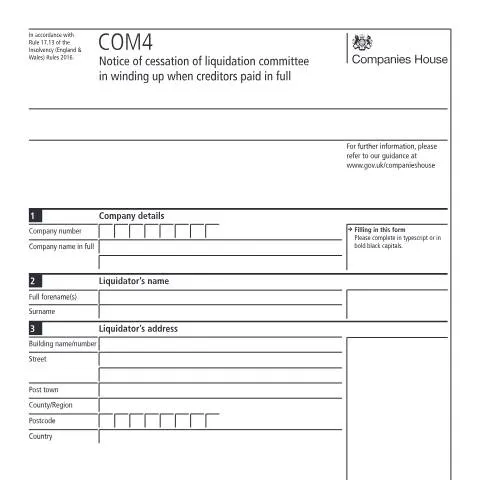
Understanding the Significance of the COM4 Notice
The COM4 Notice of Cessation of Liquidation Committee is a crucial document within the framework of corporate insolvency in the UK. It serves a specific purpose, particularly when a company has entered into liquidation but has fully repaid its creditors. This scenario is pivotal for ensuring clarity and legal compliance within the winding-up process. With the intention of fulfilling the obligations set out under the Insolvency (England & Wales) Rules 2016, this notice represents the official end of the liquidation committee's involvement.
Who Needs to Submit the COM4 Notice?
Primarily, the liquidator appointed during the winding-up process is responsible for submitting the COM4 Notice. This individual acts on behalf of the company and its stakeholders, ensuring that the appropriate procedures are followed. Situations necessitating the submission of this notice include:
- Completion of all creditor payments.
- The company’s overall financial obligations have been discharged.
- The liquidation committee has fulfilled its role in overseeing the liquidation process.
In essence, this notice marks the transition from the liquidation phase to the conclusion of the process, signifying that all involved parties have been adequately compensated.
Key Components of the COM4 Notice
The document is structured into several sections, each designed to capture essential information about the liquidation process and the company involved:
- Company Details: This section requires the full name of the company and its registered number to ensure proper identification.
- Liquidator's Information: Here, the liquidator must provide their name and address. This accountability is critical as it identifies the individual who oversaw the liquidation.
- Statement of Completion: This includes a statement certifying that all creditors have been paid in full with interest, as mandated by the Insolvency Act 1986.
- Signature and Date: The documentation must be signed by the liquidator, with a date indicating when the notice was submitted.
Procedural Steps to Effectuate the COM4 Notice
Following the completion of creditor payments, the liquidator must take specific actions to submit the COM4 Notice. Here’s a step-by-step guide:
- Verify Creditor Payments: Ensure that all payments to creditors have been completed in accordance with the corporate obligations.
- Gather Necessary Information: Collect the required details, including company name, registration number, and liquidator information.
- Complete the Notice: Fill out the COM4 Notice accurately, ensuring that all details are correct to avoid delays.
- Sign the Document: The liquidator must sign the COM4 Notice to validate and confirm the contents of the document.
- Submit the Notice: While the notice can be submitted to any Companies House address, it is advisable to send it to the central address in Cardiff for expediency. The address is:
The Registrar of Companies, Companies House, Crown Way, Cardiff, Wales, CF14 3UZ.
Legal Framework and Compliance Considerations
The submission of the COM4 Notice is governed by legal frameworks that ensure compliance and transparency in the liquidation process. Key legal aspects include:
- Insolvency Act 1986: This Act outlines the legal obligations of liquidators and companies in distress, including the need to notify creditors and stakeholders.
- Data Protection Act 2018: Any details submitted via the COM4 Notice are subject to data protection regulations, ensuring that personal information is handled appropriately.
It is essential for liquidators to be aware of these regulations to avoid potential legal repercussions.
The Role of the Liquidation Committee in the Process
The liquidation committee plays a vital role during the winding-up process, acting as a representative body for creditors. Its dissolution, indicated by the COM4 Notice, signals the conclusion of its responsibilities. Key responsibilities of the liquidation committee include:
- Overseeing the liquidation process and ensuring creditor interests are safeguarded.
- Facilitating communication between the liquidator and creditors.
- Assisting in decision-making related to asset distribution.
Once the COM4 Notice is filed and acknowledged, the committee is formally dissolved, marking the end of its oversight and the completion of the liquidation phase.
Interconnections with Other Documentation
The COM4 Notice interacts with various other documents within the insolvency realm. Understanding these relationships is vital for a comprehensive grasp of the liquidation process. Notable documents include:
| Document | Purpose | Relationship to COM4 Notice |
|---|---|---|
| Statement of Affairs | Outlines the company’s assets and liabilities. | Must be prepared before liquidation; informs creditor payments. |
| Liquidator’s Report | Summarizes the liquidator’s actions during the process. | Provides context for creditor payments; referenced in the COM4. |
| Final Distribution Notice | Details how remaining assets will be distributed. | May precede the COM4, indicating that creditors are settled. |
The Importance of Accurate Filing and Public Record
Filing the COM4 Notice accurately is paramount as it will appear on the public record. This transparency serves various stakeholders, including potential business partners and creditors, who may wish to verify the status of a company. Key reasons for accuracy include:
- Maintaining Credibility: An accurate record fosters trust in the business community, promoting future transactions.
- Legal Compliance: Ensures adherence to legal standards, reducing the risk of penalties or legal challenges.
- Stakeholder Awareness: Provides necessary information to stakeholders about the company’s financial health following liquidation.
Final Notes on the COM4 Notice Submission
Submitting the COM4 Notice is a significant event in the lifecycle of a company undergoing liquidation. It not only marks the end of the creditor’s claims but also underscores the liquidator’s accountability in ensuring all obligations have been met. For those involved in corporate finance or insolvency, understanding the nuances of this document can enhance compliance and operational efficiency.
As a final thought, stakeholders should remain vigilant about their obligations under the relevant insolvency laws and ensure that all procedures are followed meticulously to avoid complications during and after the liquidation process.
Understanding the Role of the Liquidation Committee
The liquidation committee plays a crucial role in the formal liquidation process of a company in the UK. Comprised typically of creditors, this committee is appointed to oversee the liquidator's actions, ensuring that the interests of all creditors are respected during the winding-up process. Understanding the committee's responsibilities can provide insights into why a notice of cessation may be necessary.
The duties of the liquidation committee include approving certain decisions made by the liquidator, receiving updates on the liquidation process, and having the authority to challenge or question actions taken by the liquidator if they believe it affects the recovery of debts owed to them. This oversight mechanism is designed to safeguard creditor interests and ensure transparency throughout the liquidation process.
It is essential for creditors to be involved in this committee so they can have a say in how the liquidation unfolds. However, there may be instances where the committee's functions are no longer necessary, leading to the need for a notice of cessation. Understanding these dynamics can help the liquidator effectively manage stakeholder relationships during this sensitive period.
Implications of Filing the COM4 Notice
The filing of a COM4 notice is not merely a procedural step; it carries significant implications for the liquidation process and the stakeholders involved. Upon the cessation of the liquidation committee, creditors may experience changes in how their claims are managed and how they receive updates regarding the liquidation proceedings. Understanding these implications is crucial for all parties involved.
Once the COM4 notice is filed, creditors will no longer have the same level of oversight over the liquidator's actions. This can lead to a perception of reduced transparency, as the committee's role in providing checks and balances is diminished. As a result, creditors should be proactive in seeking information directly from the liquidator or through formal channels if they have concerns about the liquidation's progress or their claims.
Furthermore, following the cessation of the committee, the liquidator may have greater autonomy to make decisions without immediate input from creditors. This can expedite certain processes, but it can also lead to situations where the liquidator's decisions are not aligned with creditor expectations. Therefore, it is advisable for creditors to remain engaged and express any concerns or questions they may have in writing to ensure their interests are still considered.
Steps to Prepare for the Cessation of the Liquidation Committee
For liquidators, preparing for the cessation of the liquidation committee involves a series of meticulous steps to ensure compliance with legal requirements and maintain clear communication with stakeholders. Here are the recommended actions:
- Review Committee Decisions: Before filing the COM4 notice, the liquidator should carefully assess any outstanding issues or decisions that require the committee's input. This ensures that all necessary approvals are obtained before dissolution.
- Notify Stakeholders: Communicate with all creditors and stakeholders regarding the impending cessation. This can be through formal correspondence, detailing the reasons for the cessation and what it means for their claims.
- Prepare Documentation: Ensure that all required documentation, including the COM4 form and any accompanying notes or explanations, are accurately completed and ready for submission.
- Schedule a Final Committee Meeting: If feasible, holding a final meeting with the committee can provide an opportunity to discuss the cessation and address any outstanding concerns before the formal notice is issued.
- File the COM4 Notice: Submit the completed COM4 notice to the appropriate registry, ensuring that it adheres to all legal formatting and timing requirements.
- Monitor Reactions: Post-filing, it is advisable to monitor reactions and feedback from creditors, as they may have questions or require clarification on their claims and the liquidation status.
By taking these preparatory steps, liquidators can facilitate a smoother transition and help mitigate potential concerns among creditors during the cessation of the liquidation committee.