Navigating the AM24 (Scot): What You Need to Know
When dealing with the dissolution of a company in Scotland, you may encounter the AM24 (Scot) document, also known as the “Notice of Court Order in Respect of Date of Dissolution.” Understanding this document is crucial for administrators and stakeholders involved in the process, especially considering its legal implications. The AM24 provides a formal mechanism to notify Companies House about a court order related to the dissolution of a company.
The Context Behind the AM24 (Scot)
The AM24 form arises within the framework of the Insolvency Act 1986, specifically under Paragraph 84(8) of Schedule B1, and Rule 3.61(6) of the Insolvency (Scotland) (Company Voluntary Arrangements and Administration) Rules 2018. This context is vital because it establishes the legal basis for the dissolution process and the role of Companies House as the regulatory body overseeing corporate registrations.
Companies House, Scotland's official register of companies, requires this notification to ensure that any dissolution is properly recorded and that all statutory obligations are met. This document serves as a bridge between the court's decision and the public record, confirming that the company has been dissolved according to legal stipulations.
Key Components of the AM24 (Scot)
The AM24 comprises several sections that need to be filled out accurately. Here are the essential elements:
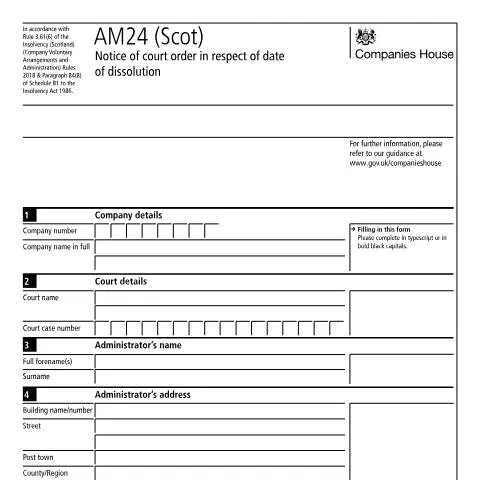
- Company Details: Including the full company name and the corresponding company number is imperative to link the court order to the correct entity.
- Court Details: The name and address of the court issuing the order, along with the court case number.
- Administrator’s Information: The full name and address of the administrator handling the dissolution, ensuring clear communication lines.
- Date of Court Order: The date on which the court order was granted is crucial for legal accuracy.
- Signature Section: The administrator must sign and date the form to authenticate it.
Completing each section with precision is critical, as any inaccuracies may lead to delays or rejections from Companies House.
Understanding the Court Order's Legal Weight
A court order carries significant legal weight and implications. It signifies that a judge has reviewed the circumstances surrounding the company’s dissolution and has determined that it should proceed. The details outlined in the AM24 reflect this judicial decision, providing clarity and transparency to creditors, shareholders, and regulatory bodies.
It's essential to grasp what constitutes a valid court order to avoid any pitfalls in the process:
- The order must specifically mention the date of dissolution.
- It should confirm compliance with the Insolvency Act and relevant rules.
- All parties involved must have the opportunity to present their case before the court.
Common Misinterpretations of the AM24
When navigating the AM24 process, several common misinterpretations can arise:
- Assuming the Court Order Automatically Dissolves the Company: While a court order is required, the AM24 must still be submitted to formalise the dissolution with Companies House.
- Overlooking Additional Documentation: Some may neglect to attach the actual court order with the AM24, which is a mandatory requirement.
- Misreporting Company Details: Incorrect details can lead to complications in the dissolution process or potential legal challenges from creditors.
Step-by-Step Guide to Using the AM24 (Scot)
To efficiently navigate the process involving the AM24, follow these steps:
- Gather Required Information: Before initiating the process, collect all necessary information, including the full company name, company number, and details of the court order.
- Complete the AM24 Form: Fill out the form meticulously. Use black capital letters and ensure all fields are completed to avoid rejection.
- Attach Supporting Documents: Include a copy of the court order as evidence of the dissolution decision.
- Submit to Companies House: Send the completed AM24 form and attachments to the appropriate address. For expediency, it’s recommended to send it to:
The Registrar of Companies, Companies House, Fourth floor, Edinburgh Quay 2, 139 Fountainbridge, Edinburgh, Scotland, EH3 9FF.
- Retain Copies: Keep copies of all documents submitted for your records, in case of future inquiries or disputes.
Interplay with Other Documents in the Dissolution Process
The AM24 does not exist in isolation; it is part of a broader interplay of documents and procedures involved in the company dissolution process. Understanding these relationships can help streamline the process:
| Document | Purpose | Relation to AM24 |
|---|---|---|
| Court Order | Legal authority confirming dissolution | Must be attached to AM24 |
| Form CB01 | Application for Company Dissolution | May precede AM24 depending on circumstances |
| Final Accounts | Clear financial standing before dissolution | Recommended for transparency |
| Confirmation Statements | Annual filing requirements | Must be up to date prior to submitting AM24 |
Having a thorough understanding of these documents can prevent any miscommunication and ensure all necessary steps are followed in the correct order.
Practical Considerations Post-Submission
Once the AM24 is submitted and accepted, it is not the end of the road for administrators or involved parties. Several practical considerations come into play:
- Monitoring Public Records: After submission, keep an eye on the Companies House public register to confirm the company’s status has been updated to 'dissolved.'
- Communication with Stakeholders: Notify creditors and stakeholders about the dissolution, providing them with the relevant information and timelines as appropriate.
- Retention of Records: Maintain the company’s records for a specified period post-dissolution, as creditors may have the right to pursue claims even after a company is dissolved.
These steps ensure compliance with legal obligations and maintain transparency throughout the process.
Final Thoughts on the AM24 (Scot)
The AM24 (Scot) is an integral part of the company dissolution landscape in Scotland. Understanding its nuances, components, and interrelations with other documentation is vital for administrators. Ensuring proper adherence to the guidelines set forth by Companies House and the legal framework will facilitate a smoother dissolution process.
Moreover, being aware of the potential pitfalls and maintaining clear communication with all parties involved can save time and resources. Navigating the dissolution process can be intricate, but with the right knowledge and approach, it can be managed effectively.
Understanding the Importance of Properly Notifying a Court Order
When dealing with the dissolution of a company in Scotland, the process of giving notice of a court order cannot be understated. The formal notification is essential not just for legal compliance, but also to maintain transparency and uphold the integrity of the corporate framework. In the UK, specifically under Scottish law, this involves certain steps that every company must follow to ensure that the dissolution is executed legally and effectively.
Failing to give proper notice can lead to complications, including challenges to the validity of the dissolution, potential legal repercussions for directors, and financial liabilities that could arise post-dissolution. Thus, understanding how to accurately complete and submit form AM24 is critical.
When a court order for dissolution is made, it’s advisable to notify all relevant stakeholders—this includes creditors, employees, and shareholders—to avoid any disputes that may arise in the future. Moreover, the notice should clearly outline the implications of the court order, including the effective date of dissolution.
Common Pitfalls and How to Avoid Them
Filing a notice of court order is not as straightforward as it may seem. Several common pitfalls can hinder the process, making it essential for directors and company secretaries to be vigilant. One major issue is the misinterpretation of the court order itself. It is crucial to read the order thoroughly to understand the stipulations it contains regarding the timing and the necessary disclosures required for notifying the dissolution.
Another frequent mistake occurs during the filing of the AM24 form. Some individuals may neglect to provide supporting documentation that verifies the dissolution process has been conducted in accordance with the court's directives. This documentation can include minutes from board meetings or proof of notice to creditors. Inadequate information may lead to the rejection of the AM24 form by the relevant authorities, such as Companies House.
Furthermore, it’s vital to adhere to the deadlines stipulated in the court order. The dissolution process does not automatically commence upon obtaining the order; compliance with the specified timeline for submitting the notice is critical. Directors should also be aware of their ongoing responsibilities until the dissolution is fully compliant.
To mitigate these pitfalls, seeking advice from professionals with expertise in corporate law can be beneficial. Legal professionals can provide clarity on interpreting court orders and ensuring compliance with the necessary formalities when notifying about the dissolution.
The Role of Companies House in the Dissolution Process
Companies House plays a pivotal role in the dissolution of a company in Scotland. Once the notice of a court order has been filed using the AM24 form, Companies House is responsible for maintaining the public record of the company’s status. This includes updating their registers to reflect that the company is in the process of dissolution.
It's important to note that Companies House will not proceed with the dissolution until they have received the AM24 form and any additional required documents. Therefore, ensuring that the submission is accurate and complete is paramount to prevent any delays. Upon receipt of the form, Companies House will review the documentation and, if everything is in order, will issue a confirmation that the company is under dissolution.
Additionally, it’s vital to remain aware of the public nature of these filings. All notices of dissolution are accessible to the public, and any discrepancies or issues in the documentation can lead to reputational damage for the directors involved. This underscores the necessity for accuracy and thoroughness in the notice process.
Directors must also be prepared for the potential that Companies House may contact them for further information or clarification regarding the dissolution. Being prompt and cooperative in these dealings can significantly streamline the process.