When Company Directors Need Form NM01c: Beyond Simple Name Changes
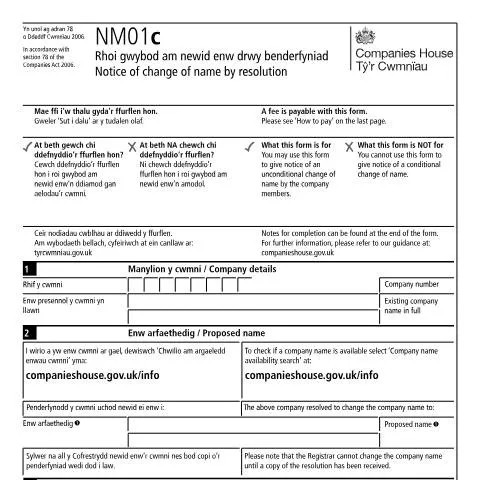
Company name changes aren't always straightforward administrative updates. When shareholders pass an unconditional resolution to alter their company's registered name, form NM01c becomes the essential bridge between boardroom decisions and official recognition at Companies House. This bilingual Welsh-English form specifically handles member-driven name changes that require no further conditions or approvals—distinguishing it from conditional changes that depend on external factors or regulatory clearance.
The form operates under section 78 of the Companies Act 2006, which governs how companies must notify the Registrar of fundamental changes to their corporate identity. Unlike simple administrative corrections or director-initiated amendments, NM01c captures the democratic process where company members collectively decide to rebrand, restructure, or simply adopt a more suitable trading name.
Understanding when to use this specific form prevents costly delays and rejected applications. Companies House receives thousands of incorrectly submitted name change requests annually, often because applicants confuse unconditional member resolutions with conditional changes requiring regulatory approval or third-party consent.
Decoding the Resolution Requirement: What Makes a Change "Unconditional"
The critical distinction lies in the nature of the resolution passed by company members. An unconditional resolution means the name change takes immediate effect once Companies House processes the application—no further approvals, conditions, or waiting periods apply.
Typical unconditional scenarios include:
- Rebranding to reflect new business focus or market positioning
- Adopting a shorter, more memorable trading name
- Correcting perceived marketing disadvantages in the current name
- Aligning subsidiary names with parent company branding
- Removing outdated geographical or sectoral references
Conversely, conditional changes require different procedures and cannot use form NM01c. These include name changes dependent on:
- Regulatory approval from sector-specific bodies
- Completion of mergers or acquisitions
- Resolution of trademark disputes
- Government department clearance for sensitive terms
- Court orders or insolvency proceedings
The resolution itself must be properly documented and attached to the NM01c submission. Companies House cannot process the name change until they receive this supporting documentation, even if the form appears complete.
Navigating Sensitive Words and Restricted Terms
Not all proposed company names sail through the approval process. The Companies Act 2006 and associated regulations restrict certain words and expressions that suggest government connection, professional status, or regulatory oversight without proper authorization.
Sensitive words requiring additional approval include terms like "Royal," "National," "British," "Authority," "Council," "Institute," or professional designations such as "Architect," "Solicitor," or "Bank." When your proposed name contains such terms, you must first submit form NM06 requesting comments from the relevant government department or regulatory body.
| Word Category | Examples | Approval Required From |
|---|---|---|
| Government Connection | Royal, National, British, Government | Cabinet Office |
| Professional Services | Architect, Solicitor, Barrister | Relevant Professional Body |
| Financial Services | Bank, Building Society, Credit Union | Financial Conduct Authority |
| Educational Terms | University, College, School | Department for Education |
The duplicate names rule presents another hurdle. Companies House maintains strict policies preventing identical or misleadingly similar names. Their online search facility allows real-time checking, but remember that names are reserved during pending applications, potentially blocking your preferred choice even if it appears available initially.
Strategic Timing for Name Availability
Experienced company secretaries often conduct multiple name searches before finalizing their resolution. Popular commercial terms or trending business concepts may see several applications submitted simultaneously, making timing crucial for securing your preferred name.
Completing Section-by-Section: Technical Requirements and Common Pitfalls
Form NM01c demands precision in completion. Each section serves specific legal and administrative purposes, and errors frequently result in rejection and resubmission delays.
Section 1: Company Details requires exact matching with existing Companies House records. The company number and current registered name must correspond precisely to the public register. Even minor spelling variations, punctuation differences, or spacing inconsistencies will trigger rejection.
Section 2: Proposed Name captures your intended new identity. Companies House recommends checking name availability immediately before submission, as popular names may be claimed by other applicants during your preparation period. The proposed name must comply with standard formation rules—no offensive terms, clear corporate status indicators (Limited, Ltd, etc.), and appropriate punctuation.
Section 3: Authentication requires careful consideration of signatory authority. The form explicitly lists authorized signatories: directors, company secretaries, authorized persons under sections 270 or 274 of the Companies Act 2006, and various insolvency practitioners where applicable.
Special Considerations for UK Societas
UK Societas (UKS) companies face unique requirements when completing NM01c. The standard "director" reference must be deleted and replaced with specific details identifying which UKS organ the authorizing person represents. This reflects the different governance structures inherent in Societas entities compared to traditional UK limited companies.
Processing Timeline: From Submission to Certificate
Companies House typically processes NM01c applications within 8-10 working days for standard submissions, though this timeframe assumes complete, accurate documentation and no complications with the proposed name.
The processing sequence follows a structured pathway:
- Initial Receipt: Application logged and fee payment verified
- Documentation Check: Resolution copy reviewed and form completion verified
- Name Validation: Proposed name checked against restrictions and duplicates
- Registration Update: New name entered into public register
- Certificate Issue: Change of name certificate dispatched
Electronic submissions through the Companies House online service generally process faster than postal applications. However, the resolution copy requirement means most NM01c applications involve mixed submission methods—the form submitted electronically while the supporting resolution follows by post.
What Happens After Approval
Upon successful processing, Companies House issues a certificate of change of name. This official document legally confirms the new company identity and provides the effective date of change. The certificate carries significant legal weight—banks, HMRC, and other institutions typically require sight of this document before updating their own records.
The company's updated details immediately appear on the public register, accessible through the Companies House online search facility. This public visibility means customers, suppliers, and other stakeholders can verify the name change authentically.
Fee Structure and Payment Methods
Form NM01c attracts statutory fees set by Companies House and reviewed annually. Current fee levels depend on submission method and processing speed requirements, with premium options available for expedited processing.
Payment methods vary by submission channel:
- Online submissions: Debit card, credit card, or Companies House account
- Postal submissions: Cheque payable to "Companies House" or postal order
- In-person submissions: Cash, card payments, or account billing at Companies House offices
Incorrect fee payments represent a common rejection cause. Companies House cannot process applications with insufficient payment and will return the entire submission for correction. This creates additional delays and may result in losing your preferred name to competing applications.
Integration with Broader Corporate Administration
Successful name changes trigger cascading administrative requirements across multiple government departments and external organizations. While Companies House handles the core registration change, companies must separately notify:
- HMRC: Corporation tax, PAYE, and VAT registrations require updating within specified timeframes
- Banks and financial institutions: Account names, authorized signatories, and legal entity documentation need revision
- Professional indemnity insurers: Policy documentation must reflect the new corporate identity
- Regulatory bodies: Sector-specific licenses and authorizations often require formal notification
- Contractual counterparties: Existing agreements may need supplemental documentation confirming corporate continuity
Experienced company administrators often prepare comprehensive notification schedules before submitting NM01c, ensuring smooth transitions across all affected relationships and regulatory requirements.
Maintaining Corporate Continuity
The legal principle of corporate continuity means the company remains the same entity despite the name change. Existing contracts, liabilities, and legal obligations transfer automatically to the new identity. However, practical implementation often requires proactive communication and documentation updates to prevent confusion or administrative delays.
Directors should consider preparing standard letters or notices explaining the change to key stakeholders, including the effective date and certificate reference number. This proactive approach minimizes disruption to ongoing business relationships and demonstrates professional change management.
Understanding the Legal Implications of Name Changes
When you change your company name using form NM01c, you're not simply updating a record—you're creating a new legal identity for your business that carries significant implications across multiple areas of law and regulation. The moment Companies House approves your name change, your company operates under the new name for all legal purposes, though certain transitional considerations apply.
Your existing contracts remain valid under the new name, but best practice dictates informing all contracting parties of the change. Whilst there's no legal obligation to renegotiate existing agreements, some contracts may include specific clauses requiring notification of name changes. Employment contracts automatically continue under the new company name, though you should update payroll systems and inform employees through official channels.
Intellectual property rights present particular complexities. Trade marks registered under your old company name don't automatically transfer to reflect the new name—you may need to file for assignment or update registrations with the Intellectual Property Office. Domain names, copyright registrations, and design rights should be reviewed to ensure consistency with your new corporate identity.
Banking relationships require careful attention following a name change. Most high street banks will require you to provide the updated certificate of incorporation showing your new name before they'll update account details. This process can take several weeks, during which you may need to continue operating certain transactions under your previous name. Consider opening new accounts in parallel rather than attempting to transfer existing ones if timing is critical.
Insurance policies present another area requiring immediate attention. Your public liability, professional indemnity, and directors' and officers' insurance must all reflect your new company name to ensure coverage remains valid. Contact your insurance providers immediately after receiving confirmation from Companies House, as some policies may become void if material changes aren't reported within specified timeframes.
For companies with international operations or subsidiaries, name changes can trigger additional regulatory requirements in foreign jurisdictions. Some countries require local subsidiary companies to reflect parent company name changes in their own registrations, whilst others may have specific notification requirements for foreign companies operating within their borders.
Managing Stakeholder Communications During Name Transitions
A strategic approach to stakeholder communication can make the difference between a smooth transition and months of confusion following your company name change. The timing and method of your announcements should align with your business objectives whilst ensuring all legal obligations are met.
Start with your most critical stakeholders—key clients, major suppliers, and financial institutions—before making any public announcements. These relationships often involve complex agreements where confusion over company identity could have immediate commercial consequences. Prepare a formal notification letter template that includes your company registration number, the effective date of the change, and clear statements that all existing agreements remain in full force and effect.
Your customer communication strategy should consider the different segments within your customer base. B2B clients typically require more detailed information about the legal implications of the name change, whilst consumer-facing communications should focus on reassurance that service levels and product quality remain unchanged. Consider the timing of customer communications carefully—announcing too early (before Companies House approval) risks confusion if the application is rejected, whilst waiting too long may damage trust if customers discover the change through third parties.
Employee communications deserve special attention, particularly in larger organisations where the name change may signal broader strategic shifts. Staff members are often your best ambassadors for explaining the change to external contacts, but they need clear, consistent messaging to do this effectively. Consider holding team briefings before the public announcement, providing FAQ documents that address common concerns, and updating internal systems like email signatures and business cards in a coordinated manner.
Regulatory bodies beyond Companies House may require specific notifications. If your company holds professional licences (such as financial services authorisations from the FCA), operates in regulated sectors, or has ongoing relationships with government departments, check whether formal notification of the name change is required. Some regulatory approvals may need to be updated or reissued in your new company name.
Digital communications present both opportunities and challenges during name transitions. Social media accounts, website domains, and online business listings all need updating, but the process rarely happens instantaneously. Plan for a transition period where both names may appear in search results or online directories. Consider purchasing domain names in your new company name well in advance and setting up redirects from your old domains to maintain SEO value and customer access.
Post-Approval Administrative Tasks and Timeline Management
The period immediately following Companies House approval of your NM01c application is critical for ensuring business continuity. A systematic approach to updating your corporate records and external registrations will help avoid disruptions to your operations and maintain compliance across all areas of your business.
Within the first 48 hours of receiving your new certificate of incorporation, priority tasks should include updating your registered office address displays (if you have physical signage), notifying your bank to begin account name change procedures, and updating your company's statutory registers. The register of members, register of directors, and register of people with significant control should all reflect the new company name in any new entries, though historical entries remain unchanged.
HMRC systems require particular attention, as mismatches between your company name in their records and your actual trading name can cause complications with tax filings and payments. Corporation Tax, VAT registrations, and PAYE schemes should all be updated through the appropriate HMRC channels. Note that these updates may not be instantaneous—HMRC systems can take several weeks to reflect name changes across all departments, so maintain clear records of your notification attempts.
Professional services providers need systematic notification. Your accountants, solicitors, and other professional advisers should receive formal notification along with copies of your new certificate of incorporation. These relationships often involve ongoing compliance obligations where accurate company details are essential for regulatory filings and professional standards.
Supplier and vendor management becomes particularly important if your company operates on credit terms or has ongoing service agreements. Many suppliers run regular credit checks or compliance reviews that could flag discrepancies between your trading name and registered name if not properly managed. Proactive communication prevents potential service interruptions or credit rating issues.
Document management systems require comprehensive review following a name change. Templates for contracts, proposals, invoices, and other business documents should be updated to reflect your new company name. However, don't simply find-and-replace your old name—review each document type to ensure the name change doesn't create inconsistencies with other referenced information like registration numbers or addresses.
Consider establishing a transition period protocol for handling documentation that references your old company name. You may receive contracts, cheques, or official correspondence addressed to your previous name for several months after the change. Establish clear procedures for handling these situations, including when to accept payments made out to your old company name and how to manage legal documents that reference your previous identity.
Property-related considerations often extend well beyond the initial name change approval. If your company holds property leases, freehold titles, or planning permissions, these may need updating to reflect your new name. Land Registry updates can take several months to process and may require additional legal documentation beyond your Companies House certificate.