When Directors Face the Critical Decision to Rebrand Their Company
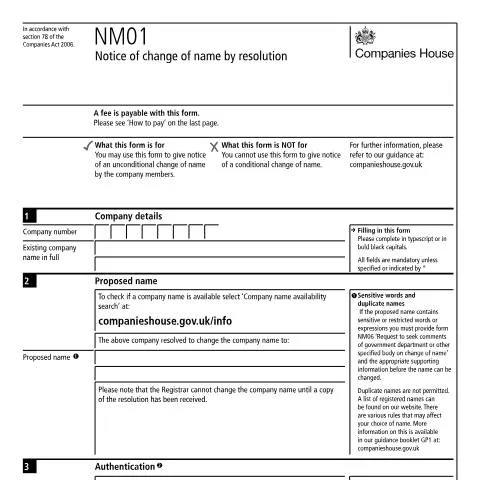
The moment arrives when a company's existing name no longer serves its strategic vision. Whether driven by market expansion, acquisition aftermath, or regulatory compliance, the decision to change a company name represents a pivotal corporate milestone. The NM01 form emerges as the statutory bridge between a company's current identity and its intended future, requiring meticulous attention to both legal requirements and administrative precision.
Under section 78 of the Companies Act 2006, companies possess the fundamental right to alter their registered name through member resolution. This process transcends simple paperwork—it demands understanding of duplicate name restrictions, sensitive word protocols, and the intricate relationship between company resolutions and public registry updates. The NM01 form serves as the formal notification mechanism, transforming internal corporate decisions into legally recognised changes within the Companies House register.
The stakes remain considerable. An incorrectly completed form triggers automatic rejection, delaying business operations and potentially affecting contractual obligations tied to the company's legal identity. Moreover, the £30 statutory fee represents just the beginning of costs—banking updates, stationery changes, and customer communications follow inevitably.
Navigating the Resolution Requirement and Supporting Documentation
The NM01 form operates exclusively for unconditional name changes approved by company members through formal resolution. This critical distinction separates it from conditional changes, which require alternative procedures and cannot utilise this particular form. Directors must ensure their internal resolution process complies with the company's articles of association and meets the requisite voting thresholds before proceeding.
Companies House demands a copy of the resolution accompanying the NM01 submission, unless previously filed through separate channels. This resolution must demonstrate clear member approval and specify the exact proposed name. The registrar cannot process name changes without this supporting documentation, regardless of form completion accuracy.
The resolution timing proves crucial. Members must have formally approved the name change before form submission, creating a clear chronological sequence: internal resolution first, then NM01 notification. Attempting to reverse this order results in automatic rejection and necessitates resubmission once proper resolution evidence becomes available.
Special Resolution Requirements
Most name changes require special resolution status, demanding 75% member approval and 21 days' advance notice to shareholders. The resolution must state the proposed name precisely as intended for registration, including any punctuation, capitalisation, or spacing. Minor discrepancies between the resolution wording and NM01 form entries trigger rejection notices.
Private companies may utilise written resolutions, avoiding formal meetings whilst maintaining the 75% threshold. Public companies face stricter requirements, typically necessitating extraordinary general meetings with proper constitutional notice periods.
Decoding the Name Availability Landscape
The proposed company name must navigate complex availability criteria extending beyond simple duplication checks. Companies House maintains sophisticated matching algorithms detecting similar names that might confuse the public or existing registrants. The Company Name Availability Search tool provides initial screening, though it cannot guarantee final acceptance.
| Name Category | Restriction Level | Additional Requirements |
|---|---|---|
| Standard Business Names | Basic duplication check | Availability search sufficient |
| Sensitive Words | Government approval required | NM06 form plus supporting evidence |
| Regulated Industries | Sector-specific approval | Professional body clearance |
| Royal/Crown References | Cabinet Office consent | Detailed business justification |
Names containing sensitive or restricted words trigger additional procedural requirements. The NM06 form becomes mandatory, seeking government department or specified body comments before name approval. Common sensitive terms include "Royal," "National," "British," "Authority," and various professional designations. Processing times extend significantly when sensitive word approval proves necessary.
The Duplicate Name Detection System
Companies House employs sophisticated algorithms examining phonetic similarities, abbreviated versions, and alternative spellings. Names deemed "too like" existing registrations face rejection, even when exact duplication doesn't occur. The system considers punctuation differences, spacing variations, and common abbreviations as potentially confusing similarities.
International variations present particular challenges. Names incorporating foreign language elements may conflict with existing English registrations if pronunciation similarities exist. Directors should conduct thorough research beyond the basic availability search, examining similar trading names and dissolved company records.
Mastering the NM01 Form Structure and Authentication
The NM01 form demands typescript or bold black capitals throughout, reflecting Companies House's document scanning requirements. Handwritten entries, particularly in cursive script, frequently trigger rejection notices due to optical character recognition limitations. All mandatory fields require completion—the asterisk system indicates optional elements only.
Section 1 captures existing company details, requiring precise matching with current register entries. The company name must appear exactly as registered, including punctuation, spacing, and capitalisation. Company numbers follow standard formatting—typically eight characters for companies incorporated after 2009, shorter sequences for older registrations.
Section 2 presents the proposed name field, where precision becomes paramount. The entered name must match the resolution wording exactly, as any discrepancy triggers automatic rejection. Directors should double-check capitalisation, punctuation, and spacing against the formal resolution before submission.
Authentication Protocols and Authorised Signatories
The authentication section requires careful consideration of signatory authority. Multiple categories possess signing rights: directors, secretaries, persons authorised under sections 270 or 274 of the Companies Act 2006, and various insolvency practitioners. The selected category must reflect the signatory's actual authority at the submission date.
UK Societas entities follow modified procedures, requiring deletion of "director" references and specification of the relevant organ membership. This reflects the distinct governance structure of European company forms operating within UK jurisdiction.
Authentication information appears on the public record permanently. Signatories should ensure their printed name accurately reflects their preferred public identification, as corrections require separate administrative procedures.
Processing Timelines and Companies House Response Protocols
Standard NM01 processing requires approximately 8-10 working days from receipt, assuming complete and accurate submission. This timeline excludes postal transit periods and potential delays during peak submission periods. Same-day processing services remain unavailable for name change applications, unlike certain other Companies House procedures.
Forms requiring sensitive word clearance face extended processing periods, potentially reaching 6-8 weeks depending on the relevant government department's response times. The NM06 process operates independently of NM01 submission, requiring sequential completion before name change approval.
Companies House operates a rejection and resubmission protocol for incorrect applications. Rejected forms receive detailed explanatory notes identifying specific deficiencies. Common rejection reasons include missing resolutions, unavailable names, incorrect authentication, or incomplete mandatory fields. Each rejection necessitates fresh submission with corrected information and additional fee payment.
Electronic Submission Advantages
Online submission through Companies House WebFiling services offers several advantages over postal applications. Electronic forms provide immediate validation checks, reducing rejection likelihood through real-time error detection. Processing times typically improve by 2-3 days compared to postal submissions, whilst confirmation receipts provide instant submission acknowledgment.
However, resolution copies still require separate submission via post or document upload facilities. The hybrid process combines electronic form completion with traditional document transmission for supporting evidence.
Financial Obligations and Payment Processing
The statutory £30 fee accompanies every NM01 submission, payable to "Companies House" through various methods. Cheques and postal orders suit postal submissions, whilst electronic payments support online applications. Fee amounts remain static regardless of company size, turnover, or name complexity.
Payment timing proves critical—forms submitted without correct fees face automatic rejection. Companies House cannot process applications on credit terms or accept partial payments. Fee refunds apply only when Companies House errors cause rejection, not when applicant mistakes trigger resubmission requirements.
Additional costs frequently accompany name changes beyond the statutory fee. Banking institutions typically charge for account name updates, ranging from £15-50 depending on account complexity. Stationery replacement, website updates, and marketing material amendments create further financial obligations requiring budgetary consideration.
Cost-Benefit Analysis for Name Changes
Directors should evaluate comprehensive name change costs against anticipated benefits. Beyond immediate administrative expenses, consider customer confusion periods, potential lost business during transition phases, and ongoing dual-name recognition requirements. Marketing investments supporting name change announcements often exceed statutory costs significantly.
Conversely, strategic name changes may unlock new market opportunities, resolve trademark conflicts, or align corporate identity with business evolution. Professional advice regarding timing, market communication, and stakeholder management frequently justifies additional investment in change management processes.
Post-Approval Procedures and Corporate Identity Transition
Successful NM01 processing triggers automatic updates across Companies House systems, with the new name appearing on the public register within 24 hours of approval. The registrar issues confirmation documentation, providing official evidence of name change completion for third-party notifications.
Directors must promptly notify multiple stakeholders following name change approval. HMRC requires immediate notification for corporation tax, VAT, and PAYE purposes, with potential penalties applying for delayed reporting. Banking institutions need formal notification with Companies House confirmation documentation to update account details.
Contractual obligations continue under the new company name automatically, though prudent practice involves notifying counterparties to avoid confusion or payment delays. Insurance policies, lease agreements, and ongoing commercial contracts may require specific amendment procedures depending on their terms.
Regulatory Notification Requirements
Companies operating in regulated sectors face additional notification obligations. Financial services firms must inform the Financial Conduct Authority, whilst licensed premises require local authority updates. Professional service companies may need regulatory body notifications to maintain practising certificates or authorisations.
The notification timeline varies by regulator, though most expect prompt communication following Companies House approval. Failure to notify relevant authorities may result in regulatory breaches, potentially affecting operating licences or professional standings.
Strategic Considerations for Directors and Corporate Planning
Name change decisions extend beyond administrative procedures into strategic corporate planning. Market research regarding customer recognition, competitor analysis, and trademark implications should precede NM01 submission. The chosen name must support long-term business objectives whilst avoiding future change requirements.
International expansion plans particularly influence name selection. Names acceptable within UK jurisdiction may face restrictions in target markets, potentially necessitating subsidiary structures or trading name arrangements. Directors should consider global trademark searches and cultural appropriateness across intended operating territories.
The timing of name changes affects business operations significantly. Avoiding peak trading periods, major product launches, or contractual renewal phases minimises operational disruption. Some companies coordinate name changes with financial year-ends or strategic milestone achievements for maximum market impact.
Digital presence management becomes increasingly complex with name changes. Domain name availability, social media handles, and search engine optimisation require careful planning. Companies may need to maintain former name recognition through transitional marketing strategies or redirect arrangements.
The NM01 form represents more than administrative compliance—it facilitates corporate evolution whilst maintaining legal continuity. Success depends on thorough preparation, accurate completion, and comprehensive post-approval planning. Directors who approach name changes strategically, with proper attention to both procedural requirements and business implications, position their companies for smooth transitions and continued commercial success.
NM01 Form Processing Times and Tracking Your Application
Once you've submitted your NM01 form to Companies House, understanding the processing timeline becomes crucial for planning any related business activities. The standard processing time for a company name change is typically 8 to 10 working days from receipt of your application, though this can vary depending on current workload and whether your application requires additional scrutiny.
Companies House operates on a first-come, first-served basis for most standard applications. However, certain factors can extend processing times significantly. If your proposed name is similar to existing company names, requires sensitivity checks, or falls into restricted categories, the review process may take up to 6 weeks. Applications involving company names that suggest government affiliation, royal connections, or professional body associations typically face more rigorous examination.
You can track your application's progress through the Companies House online service using your submission reference number. The system provides real-time updates showing whether your application is received, under review, or completed. If Companies House identifies issues with your application, they'll contact you using the correspondence address provided on the form, so ensure this information remains current throughout the process.
For urgent name changes, Companies House offers a same-day service for an additional fee, though this service isn't guaranteed and depends on capacity. The same-day service costs significantly more than standard processing and must be requested when submitting your application. This option proves particularly valuable when coordinating name changes with marketing campaigns, rebranding exercises, or time-sensitive commercial agreements.
During the processing period, your company continues operating under its current name. You cannot use the new name in official correspondence, contracts, or regulatory filings until Companies House confirms the change. However, you can begin preparing updated stationery, signage, and marketing materials, provided you don't deploy them until receiving official confirmation.
Post-Approval Administrative Requirements and Compliance
Successfully changing your company name through the NM01 process triggers a cascade of additional administrative obligations that extend well beyond the Companies House confirmation. These requirements span multiple government departments and regulatory bodies, each with distinct timelines and procedures.
HMRC notifications represent perhaps the most critical post-approval task. You must inform HMRC of your name change within three months, though best practice suggests notification within 30 days. This affects your Corporation Tax records, VAT registration (if applicable), and PAYE scheme details. HMRC requires written notification including your company registration number, previous name, new name, and effective date of change. Failure to notify HMRC promptly can result in correspondence being sent to the wrong name, potentially causing compliance issues or missed deadlines.
Your bank relationships require immediate attention following name approval. Most banks freeze accounts or restrict transactions when they detect a company name change through their monitoring systems. Contact your bank's commercial team before the change takes effect, providing them with the Companies House certificate and any required documentation. Banks typically require board resolutions authorising the name change and updated mandates for account signatories. Processing times vary between institutions, but expect 5 to 15 working days for full account updates.
Insurance policies must be updated to reflect the new company name, as coverage may be invalidated if the named entity doesn't match your current legal status. Contact insurers immediately after receiving Companies House confirmation, as some policies include specific clauses requiring notification within defined timeframes. Professional indemnity, public liability, and directors' insurance policies all require updating, along with any sector-specific coverage.
Regulatory bodies relevant to your industry must also be notified. For example, companies regulated by the Financial Conduct Authority (FCA), Ofgem, or sector-specific bodies face additional notification requirements with their own deadlines and procedures. Professional service firms may need to update registrations with bodies like the Solicitors Regulation Authority or Institute of Chartered Accountants.
Contractual obligations present another critical consideration. Review all existing contracts, supplier agreements, and customer arrangements to determine notification requirements. Many commercial contracts include specific clauses addressing name changes, some requiring formal notification or even consent from counterparties. Employment contracts may also reference the company name and could require updating or formal notification to employees.
Common Complications and Resolution Strategies
Despite careful preparation, company name changes frequently encounter complications that can delay or complicate the process. Understanding these potential issues and their resolution strategies helps minimise disruption to your business operations.
Name similarity objections represent the most frequent complication. Companies House may reject applications where proposed names too closely resemble existing companies, even if an initial name check suggested availability. The assessment considers phonetic similarity, visual appearance when written, and potential for confusion in the marketplace. If your application faces rejection on these grounds, you have several options: propose alternative names, provide evidence that the similar company consents to your name choice, or demonstrate that no confusion would arise due to different business activities or geographical separation.
When facing similarity objections, Companies House sometimes accepts supporting evidence that distinguishes your business from the existing company. This might include detailed business descriptions, evidence of different market sectors, or confirmation that the existing company operates in different geographical areas. However, such evidence must be substantial and clearly demonstrate that consumer confusion is unlikely.
Sensitive name complications arise when proposed names suggest connections to government, royal family, or regulated activities. Companies House maintains lists of sensitive words and expressions requiring additional approval. If your application includes such terms, expect extended processing times and potentially additional documentation requirements. Some sensitive words require approval from specific government departments or regulatory bodies before Companies House can approve the name change.
Technical complications can also emerge during the application process. Digital submission errors sometimes result in incomplete or corrupted applications, particularly when uploading supporting documents. If you receive notification of technical issues, respond promptly with corrected information to avoid your application being treated as withdrawn. Companies House typically provides a reasonable timeframe for correction, but delays can impact your planned implementation timeline.
Payment processing problems occasionally occur, particularly with online submissions. If payment fails or processes incorrectly, Companies House may hold your application pending payment resolution. Monitor your payment method for several days after submission and contact Companies House immediately if you suspect payment issues.
Sometimes complications arise from incomplete or incorrect information on the NM01 form itself. Common errors include incorrect company numbers, mismatched director details, or inconsistent addresses. Such errors can result in application rejection and require complete resubmission with correct information and additional fees.
Resolution strategies for most complications involve prompt communication with Companies House. Their customer service team can provide specific guidance for your situation and sometimes offer alternative solutions. When contacting Companies House about complications, have your application reference number, company registration number, and all relevant documentation readily available. Keep detailed records of all communications, as these may prove valuable if further complications arise or if you need to escalate issues.
For complex cases involving multiple complications or sensitive commercial considerations, some companies engage specialist advisers familiar with Companies House procedures. While this involves additional costs, professional assistance can often resolve complications more efficiently than attempting to navigate complex issues independently, particularly when dealing with time-sensitive business requirements or regulatory constraints.