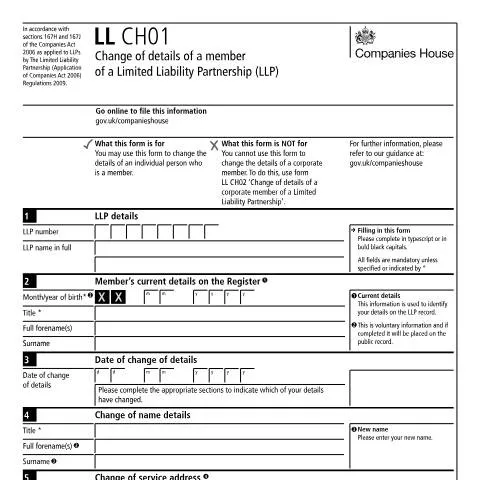
Understanding the LL CH01: Your Gateway to Member Detail Updates
When a member of a Limited Liability Partnership (LLP) needs to update their personal details on the official register, the LL CH01 form becomes the essential document bridging the gap between private changes and public compliance. This form, governed by sections 167H and 167J of the Companies Act 2006 as applied to LLPs, serves as the formal mechanism for maintaining accurate member information at Companies House.
The LL CH01 specifically handles changes for individual members only – a crucial distinction that prevents confusion with corporate member updates, which require the separate LL CH02 form. This targeted approach ensures that personal data updates follow appropriate procedures whilst maintaining the integrity of the LLP register.
Who Must File and When: The Scope of Member Updates
The obligation to file an LL CH01 falls on the LLP itself, specifically requiring authentication by a designated member or judicial factor. This isn't a personal responsibility of the individual member whose details are changing, but rather a corporate duty of the partnership entity.
Individual Members Covered
The form applies exclusively to natural persons who are members of the LLP. Whether they hold designated member status or are ordinary members, any individual requiring detail updates must use this specific form. The scope includes:
- Changes to personal names following marriage, divorce, or deed poll
- Updates to service addresses appearing on the public record
- Modifications to usual residential addresses (kept private)
- Changes in country or state of residence
- Alterations to designated member status
Corporate Members: The Clear Exclusion
Companies, other LLPs, or corporate entities serving as members cannot use the LL CH01. These situations demand the LL CH02 form instead, reflecting the different legal frameworks and disclosure requirements governing corporate versus individual members.
Navigating the Dual Address System: Service vs Residential
One of the most intricate aspects of the LL CH01 involves understanding the dual address system that governs member information. This structure balances transparency requirements with privacy protection, creating specific rules about what appears on the public record.
| Address Type | Public Visibility | Requirements | Special Provisions |
|---|---|---|---|
| Service Address | Fully public | Physical location only | Can state "The LLP's Registered Office" |
| Usual Residential | Private record only | Cannot be PO Box/DX/LP | Can match service address if declared |
Service Address Strategies
Members enjoy considerable flexibility in choosing their service address. Many opt to use the LLP's registered office, providing a simple solution that maintains privacy whilst fulfilling legal requirements. However, this choice creates specific completion rules – if using the registered office as service address, the residential address must be completed in full rather than cross-referenced.
The prohibition on PO Boxes, DX numbers, and Legal Post addresses ensures that service addresses represent genuine locations where official correspondence can be delivered effectively. This requirement extends to both address types, preventing the use of mail forwarding services as primary contact points.
Completing Section by Section: Technical Requirements and Pitfalls
The LL CH01's structure follows a logical progression, but several sections contain technical requirements that can trip up first-time filers. Understanding these nuances prevents rejection and delays.
LLP Identification and Current Member Details
Section 1 requires the full LLP name exactly as registered, alongside the company number. Even minor variations in formatting can trigger rejection. Section 2 serves as a verification mechanism, requiring current details exactly as they appear on the existing register. This creates a matching system that prevents unauthorised changes.
The optional title field demonstrates the form's flexibility – whilst not mandatory, any completed title information becomes part of the public record. This voluntary disclosure principle extends throughout the form, allowing members to control their level of public visibility within legal constraints.
Date of Change: The Critical Timestamp
Section 3's date field establishes the official effective date for all changes listed on the form. This date cannot be retrospective beyond reasonable limits, and Companies House may query dates that appear inconsistent with filing timing. The date applies to all changes on a single form, meaning multiple changes occurring on different dates require separate filings.
Name Changes: Documentation and Verification
Section 4 handles name changes with particular attention to verification requirements. Whilst the form itself doesn't explicitly require supporting documentation, Companies House reserves the right to request evidence of legal name changes, particularly for significant alterations that might indicate identity fraud concerns.
Status Changes and Designated Member Appointments
Section 7 addresses one of the most legally significant updates possible: changes in designated member status. This section requires explicit consent confirmation, reflecting the enhanced responsibilities and potential liabilities associated with designated membership.
Understanding Designated Member Implications
The transition to or from designated member status carries substantial legal consequences. Designated members bear additional responsibilities for LLP compliance, including filing obligations and potential personal liability in certain circumstances. The consent requirement ensures informed acceptance of these enhanced duties.
The form accommodates both directions of status change – appointing new designated members and removing existing ones. However, LLPs must maintain at least two designated members at all times, creating potential sequencing requirements when multiple status changes occur simultaneously.
Authentication Requirements
Section 8's authentication must come from an existing designated member or judicial factor. This creates a verification chain ensuring that only authorised individuals can modify member details. The authentication doesn't require a traditional signature – a printed name suffices, reflecting Companies House's modernised approach to form completion.
Filing Channels and Processing Considerations
Companies House offers multiple filing channels for the LL CH01, each with distinct characteristics affecting processing times and user experience.
Online Filing Advantages
The digital filing option through the Companies House website provides immediate acknowledgment and typically faster processing. Online submission also reduces transcription errors and allows real-time validation of certain data fields. However, not all LLPs may have access to online filing depending on their registration status and authentication credentials.
Postal Submission Protocol
Paper forms require careful attention to completion standards – typescript or bold black capitals only, with all mandatory fields completed. The postal process introduces additional variables including delivery times and manual processing requirements that can extend overall completion periods.
Critical addressing requirements depend on the LLP's jurisdiction within the UK. Scottish LLPs, for instance, must send forms to the Edinburgh office, whilst those registered elsewhere use Cardiff. Incorrect addressing can add weeks to processing times.
Integration Within LLP Compliance Frameworks
The LL CH01 operates within a broader ecosystem of LLP compliance obligations. Understanding its relationship to other filings helps ensure comprehensive regulatory adherence.
Annual Confirmation Statements
Member detail changes often intersect with annual confirmation statement requirements. If changes occur close to the confirmation statement due date, careful coordination prevents duplicated information or conflicting data submissions. Some changes might be more efficiently handled within the confirmation statement process rather than through separate LL CH01 filings.
Appointment and Resignation Procedures
The LL CH01 handles existing member detail changes but doesn't cover new appointments or resignations. These events require different forms – LL AP01 for appointments and LL AP03 for resignations. Understanding these boundaries prevents inappropriate form selection and associated delays.
Monitoring and Follow-up Procedures
Once filed, the LL CH01 enters Companies House's processing system with specific timescales and tracking mechanisms available to filers.
Processing Timescales
Standard processing typically occurs within 8-10 working days for online submissions and 10-15 working days for postal filings. However, these timescales assume correctly completed forms without queries. Incomplete or inconsistent information can extend processing significantly whilst Companies House seeks clarification.
Rejection and Query Resolution
Common rejection reasons include mismatched LLP details, incomplete address information, or missing authentication. The checklist provided with the form highlights frequent problem areas, but careful attention to detail remains the best prevention strategy.
When queries arise, Companies House typically contacts the presenter information provided on the form. Prompt response to queries prevents extended delays and potential automatic rejection of the filing.
The public record update occurs immediately upon successful processing, making updated information visible to searchers. This immediate visibility underscores the importance of accuracy in all submitted details, as corrections require additional filings and potential explanatory documentation.
When Changes Must Be Reported: Timing Requirements and Compliance Deadlines
Understanding when to submit an LL CH01 form is crucial for maintaining your LLP's legal standing with Companies House. The timing requirements vary significantly depending on the type of change you're reporting and the specific circumstances surrounding that change.
For most member detail changes, you have 14 days from the date the change takes effect to file the LL CH01 form. This deadline applies to changes in residential addresses, service addresses, and amendments to members' names. However, it's important to note that this 14-day period begins from when the change actually occurs, not when you become aware of it or decide to act upon it.
When a new member joins the LLP, the 14-day countdown starts from their official admission date as recorded in your LLP agreement or partnership documentation. Similarly, if a member's details change due to marriage, deed poll, or other legal name change, the clock starts ticking from the date the legal change takes effect, not the wedding date or when the deed poll is executed.
For service address changes, there's an important distinction to understand. If you're simply updating a service address to reflect a move or new preference, the standard 14-day rule applies. However, if you're changing from a service address back to using the residential address, or vice versa, you must ensure the new arrangement is already in place before filing, as Companies House needs to be able to serve documents immediately.
Late filing carries consequences that extend beyond simple administrative inconvenience. Companies House may impose penalties for late submission, and in severe cases of non-compliance, could initiate enforcement action. More critically, if your LLP's registered information is not current, it could affect your ability to conduct business, particularly when dealing with banks, suppliers, or when entering contracts where up-to-date Companies House records are verified.
There are limited circumstances where the 14-day rule may be extended or where different timing applies. If exceptional circumstances prevented timely filing—such as serious illness, natural disasters, or postal strikes—you can include an explanation with your late filing. While this doesn't guarantee acceptance, Companies House does consider such explanations when deciding whether to impose penalties.
For LLPs operating internationally or with members based overseas, timezone considerations can affect compliance timing. The 14-day period is calculated using UK time, so if a change occurs abroad, you'll need to account for time differences when determining your filing deadline.
Designated Members: Special Responsibilities and Compliance Obligations
Designated members occupy a unique position within LLP structures, carrying enhanced responsibilities that extend far beyond those of ordinary members. When filing LL CH01 forms, understanding these distinctions is essential for proper compliance and avoiding potential legal complications.
Every LLP must have at least two designated members at all times, and these individuals bear specific statutory duties under the Limited Liability Partnerships Act 2000. When changes affect designated members, additional considerations apply to your LL CH01 submission. You cannot simply change the details of a designated member without ensuring the LLP maintains its minimum complement of two designated members throughout the process.
If a designated member's details change due to resignation, death, or removal, you must demonstrate that replacement arrangements are in place before the change takes effect. This might require filing multiple forms simultaneously—an LL CH01 to remove the departing designated member and another to appoint their replacement, or to designate an existing ordinary member to fill the role.
The responsibilities of designated members include ensuring the LLP's annual accounts are prepared and filed, maintaining proper accounting records, and serving as the primary points of contact for regulatory matters. When their personal details change, there's heightened scrutiny from Companies House because these individuals are considered the LLP's responsible officers for various statutory purposes.
For designated members who are also persons with significant control (PSCs), additional reporting obligations apply. Changes to their details may trigger requirements to update PSC information separately from the LL CH01 form, particularly if the changes affect their control status or influence within the LLP structure.
When a designated member moves abroad, special considerations apply. While there's no general restriction preventing designated members from being resident overseas, practical implications arise for service of documents and regulatory communications. You may need to establish alternative arrangements for receiving official correspondence, and some professional service providers or financial institutions may require at least one UK-resident designated member.
Corporate designated members face additional complexity when their details change. If a corporate entity serving as a designated member undergoes restructuring, changes its registered office, or alters its company name, these changes must be reflected in your LLP records through an LL CH01 filing. You'll need to provide evidence of the corporate changes, typically in the form of updated certificate of incorporation or confirmation statements from the corporate member's own Companies House records.
Cross-Border Considerations and International Members
LLPs with international members or cross-border operations face unique challenges when managing member details through LL CH01 forms. The increasing globalisation of business structures means many UK LLPs now include members resident in various jurisdictions, each bringing specific compliance considerations.
When an international member changes their overseas address, you must provide the new address in a format recognisable to UK authorities while respecting local addressing conventions. Companies House accepts international addresses but requires sufficient detail for official correspondence to reach the intended recipient. This includes proper country identification, postal codes in local format, and any necessary regional or state information.
For members moving between jurisdictions, timing becomes critical. If a UK-resident member relocates abroad, this may trigger tax implications requiring coordination with HMRC, particularly if the member has been subject to UK income tax on LLP profits. The LL CH01 form should reflect their new status, but you may need to consider whether additional notifications to tax authorities are required.
Currency considerations affect international members when LLP agreements specify profit-sharing arrangements or capital contributions in foreign currencies. While the LL CH01 form itself doesn't capture financial details, changes in member circumstances abroad might necessitate updates to your LLP agreement, which in turn could require disclosure through other Companies House filings.
Documentation requirements intensify for international members. Address verification becomes more complex when standard UK verification methods aren't applicable. You may need to obtain certified translations of foreign documents or secure apostilled certificates to satisfy Companies House requirements, particularly when member name changes involve foreign legal processes.
Data protection obligations under UK GDPR extend to international member information. When collecting and processing overseas members' personal data for LL CH01 submissions, you must ensure compliance with both UK data protection requirements and any applicable foreign privacy laws. This is particularly relevant for members resident in jurisdictions with strict data protection regimes.
Professional service providers often require enhanced due diligence for international members, affecting your ability to open bank accounts, secure professional indemnity insurance, or engage with certain regulated sectors. Keeping international member details current through timely LL CH01 filings helps maintain these essential business relationships.
Brexit implications continue to affect EU-resident members, particularly regarding their right to provide services in the UK or EU markets. While LL CH01 forms don't directly address these issues, maintaining accurate member location information helps demonstrate compliance with post-Brexit regulatory requirements that may affect your LLP's operational permissions.