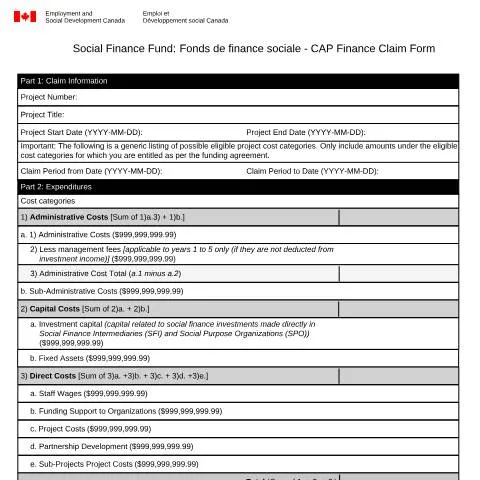
Understanding the Social Finance Fund: An In-Depth Look at the CAP Finance Claim Form
The Social Finance Fund plays a crucial role in fostering innovative social solutions across Canada. This fund is designed to support investment in projects that can contribute positively to society while also serving a financial purpose. If you are involved in such a project, you will encounter the CAP Finance Claim Form (EMP5735), a pivotal document for accessing the financial support you need. This article will guide you through its significance, completion, submission, and follow-up processes, ensuring you are well-prepared for your funding journey.
The Strategic Role of the CAP Finance Claim Form in Your Project
When embarking on a project eligible for funding under the Social Finance Fund, the CAP Finance Claim Form serves as the formal mechanism through which you can reclaim certain eligible expenses. It is essential to recognize that this form is not merely a bureaucratic requirement; it is your ticket to securing the financial backing necessary for your initiative.
Each claim you submit in this form is linked to the broader objectives of the funding agreement. It's crucial to understand that any inaccuracies or omissions can delay the processing of your claim or even result in a denial. Be thorough and precise, ensuring that all sections are completed according to the guidelines provided.
Who Should Submit This Form?
The CAP Finance Claim Form is intended for organizations that have engaged with the Social Finance Fund and are ready to claim eligible expenditures. This may include:
- Social Purpose Organizations (SPOs)
- Non-profit organizations working on social innovations
- Community organizations that are part of a funded project
By identifying your organization as a claimant, you confirm your eligibility and readiness to proceed with the funding process.
Completing the CAP Finance Claim Form: Step by Step
Filling out the CAP Finance Claim Form requires careful attention to detail. The form is divided into key sections that align with the types of expenses you may be claiming. Below is a breakdown of these sections and tips for completing them accurately.
Claim Information Section
- Project Number: This identifier helps in tracking the claim.
- Project Title: Clearly state the name of your project.
- Project Dates: Specify both the start and end dates. This ensures alignment with your funding agreement.
- Claim Period: Indicate the specific period for which you are making the claim.
Accuracy in this section is vital, as any discrepancies can lead to processing delays.
Expenditures Breakdown
The expenditures section is where you itemize the costs associated with your project. You will need to categorize expenses under:
- Administrative Costs
- Capital Costs
- Direct Assets
Each category requires you to summarize the costs in more detail:
Administrative Costs
Include all general expenses related to project management. Be sure to document:
- Any management fees applicable for the project.
- Sub-administrative costs.
Capital Costs
These are costs related to tangible assets needed for your project. It includes:
- Investment capital.
- Fixed assets.
Direct Assets
Here you will account for:
- Staff wages.
- Funding support to organizations.
- Specific project costs and partnership developments.
Each expense must be justified with appropriate documentation.
Submission Process: How and Where to Send Your Claim
After completing the form, the next crucial step is submission. Proper submission is key to avoiding unnecessary delays in the processing of your claim.
Where to Submit
All completed CAP Finance Claim Forms must be sent to Employment and Social Development Canada (ESDC). Ensure that you use the correct mailing address or electronic submission method as specified in your agreement.
What Happens After Submission?
Upon submission, your claim will go through several processing stages:
- Initial Review: ESDC will review your submission for completeness and accuracy.
- Assessment: A detailed examination of the expenses claimed will be conducted against the funding agreement.
- Decision: You will be notified regarding the approval or denial of your claim.
Typically, you can expect a decision within a few weeks; however, actual timelines can vary based on the volume of claims being processed.
What to Prepare: Justifying Your Expenses with Supporting Documents
Supporting documents play a critical role in validating your claims. Each category of expenses requires different types of documentation:
Required Documentation for Each Expense Category
| Expense Category | Required Documents |
|---|---|
| Administrative Costs | Invoices, receipts, and payroll records |
| Capital Costs | Proof of purchase, contracts, and investment agreements |
| Direct Assets | Staff contracts, project agreements, and partnership documents |
Ensure all documents are organized and easily accessible, as the review process may require additional clarification.
Timelines: Key Dates in the Claim Process
Understanding the timeline for your claim is essential for effective planning. Here’s an overview of the critical dates to keep in mind:
- Submission Deadline: Claims for a given period should generally be submitted no later than 30 days after the conclusion of that period.
- Processing Time: Expect an initial review within 2-4 weeks of submission.
- Follow-up Period: If you have not received a decision after 4 weeks, it’s advisable to follow up with ESDC.
Adhering to these timelines helps ensure that your claim is processed smoothly and promptly.
Distinguishing the CAP Finance Claim Form from Other Forms
It’s essential to differentiate this form from similar documents you may encounter. One common area of confusion is between the CAP Finance Claim Form and other funding application forms.
Key Differences
- Purpose: The CAP Finance Claim Form specifically focuses on claiming expenditures already incurred, whereas other forms may be for initial funding requests.
- Documentation: The claim form requires proof of expenses, while other applications may need project proposals or funding justifications.
Understanding these distinctions will not only streamline your process but also enhance your compliance with ESDC's requirements.
Final Thoughts: Navigating the CAP Finance Claim Form with Confidence
Filing the CAP Finance Claim Form (EMP5735) can seem daunting, but with a clear understanding of its structure, purpose, and processes, you can navigate this essential administrative task with ease. Remember that accuracy is vital; double-check all entries and ensure your supporting documents align with the expenses claimed. By following the guidelines in this article, you will enhance your likelihood of a successful claim and, consequently, contribute positively to the objectives of the Social Finance Fund.
As you embark on this process, remain proactive—don’t hesitate to reach out to ESDC for clarification or assistance at any step along the way. Your commitment to transparency and diligence will not only benefit your organization but also foster greater trust in the mechanisms of social finance across Canada.
Understanding the Social Finance Fund in Canada
The Social Finance Fund represents a significant initiative by the Canadian government to foster social impact investments across the country. Launched in 2021, this fund aims to generate positive social outcomes while providing access to capital for organizations that create measurable social benefits, particularly in sectors like health, education, and environmental sustainability.
Through the Social Finance Fund, organizations can access funding to deliver programs that address pressing social issues, ranging from poverty alleviation to employment training for vulnerable populations. The fund supports a range of financing options, including loans, equity investments, and guarantees, thereby enabling innovative solutions to social challenges.
Eligibility for funding under the Social Finance Fund is generally aimed at non-profit and charitable organizations, social enterprises, and Indigenous communities. These entities are required to demonstrate a clear plan for social impact, outlining how the funding will be used to benefit the community or a specific demographic group.
To apply for funding, organizations need to submit a detailed proposal that includes a description of the project, its intended outcomes, and a plan for sustainability after the funding period ends. Applications are evaluated based on the potential for social impact, financial viability, and the capacity of the organization to deliver on the proposed outcomes.
Submitting the CAP Finance Claim Form
The CAP Finance Claim Form is an essential document for organizations that have received grants or investments from the Social Finance Fund. This form is designed to facilitate the reimbursement process for eligible expenses incurred in the execution of funded projects. It ensures that organizations can efficiently claim back costs related to their social initiatives, which can include staffing, program materials, and operational expenses.
Upon completion of the project, organizations must fill out the CAP Finance Claim Form and submit it alongside relevant documentation, such as invoices and receipts, to substantiate the expenses claimed. It’s critical to adhere strictly to the guidelines provided by the funding agency, as missing documentation can delay reimbursement or lead to the denial of the claim.
Additionally, the form requires a detailed report on the outcomes achieved as a result of the program funded by the Social Finance Fund. This not only demonstrates accountability but also highlights the impact of the investment to stakeholders and potential future funders.
Be sure to check the specific submission deadlines for the CAP Finance Claim Form, as failing to submit within the designated time frame can affect your funding status and eligibility for future grants. Always keep copies of submitted forms and documentation for your records, as this will facilitate any queries that may arise during the review process.
Impact Measurement and Reporting Requirements
One key aspect of the Social Finance Fund is the emphasis on impact measurement and reporting. Organizations funded through this initiative are required to track and report on specific metrics that demonstrate the social outcomes achieved as part of their projects. This is crucial for several reasons: it provides transparency regarding the use of public funds, ensures accountability, and helps build a body of evidence on what works in social finance.
Impact measurement involves developing clear indicators related to the goals and objectives of the funded project. For instance, if the project aims to reduce youth unemployment, relevant indicators might include the number of participants who secure jobs following training and the duration taken to achieve employment. These metrics should be defined at the outset of the project and continuously monitored throughout its implementation.
The reporting requirements typically include both qualitative and quantitative data. Organizations may be asked to provide testimonials from beneficiaries, case studies, and updates on how the project is evolving, in addition to numerical data that demonstrates progress against the established indicators. This comprehensive approach to reporting not only satisfies funder requirements but can also be instrumental for organizations in assessing their own effectiveness and refining their future strategies.
It is advisable for organizations to set up a robust monitoring and evaluation framework at the beginning of the project to streamline this process. This framework should include regular check-ins to collect and analyze data, allowing for adjustments in strategy to enhance impact. By effectively measuring and reporting on their social outcomes, organizations can position themselves more favorably for future funding opportunities and contribute valuable insights to the broader field of social finance in Canada.