Navigating the Social Finance Fund: A Guide to Completing the CAP Finance Activity Report
For organizations engaged in social finance initiatives, accurately reporting on your activities is crucial. The EMP5728, or Social Finance Fund: CAP Finance Activity Report, serves as a key document for tracking progress and ensuring accountability. Understanding its role, the completion process, and submission channels is vital for compliance and success.
Understanding the Framework: Why the CAP Finance Activity Report Matters
The Social Finance Fund aims to provide funding that supports innovative projects addressing social issues. The CAP Finance Activity Report is not just a form; it embodies the collaboration between your organization and Employment and Social Development Canada (ESDC), ensuring that federal funds are utilized effectively. This report allows you to reflect on your project’s objectives, activities, and accomplishments, thereby facilitating transparency and promoting continuous improvement.
Who is Required to Submit the CAP Finance Activity Report?
The obligation to submit this report falls to organizations that have received funding under the Social Finance Fund. Typically, this includes non-profits, community organizations, and social enterprises that have established a contractual relationship with ESDC. If your organization has accessed funding for initiatives aimed at fostering social benefits, you are likely required to complete this report quarterly.
Eligibility Criteria for Submission
- Organizations must be registered and in good standing with ESDC.
- Funding must have been received under the Social Finance Fund.
- Projects should be aligned with the objectives set out in your funding agreement.
Breaking Down the Report: Key Components to Address
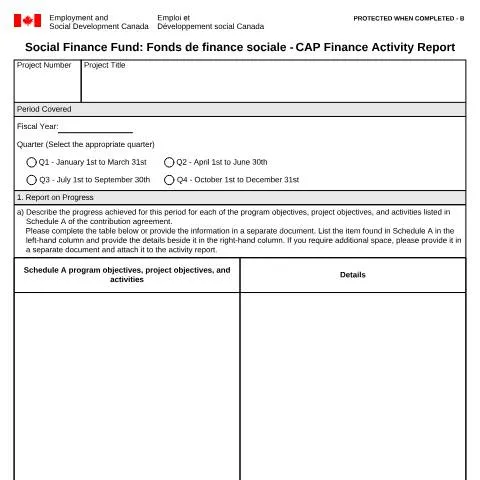
The CAP Finance Activity Report is structured to collect comprehensive information regarding your project’s progress. The first section primarily focuses on the description of accomplishments in relation to the project objectives.
Section-by-Section Overview
- Project Number & Title: Clearly indicate the assigned project number and title to ensure correct identification.
- Period Covered: Specify the fiscal year and quarter for which you are reporting. Accuracy here aligns your report with funding timelines.
- Report on Progress: This section requires a narrative description of your project’s advancement towards its goals. List specific achievements against the objectives detailed in Schedule A.
Details of Progress Reporting
In detailing your progress, consider the following:
- Quantitative Metrics: Include data that clearly demonstrates progress (e.g., number of beneficiaries served).
- Qualitative Outcomes: Describe any changes in the community or target demographic resulting from your initiatives.
- Challenges Faced: Be transparent about obstacles and how your organization has addressed them.
Preparing Your Documentation: Essential Steps
Before submission, ensuring your documentation is robust and accurate is vital. Here’s how to prepare effectively:
Gathering Evidence and Supporting Documents
- Compile relevant performance data, such as surveys and feedback forms.
- Document any partnerships or collaborations that enhanced your project’s impact.
- Ensure all financial records align with the progress reported.
Submitting Your Report: Channels and Processes
After completing the CAP Finance Activity Report, the next step is submission. Understanding the available channels can streamline this process.
Online vs. Paper Submission
| Submission Method | Description | Advantages |
|---|---|---|
| Online Submission | Submit via ESDC’s online portal. | Faster processing, immediate confirmation of receipt. |
| Paper Submission | Mail the completed report to the designated ESDC office. | Useful for organizations without reliable internet access. |
Timeline for Submission
Each report must be submitted within 30 days of the end of the reporting quarter. Therefore, ongoing tracking and timely preparation are essential to meet deadlines and maintain your funding eligibility.
After Submission: What to Expect?
Once you’ve submitted your CAP Finance Activity Report, your organization enters a phase of evaluation by ESDC. It’s important to remain proactive during this period.
Review Process and Feedback
Typically, ESDC will review reports to assess:
- Alignment with project objectives.
- Proper use of allocated funds.
- Overall impact of the project.
Should ESDC require clarification or additional information, they will reach out directly. Addressing these requests promptly will facilitate a smoother review process.
Continuous Improvement
Utilize feedback received to refine future reports and enhance project outcomes. The CAP Finance Activity Report serves not only as a compliance document but also as a learning tool to improve your organization’s effectiveness.
Common Pitfalls: Navigating Challenges in Reporting
While completing the CAP Finance Activity Report, certain common pitfalls can arise. Awareness of these can aid in crafting a robust submission.
Challenges in Data Collection
- Inconsistent tracking of performance metrics can lead to incomplete reporting.
- Failure to document qualitative outcomes may weaken the perceived impact of your project.
Clarity and Precision in Language
Ensure that the language used in the report is clear and precise. Avoid jargon unless necessary and always define terms that may not be commonly understood.
Final Thoughts: Enhancing Your Reporting Process
The Social Finance Fund: CAP Finance Activity Report is not merely a bureaucratic requirement; it is an opportunity for organizations to showcase their impact and commitment to social change. By carefully preparing, accurately reporting, and utilizing feedback, your organization can enhance its effectiveness, secure future funding, and contribute meaningfully to the community.
Ultimately, the journey of social finance is rooted in continuous learning and adaptation. The CAP Finance Activity Report plays an integral part in this ongoing process, fostering a culture of accountability and transparency.
Understanding the Social Finance Fund: Objectives and Framework
The Social Finance Fund (SFF) is a pivotal initiative introduced by the Government of Canada aimed at fostering social innovation and addressing critical social challenges through the lens of finance. The primary objective of the SFF is to provide funding and support for projects that generate measurable social impact alongside a financial return. This dual-focus on social and financial outcomes is what distinguishes social finance from traditional funding models.
The SFF operates under the auspices of Employment and Social Development Canada (ESDC) and is designed to empower social purpose organizations (SPOs), charities, and non-profits. By leveraging public and private capital, the SFF seeks to enhance the capacity of these organizations to deliver services and solutions that effectively address pressing societal issues such as homelessness, mental health, and employment challenges among marginalized populations.
The framework of the SFF encompasses various components, including:
- Investment Readiness: The SFF provides resources to help organizations become "investment-ready," enabling them to effectively attract and manage capital for their social ventures.
- Capacity Building: Through training and mentorship programs, the SFF ensures that organizations develop the necessary skills to implement successful social finance initiatives.
- Partnerships: The SFF encourages collaboration between public, private, and philanthropic sectors, fostering a collective approach to social problem-solving.
These components work synergistically to create a vibrant ecosystem where social finance can thrive, ultimately enhancing the socio-economic landscape across Canada.
Case Studies: Successful Projects Funded by the Social Finance Fund
To illustrate the practical impact of the Social Finance Fund, let's delve into some case studies that highlight successful projects funded through this innovative financing mechanism. These examples not only showcase the diversity of initiatives supported by the SFF but also underline the measurable social outcomes achieved through a strategic blend of financial investment and community engagement.
1. The Housing First Initiative
This project aimed to address homelessness by providing stable housing solutions combined with support services tailored to individual needs. Funded by the SFF, the initiative demonstrated that by investing in housing as a first step, participants were more likely to improve their overall health, secure employment, and reintegrate into society. The data indicated a 60% decrease in emergency room visits and a significant reduction in legal entanglements among participants within the first year of the program.
2. Mental Health and Employment Support
A social enterprise focusing on mental health support services received backing from the SFF to develop job training programs and mental health workshops. The initiative not only provided participants with the skills needed to find stable employment but also created a supportive community where individuals could openly discuss mental health challenges. Post-program evaluations showed that 75% of participants secured employment within six months, and many reported improved mental health outcomes as a result of the program.
3. Youth Leadership and Social Entrepreneurship
This project aimed to empower youth in underserved communities through leadership training and social entrepreneurship initiatives. Funded by the SFF, the program provided resources for young individuals to develop their own social ventures, thereby fostering a sense of agency and responsibility. By the end of the program, participants had launched multiple businesses addressing local community needs, such as food insecurity and environmental sustainability. Feedback from participants indicated a 90% satisfaction rate, highlighting the transformative impact of the initiative on their personal and professional lives.
These case studies illustrate the tangible benefits of the Social Finance Fund, demonstrating how targeted investments can lead to impactful social change while fostering community resilience and empowerment.
How to Access the Social Finance Fund: Application Process and Requirements
If you're interested in accessing the Social Finance Fund for your organization or project, understanding the application process and requirements is crucial. The SFF offers funding opportunities through a competitive grant process, which involves several key steps designed to assess the viability and potential social impact of proposed initiatives.
Step 1: Eligibility Assessment
Before applying, you must determine if your organization qualifies for funding. Eligible applicants typically include:
- Social purpose organizations
- Non-profit organizations and charities
- Cooperatives
- Indigenous organizations and communities
Additionally, your proposed project should align with the SFF’s objectives, focusing on generating measurable social outcomes alongside financial sustainability.
Step 2: Proposal Submission
Once eligibility is confirmed, you will need to prepare and submit a comprehensive funding proposal. Your proposal should include:
- A clear description of your project, outlining its goals, target population, and intended social impact.
- A detailed budget, showcasing how the funds will be allocated.
- A plan for measuring and evaluating the social outcomes of your project.
- Evidence of collaboration and partnership with other organizations or stakeholders, if applicable.
Be sure to follow the guidelines provided on the SFF website to ensure your application meets all requirements.
Step 3: Review and Selection
Your proposal will be reviewed by a panel of experts focusing on various criteria, including innovation, scalability, and potential impact. Successful applicants will be notified and invited to enter into a funding agreement with the SFF, outlining the terms and conditions of the provided funding.
By understanding and navigating the application process effectively, you can position your organization to secure funding through the Social Finance Fund and contribute to meaningful social change in your community.