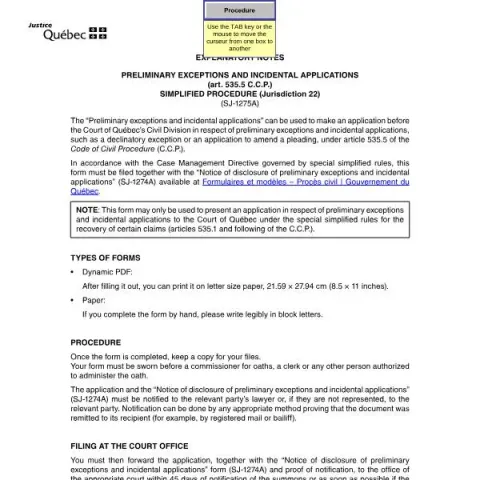
Understanding the SJ-1275A Form: A Guide to Preliminary Exceptions and Incidental Applications in the Court of Québec
The SJ-1275A form is an official document used within the judicial proceedings of the Court of Québec, specifically tailored for presenting applications related to preliminary exceptions and incidental applications under article 535.5 of the Code of Civil Procedure (C.C.P.). This guide aims to help legal practitioners, parties involved in civil litigation, or individuals seeking to understand the purpose and proper use of this form.
Objective and Scope of the SJ-1275A Form
The primary purpose of the SJ-1275A form is to formally submit an application before the Court of Québec’s Civil Division concerning preliminary exceptions or incidental applications. These may include requests such as a declinatory exception (challenging jurisdiction) or applications to amend a pleading. The form is designed to streamline the process under the special simplified rules for the recovery of certain claims, as outlined in articles 535.1 and following of the C.C.P.
It is important to note that this form is only applicable for applications under the simplified procedures, which aim to facilitate quicker resolutions in specific types of civil cases. It cannot be used for general civil applications outside this scope.
Preparing Your Application: Key Steps and Requirements
Filling Out the Form
When completing the SJ-1275A, ensure that all sections are filled out legibly and accurately. The form includes several essential parts:
- Header: Enter the name of the judicial district, locality, court, and the file number associated with your case.
- Parties’ Identification: Provide the full names and addresses of all parties involved, as they appear in the court records.
- Title of Application: Clearly specify the nature of your application, such as “Request for disclosure of a document” or “Application to amend a pleading.”
- Content of Application: Describe the object (purpose) of your application in paragraph 1 and the grounds (legal or factual basis) supporting it in paragraph 2.
- Conclusions: State precisely what you are asking the court to order, such as allowing your application or requesting specific procedural actions.
- Sworn Statement: Sign and swear the statement before an authorized person, such as a commissioner for oaths or a court clerk.
- Notice to the Opposing Party: Include a notice informing the opposing party of their 10-day period to submit written comments.
Important Considerations
Ensure that the application is signed and sworn in the presence of an authorized official. Keep a copy of the completed form for your records. The form must be accompanied by the “Notice of disclosure of preliminary exceptions and incidental applications” (SJ-1274A), which is available through official Québec government forms.
Submitting and Filing the Application
Notification and Filing Timeline
Once completed, the application, along with the notice and proof of notification, must be served on the opposing party. Service can be performed via registered mail, bailiff, or any method that provides proof of delivery.
Following notification, you must submit the application package to the appropriate court office within 45 days of receiving the summons. If the application cannot be filed within this period, it should be done as soon as possible afterward.
Digital Filing Options
The Court of Québec offers a digital platform for filing documents, known as the Québec Court Digital System. You can upload your application and supporting documents through this platform at Québec.ca/justice-et-etat-civil/systeme-judiciaire/processus-judiciaire/services-judiciaires-numeriques.
Fill in your form directly online
No printing: type your details into the boxes of the official form, tick, then download the PDF ready to send.
- 1Type into the form boxes
- 2Tick in one click
- 3Save and download the PDF
Role of the Court and Next Steps
After filing, the opposing party is given a 10-day window to submit written comments. The court will then review the application and comments, and unless a hearing is deemed necessary, it will render a decision based on the record. This process aims to expedite preliminary issues, avoiding unnecessary delays in civil proceedings.
Additional Resources and Contact Information
For further guidance on completing the SJ-1275A form or to access other related documents, you can consult the official Québec government website or contact the civil court office in your jurisdiction. The Court of Québec’s streamlined procedures are designed to facilitate efficient resolution of preliminary legal matters, ensuring that cases proceed smoothly and fairly.